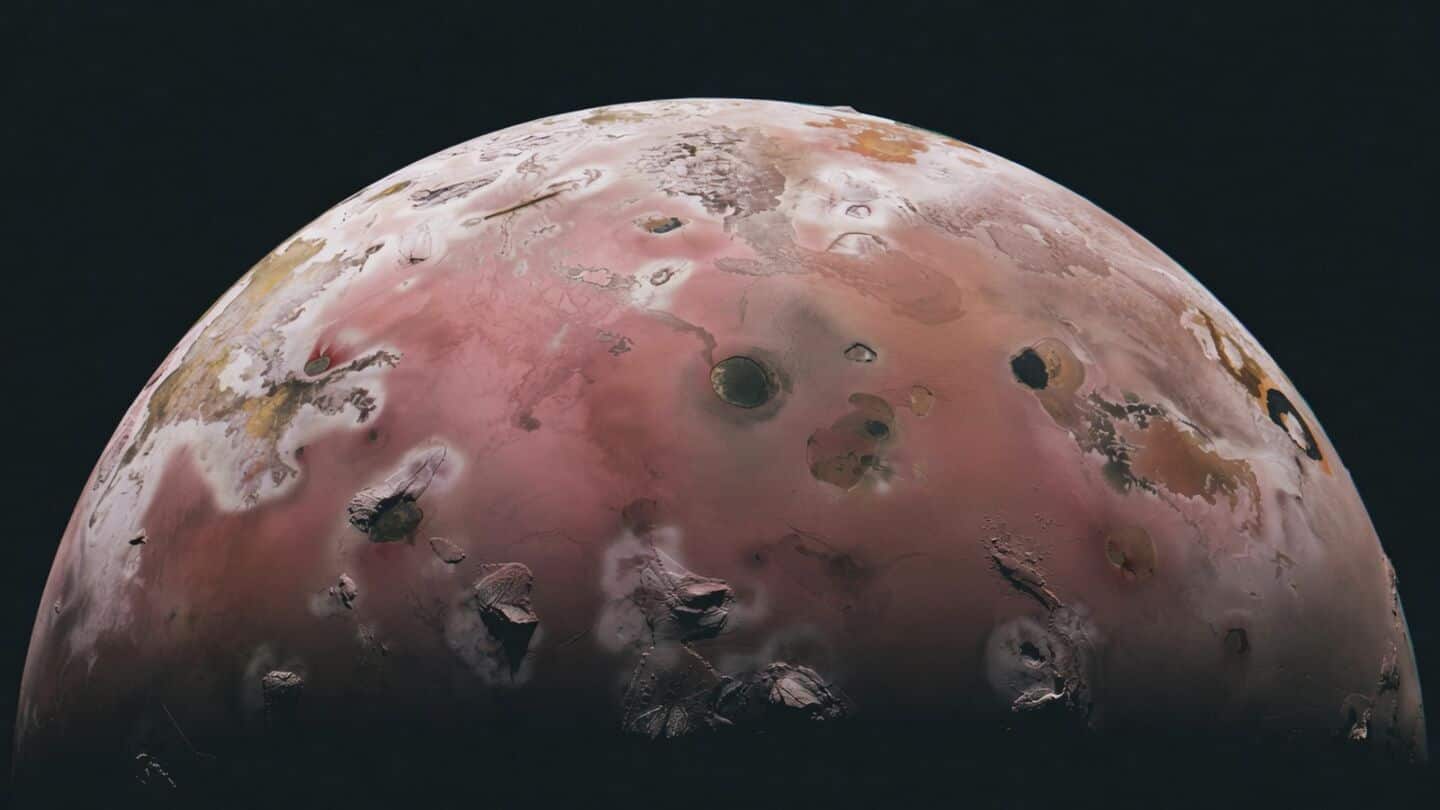
This is what lurks beneath volcanoes of Jupiter's moon Io
What's the story
NASA's Juno spacecraft has unveiled the first-ever glimpse of the hidden heat beneath Jupiter's moon Io, the most volcanically active world in our solar system. The revelations came during close flybys in late 2023 and early 2024 when Juno used its Microwave Radiometer (MWR) instrument to peer six to 20 feet beneath Io's surface. The findings were published in the Journal of Geophysical Research: Planets.
Innovative technology
Implications for understanding Earth's volcanoes
Originally designed to look through Jupiter's thick clouds, Juno's MWR instrument has turned out to be a powerful new tool for studying how heat moves through planetary crusts.
"The discovery that we could see below Io's surface has important implications for studying Earth's volcanoes," said Scott Bolton, co-author of the study and Juno's principal investigator.
He added that similar signatures in the subsurface temperature gradient could provide new insights into terrestrial volcanoes.
Heat discovery
First subsurface temperature measurements
Until now, scientists had mostly relied on infrared observations to detect only the temperature of Io's surface.
However, Juno has provided a first-of-its-kind look at how heat moves through the moon's crust by probing several feet underground.
The measurements showed temperatures rising by over 22 degree Celsius just below the surface, much more than sunlight alone could explain.
Surface analysis
Heat patterns and geological mysteries
Juno's heat map also revealed localized regions of elevated heat, with temperatures between 10 degree Celsius to 20 degree Celsius warmer than the surrounding terrain.
Despite its towering mountains and active volcanoes, much of Io's surface appears remarkably smooth and composed of unusually low-density material.
Researchers believe the moon is blanketed by porous layers of volcanic ash, sulfur frost, and other eruptive debris that continually resurface Io.
Heat origin
Understanding Io's volcanism
The heat detected beneath Io's surface could be rising steadily from the moon's molten interior through a conductive crust or coming from pockets of cooling lava flows trapped just below the surface.
The data provide the clearest picture yet of how Io transports heat from its interior.
Unlike Earth, where volcanism is driven largely by heat from radioactive decay, Io is continuously stretched and squeezed by Jupiter's immense gravity as it orbits the giant planet.
Future implications
Broader implications for planetary science
The same microwave techniques used by Juno could one day help researchers better monitor Earth's volcanoes and improve eruption forecasting.
"Io provides a unique window into learning how tidal heating works throughout the cosmos," Bolton said.
He added this process can create the most volcanic body in the solar system, such as Io, and fuels subsurface oceans on giant moons like Europa and Ganymede.