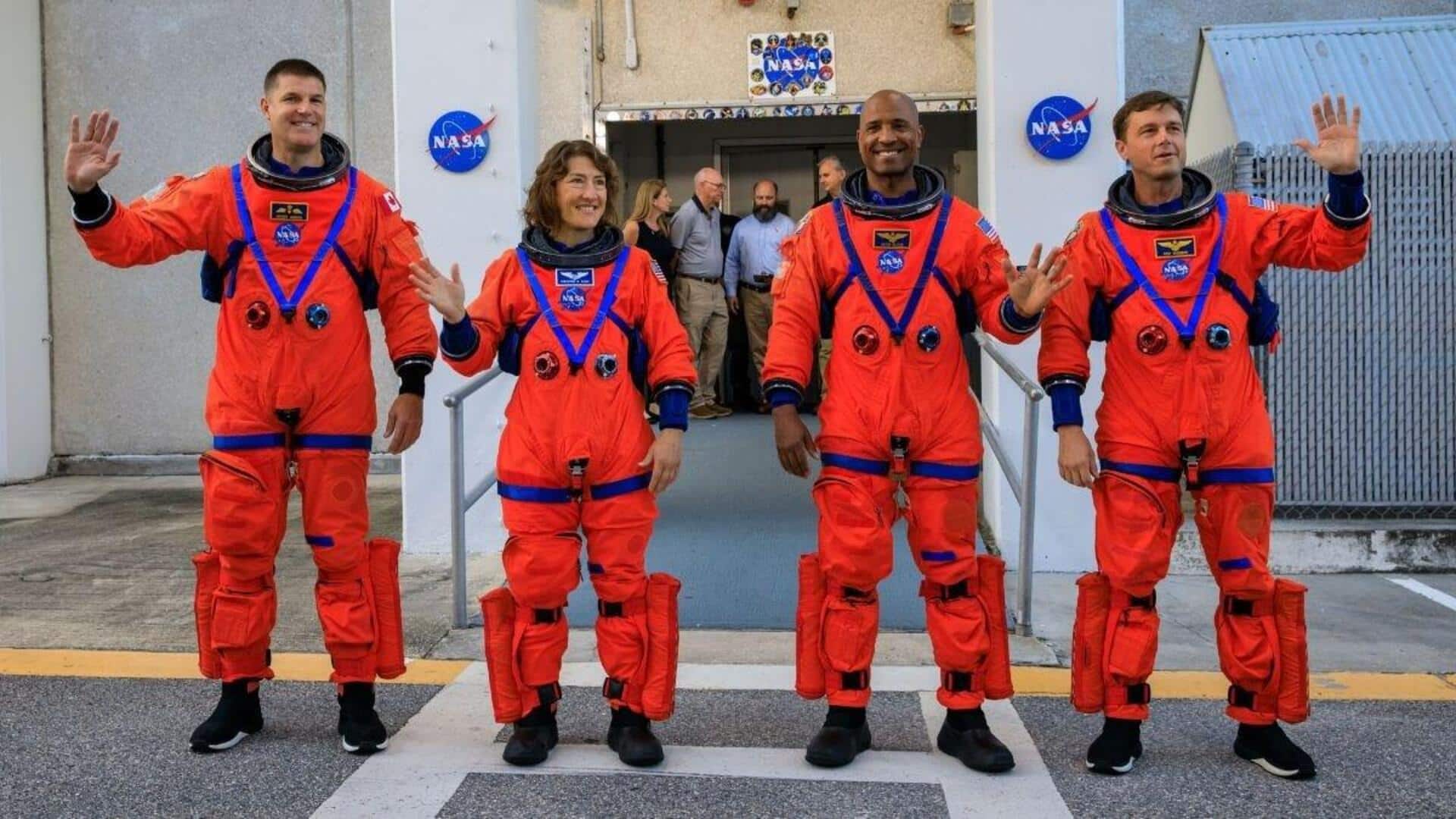
How NASA will protect Artemis II astronauts from space radiation
What's the story
NASA is gearing up for the Artemis II mission. It presents unique challenges compared to those on International Space Station (ISS), primarily due to exposure to intense radiation beyond low-Earth orbit. The Earth's magnetic field protects us from most harmful solar particles. However, as the Artemis II crew heads toward Moon, they'll be leaving this protective bubble behind. Deep space is full of cosmic rays that can damage human cells and DNA, increasing risks of cancer and other health issues.
Radiation exposure
Crossing the Van Allen belts
To reach the Moon, the Artemis II crew will have to cross the Van Allen belts, two huge rings of trapped radiation held by Earth's magnetic field.
Unlike Apollo astronauts who passed through these zones quickly, Artemis II will spend a lot of time in high-Earth orbit testing systems before going for lunar flyby.
This means they will cross the belts multiple times and be exposed to radiation levels 50-100 times more than what we experience on Earth.
Protective measures
How will NASA protect the crew?
To protect the crew from radiation, NASA engineers have designed the Orion capsule with advanced shielding.
The idea is to absorb as much radiation as possible.
In case of a solar storm, the crew can use the spacecraft's center as an improvised storm shelter by stacking supplies and equipment to create a thicker barrier against incoming particles.
Tech innovation
Use of AstroRad vest
Along with the advanced shielding of the Orion capsule, astronauts may also wear innovative tech like the AstroRad vest. This is designed to protect vital organs from radiation exposure.
NASA experts expect that the total radiation dose for this 10-day mission will be within safe limits for the four professional astronauts.