Nobel Prize in Medicine honors scientists enabling light-controlled brain cells
What's the story
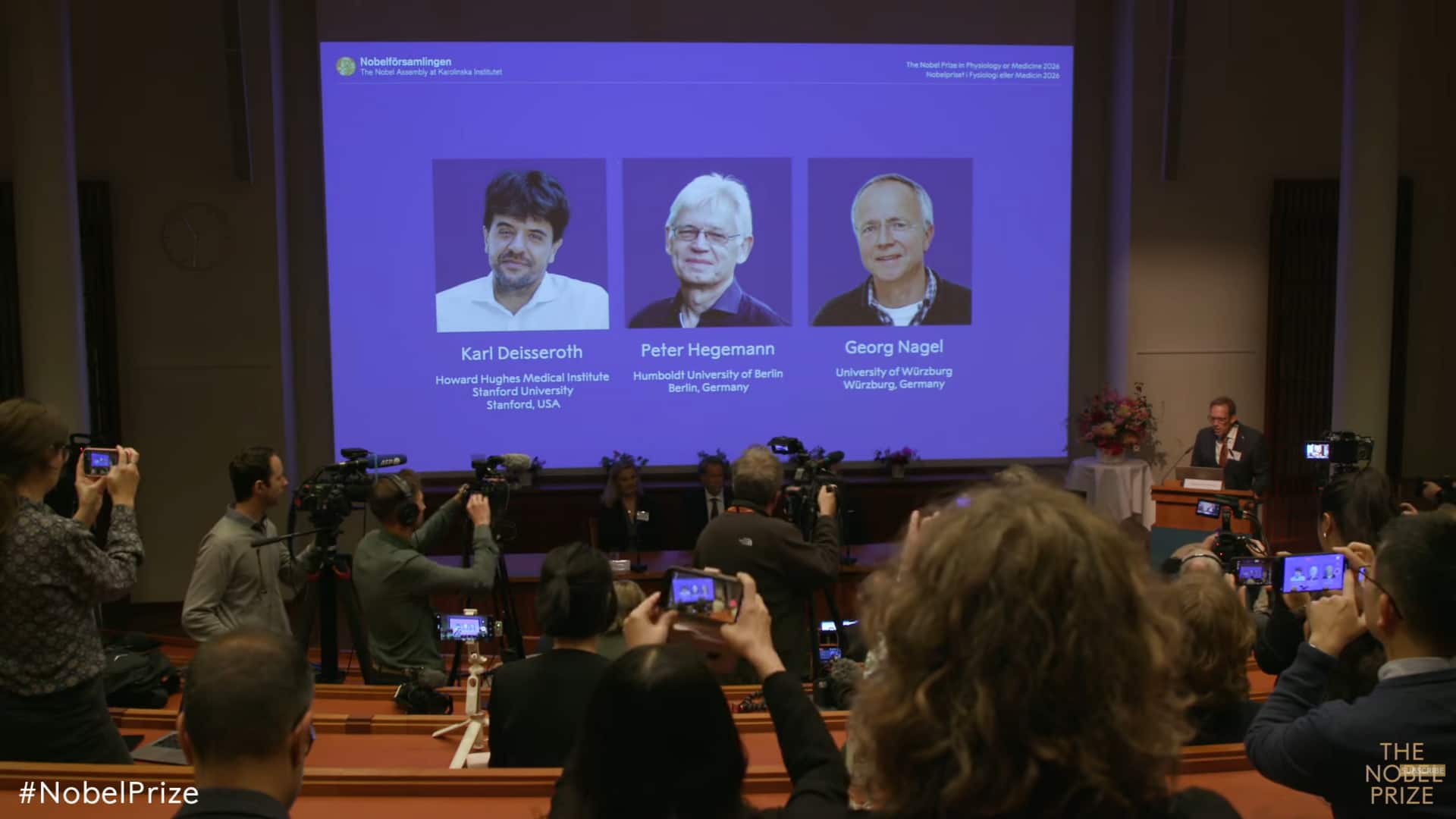
The 2026 Nobel Prize in Physiology or Medicine has been jointly awarded to Karl Deisseroth, Peter Hegemann, and Georg Nagel for their "discoveries concerning light-gated ion channels and optogenetics." The Nobel Assembly at Karolinska Institutet recognized work that transformed scientists' ability to control nerve-cell activity, using light as a precise tool to study how the brain and nervous system function.
Specialization
The key discovery
Hegemann and Nagel discovered channelrhodopsin, a protein with remarkable light-sensitive properties.
They found that when the protein was introduced into different cells, those cells became responsive to light.
Their discovery provided the crucial biological switch needed for later experiments, opening a new way to influence cellular activity with remarkable precision and helping lay the foundation for modern optogenetics.
Progress
From cells to living brains
Deisseroth took the discovery further by introducing the gene for channelrhodopsin into rat nerve cells.
When he illuminated the cells with blue light, he could trigger nerve signals.
He later demonstrated that the same light-controlled switch could operate inside the brains of living mice.
This approach, now known as optogenetics, has rapidly gained global impact in neuroscience and biomedical research.
Praise
Method now being used in laboratories to reveal brain's mysteries
The Nobel committee praised their work "for discoveries leading to optogenetics, which makes it possible to switch on, or off, the activity of individual nerve cells in a living brain."
"This method is now being used in laboratories around the world to reveal the brain's mysteries," the committee wrote in its official blog post.
Twitter Post
Take a look at the official announcement
BREAKING NEWS
— The Nobel Prize (@NobelPrize) October 5, 2026
The 2026 #NobelPrize in Physiology or Medicine has been awarded to Karl Deisseroth, Peter Hegemann and Georg Nagel “for their discoveries concerning light-gated ion channels and optogenetics.” pic.twitter.com/pkDDEBWtkz
History
This prize has been awarded 117 times since its inception
The Nobel Prize in Physiology or Medicine has been awarded 117 times since 1901.
At 31, Frederick G. Banting was the youngest recipient of the Nobel Prize in Physiology or Medicine. He received the 1923 prize for the discovery of insulin.
Peyton Rous was the oldest recipient, receiving the 1966 prize at age 87 for his discoveries concerning tumour-inducing viruses.