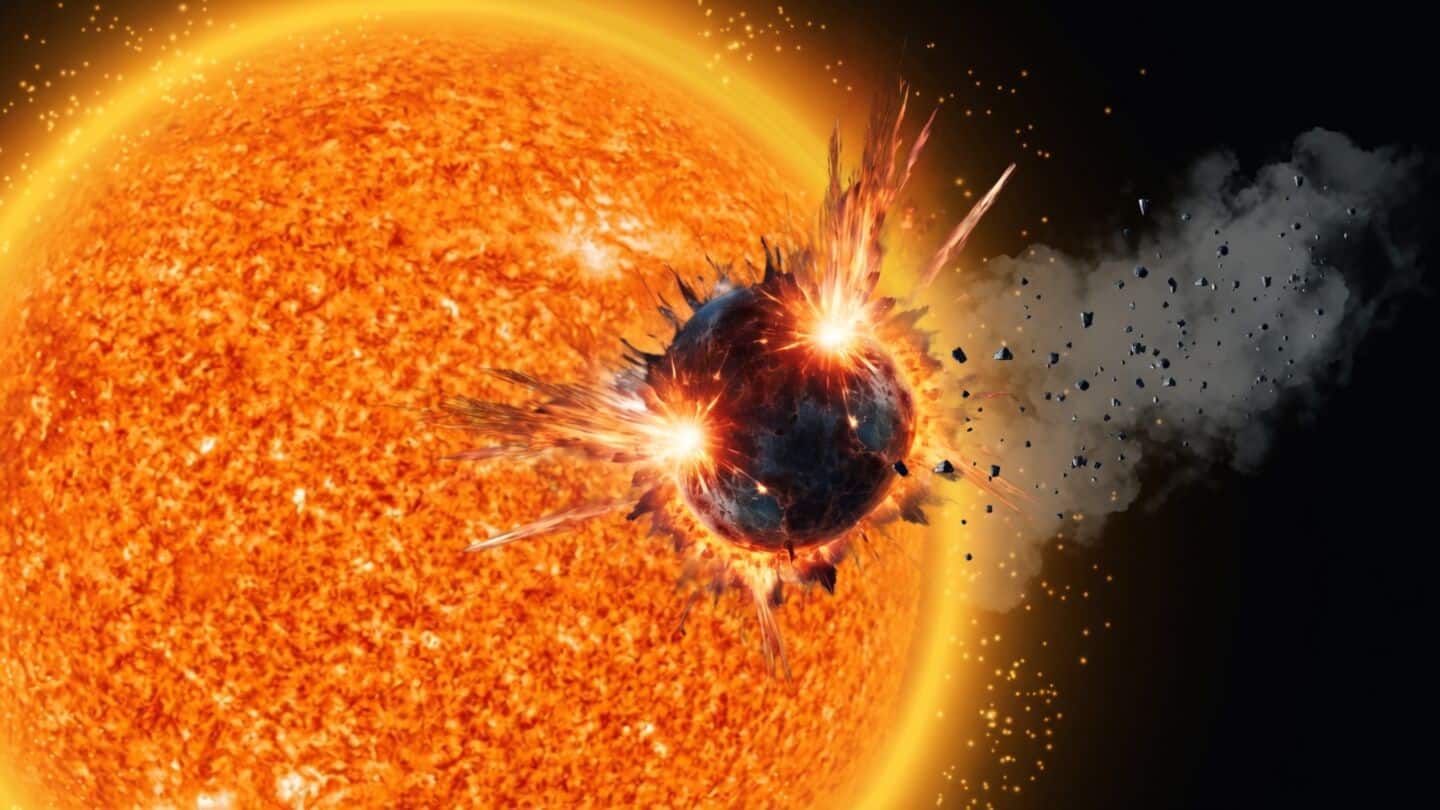
Did our Sun swallow a super Earth?
What's the story
A new study has proposed that our Sun, the star at the center of our solar system, may have consumed a 'super-Earth' planet billions of years ago. The research suggests that this event could explain some of the mysteries surrounding our solar system. Super-Earths are common in other planetary systems but are notably absent from ours.
Findings
Sun may have consumed planet more massive than Earth
The scientists behind the study, including Mutlu Yildiz from Turkey's Ege University, believe that the Sun might have consumed a planet several times more massive than Earth. They think this event could have left a chemical signature deep within the solar interior.
Stellar evolution models
Theory could explain why lithium is scarce on Sun's surface
The researchers think that the Sun's potential consumption of a planet could explain some discrepancies between observed and predicted solar properties.
These include the depth of the Sun's convection zone and its sound-speed structure just below this zone.
The theory could also explain why lithium is scarce on the Sun's surface.
Planetary formation
Young stars like Sun are surrounded by protoplanetary disks
Yildiz explained that young stars like our Sun are surrounded by protoplanetary disks, where large amounts of material can flow between the disk and the star.
Since planets are made of chemically distinct material from the gas in these disks, the scientists wondered if a planet's early consumption could leave a chemical signature inside the young Sun.
Their research used advanced stellar evolution software to investigate different scenarios of how this could have happened.
Results
What did the research find?
The team's research found that the best match for the Sun's current characteristics was the consumption of a planet five to 10 times Earth's mass, a super-Earth.
This could explain some of the Sun's strange, unpredicted characteristics.
"We thought planetary engulfment might affect the solar structure but did not expect the calculations to converge on such a specific super-Earth mass range," said Professor Yildiz.