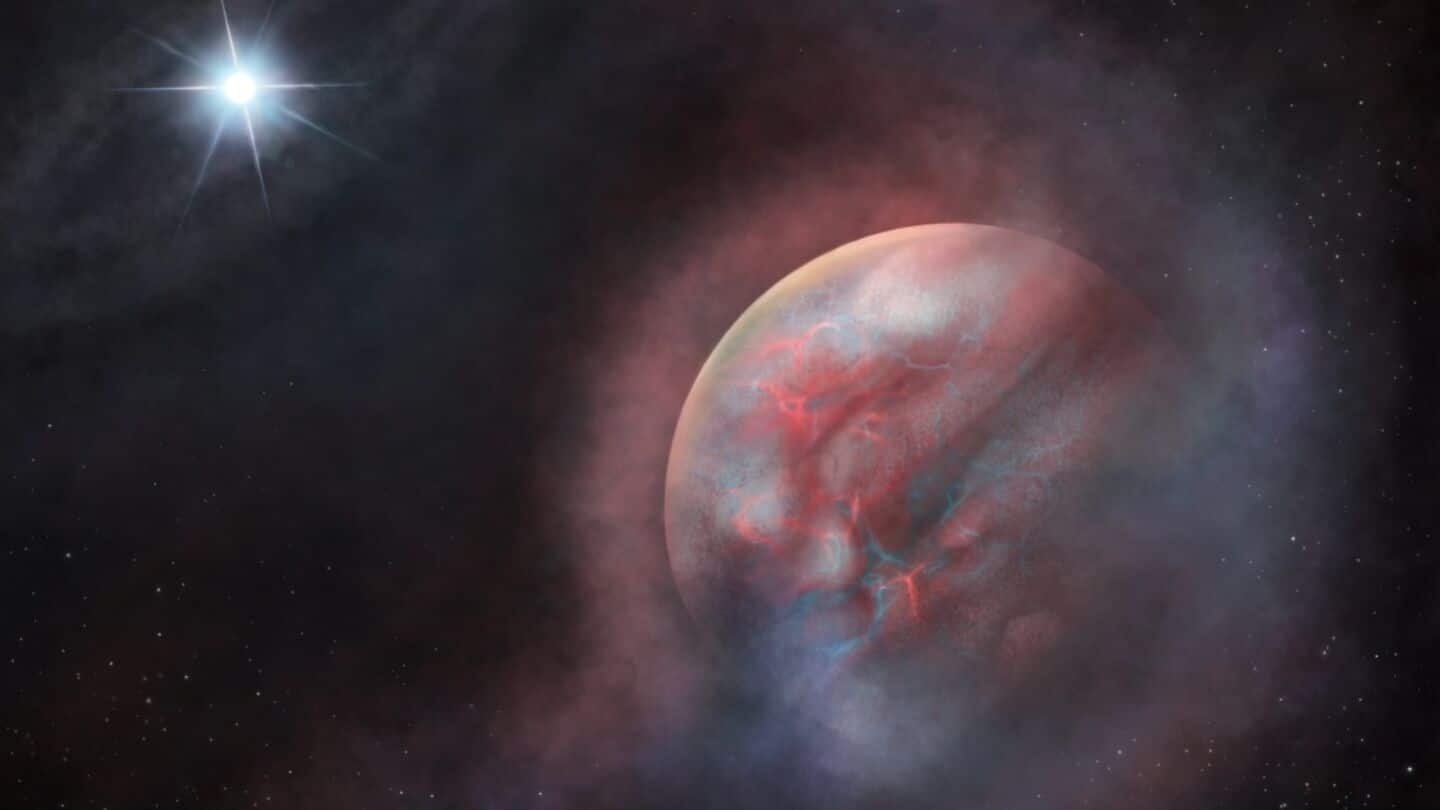
This 'phoenix planet' is orbiting remains of a dead star
What's the story
Astronomers have made a groundbreaking discovery of a second-generation planet, the "Phoenix planet," orbiting the remains of its parent star. The unusual world was found circling the smoldering white dwarf HS 0209+0832, located some 790 light-years away. This is the first time such a phenomenon has been observed around a white dwarf, although scientists had previously theorized that reborn planets could orbit neutron stars.
Planetary formation
Second-generation planets
The discovery of the Phoenix planet is a major milestone in understanding planetary formation and evolution.
"Second-generation planets are worlds that form out of the material a star casts off as it dies. They're incredibly rare, and finding one around a white dwarf was completely unexpected," said Jamie Williams from the University of Warwick.
The find is particularly relevant for our solar system's future, as our Sun will leave behind a white dwarf stellar remnant in about six billion years.
Stellar transformation
What are white dwarfs?
White dwarfs are formed when stars like our Sun exhaust the hydrogen in their cores, ending nuclear fusion and creating helium.
This process also ends the outward pressure that prevents stars from collapsing under their own gravity.
As these dead stars' cores collapse, their outer layers swell out, forming a disk of material far from the star called a protoplanetary disk.
Elemental composition
The white dwarf's unusual atmosphere
The white dwarf HS 0209+0832 has an atmosphere rich in zinc, copper, and niobium.
However, these elements are present at concentrations around 1,000 times greater than those found on the Sun.
This unusual elemental composition led scientists to believe that this white dwarf is stealing material from a planet that formed in its protoplanetary disk during its red giant phase.
Orbital details
TESS observations and future of the Phoenix planet
The Phoenix planet was further studied using NASA's Transiting Exoplanet Survey Satellite (TESS), which detects exoplanets by observing light dips as they cross their parent stars.
The data revealed that this gas giant has an orbit of about 4.4 Earth days around its white dwarf.
However, the stellar radiation it receives due to its proximity will eventually boil away its atmosphere.