Planet orbiting dead star could predict our solar system's future
What's the story
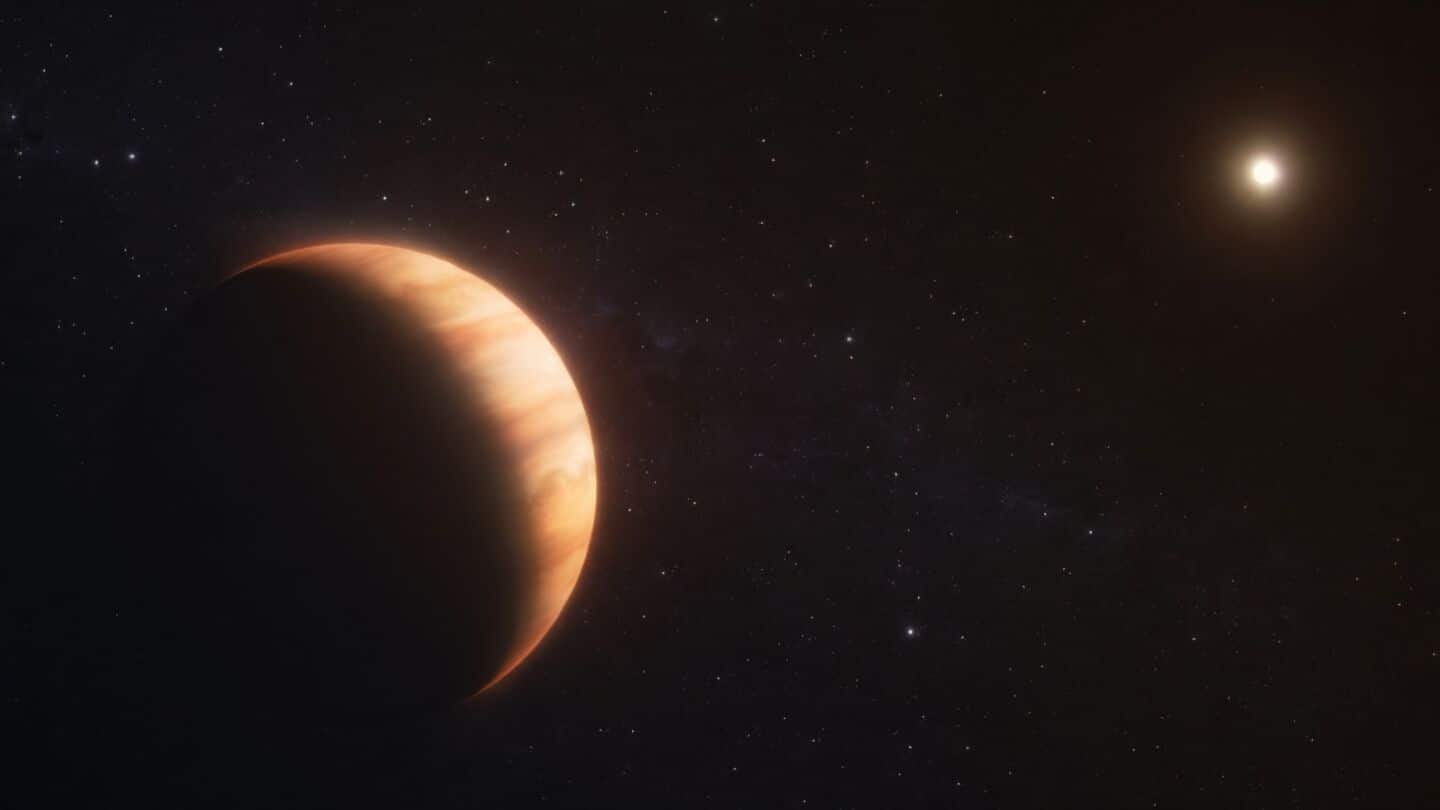
Astronomers have discovered a strange Jupiter-sized exoplanet, WD 1856 b, orbiting a dead white dwarf star. The planet is located 80 light-years away and is seven times larger than its Earth-sized star. The discovery could provide insights into the future of our solar system's gas giants, Jupiter and Saturn, when the Sun dies in about five billion years.
Planetary survival
How did WD 1856 b survive?
WD 1856 b completes an orbit around its host star in just 34 hours, at a distance of less than three million kilometers.
This proximity raised questions among astronomers about how the planet survived the destruction of its host star.
To understand this, Dr. Christopher O'Connor and his team used the James Webb Space Telescope to study WD 1856 b's atmosphere, mass, and temperature.
Planetary characteristics
The exoplanet has a temperature of 127°C
The data from Webb revealed that WD 1856 b is four to 11 times more massive than Jupiter and has a temperature of about 127°C. This was much hotter than what would be expected if it were only heated by the dead star.
The team combined these new measurements with models of how giant planets like Jupiter and Saturn cool over time, which happens at a predictable rate related to their mass.
Planetary migration
Two theories proposed by the team
The team proposed two theories to explain how WD 1856 b ended up in its tight orbit.
The "engulfment model" suggests that the planet was swallowed by the host star as it expanded before dying but managed to survive.
The "gravitational interaction model," on the other hand, suggests that other objects' gravitational influence pushed it closer to the white dwarf after avoiding the star's death throes.
Planetary heating
Data suggests it was heated long ago
The team's data suggests that the planet was heated about three billion to 5.5 billion years ago. This could rule out engulfment as a possibility.
The Webb spectrum also detected signs of the planet's chemical composition, including small cloud particles and hydrocarbons such as methane.
The presence of methane further supports that the planet didn't undergo engulfment during its red giant phase, which would have diluted the gas' abundance as it accreted hydrogen from its star.
Solar fate
What does this mean for our solar system?
The WD 1856 system gives us a glimpse of what might happen to our own solar system.
In around five billion years, our Sun will expand into a red giant, swallowing up the inner planets like Mercury and Venus.
The fate of Earth remains uncertain as it lies on the edge of this future "danger zone."
However, unlike other planets, gas giants in our solar system could survive and evolve for billions of years after the Sun's death.