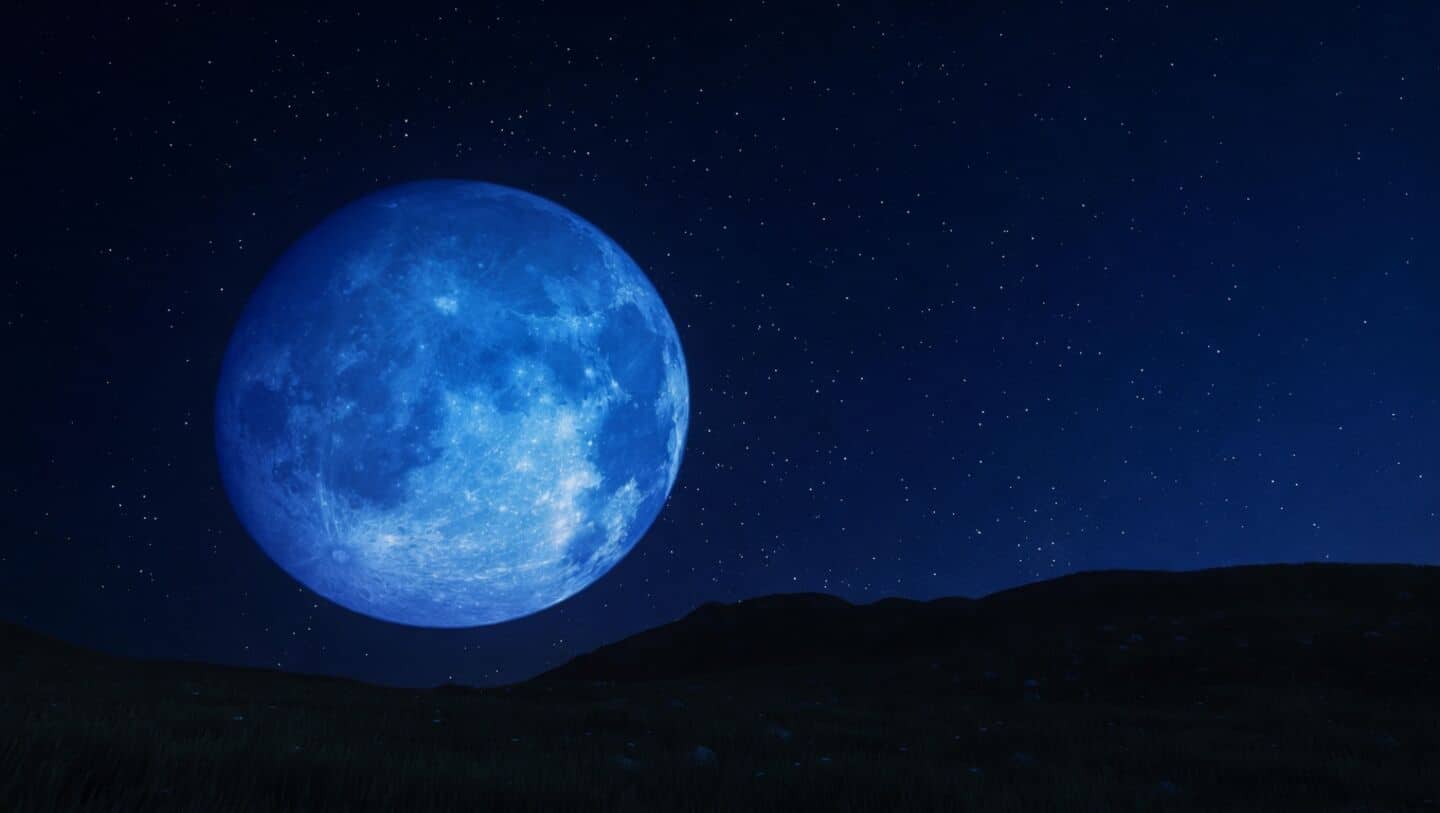
Rare Blue Moon appears on May 31
What's the story
The term "once in a blue moon" refers to something that is extremely rare. However, the truth is that 'blue moons' are not as uncommon as the saying implies. A blue moon occurs when two full moons appear in a single month, which happens about every two to three years. The next such event will occur on May 31, 2026, making it an official blue moon month.
Cosmic alignment
Why do blue moons happen?
The lunar cycle, determined by the Moon's orbit around Earth, doesn't perfectly align with the solar year, which is based on Earth's orbit around the Sun.
This misalignment creates a gap that sometimes results in two full moons within a single calendar month.
The modern definition of a blue moon refers to this second full moon.
Etymology
How did the term 'blue moon' originate?
The term "blue moon" has been around for centuries, but its modern definition was popularized in 1946 by writer James Hugh Pruett.
He misread old editions of the Maine Farmers' Almanac and defined a blue moon as the second full moon in a calendar month.
This definition is now widely accepted, although astronomers also use it to refer to seasonal blue moons—those that occur when an astronomical season has four full moons instead of three.
Upcoming event
When will the next blue moon occur?
The next seasonal blue moon will occur on May 20, 2027. However, the one on May 31, 2026, will be a modern blue moon as it is the second full moon in a calendar month.
The name "blue moon" does not refer to the actual color of the Moon but is more of a calendrical term.