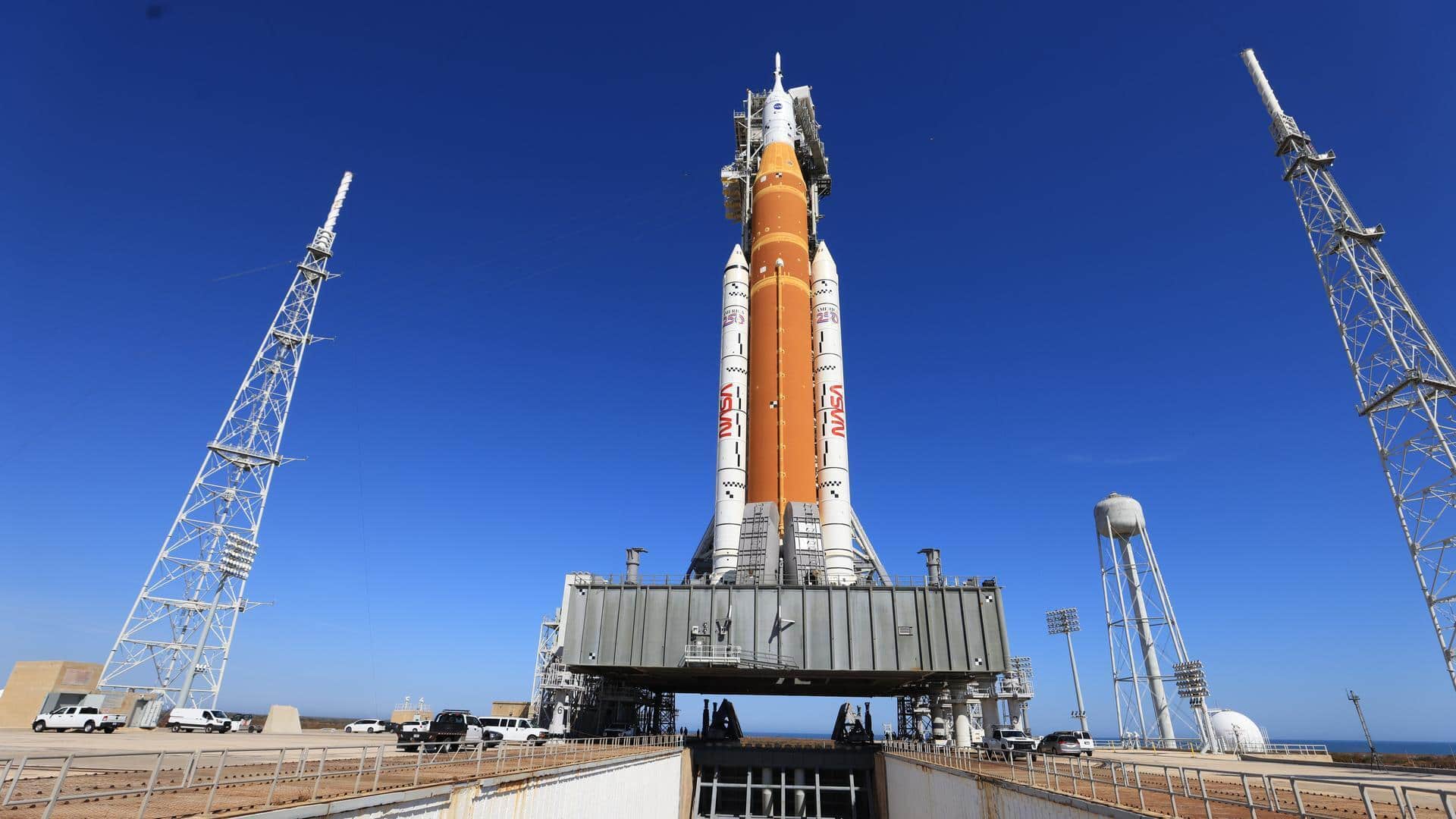
Could NASA's launch of Artemis II mission be delayed?
What's the story
NASA's highly anticipated Artemis II mission is facing a potential delay, thanks to a powerful solar flare and coronal mass ejection (CME) from the Sun. The event was recorded by the National Oceanic and Atmospheric Administration's Space Weather Prediction Center (SWPC). The solar activity poses risks of damaging electronic circuits and disrupting radio communication with the launch vehicle, which could force NASA to reschedule the launch.
Flare effects
Solar flare impacts radio communication
The solar flare, classified as an X1.4 event, was emitted by a group of sunspots known as active region 4405.
It sent a wave of radiation across the solar system and caused a strong high-frequency radio blackout on Earth's Sun-facing side, affecting Southeast Asia and northern Australia.
The region is now rotating into view of Earth, increasing the chances of another eruption impacting mission preparations for Artemis II.
CME concerns
CME headed toward Earth may exacerbate situation
The solar flare was followed by a CME, which is a violent eruption of plasma and magnetic field now headed toward Earth.
The SWPC has issued a G2 (moderate) geomagnetic storm watch for today, anticipating its arrival.
Geomagnetic storms can disrupt satellite operations and navigation systems, potentially posing further challenges to the Artemis II mission depending on their timing and severity.
Launch guidelines
NASA cannot launch during severe solar activity
According to NASA's Artemis II weather criteria, the mission cannot launch "during severe or extreme solar activity."
This is due to the risk of increased density of solar energetic particles damaging electronic circuits and disrupting radio communication with the launch vehicle.
Despite these concerns, NASA has given an 80% chance of favorable weather conditions for Wednesday's launch in its latest update.
Vigilance
NASA will monitor solar activity closely
NASA will be closely monitoring active sunspot region AR 4405 and the CME over the next few days.
Solar physicist Tamitha Skov has stressed the importance of keeping an eye on radio bursts, which can significantly impact the high frequency/very high frequency radio communications during launch operations and early orbit maneuvers.
If solar activity threatens communications or navigation systems, Artemis II's launch may be delayed again.