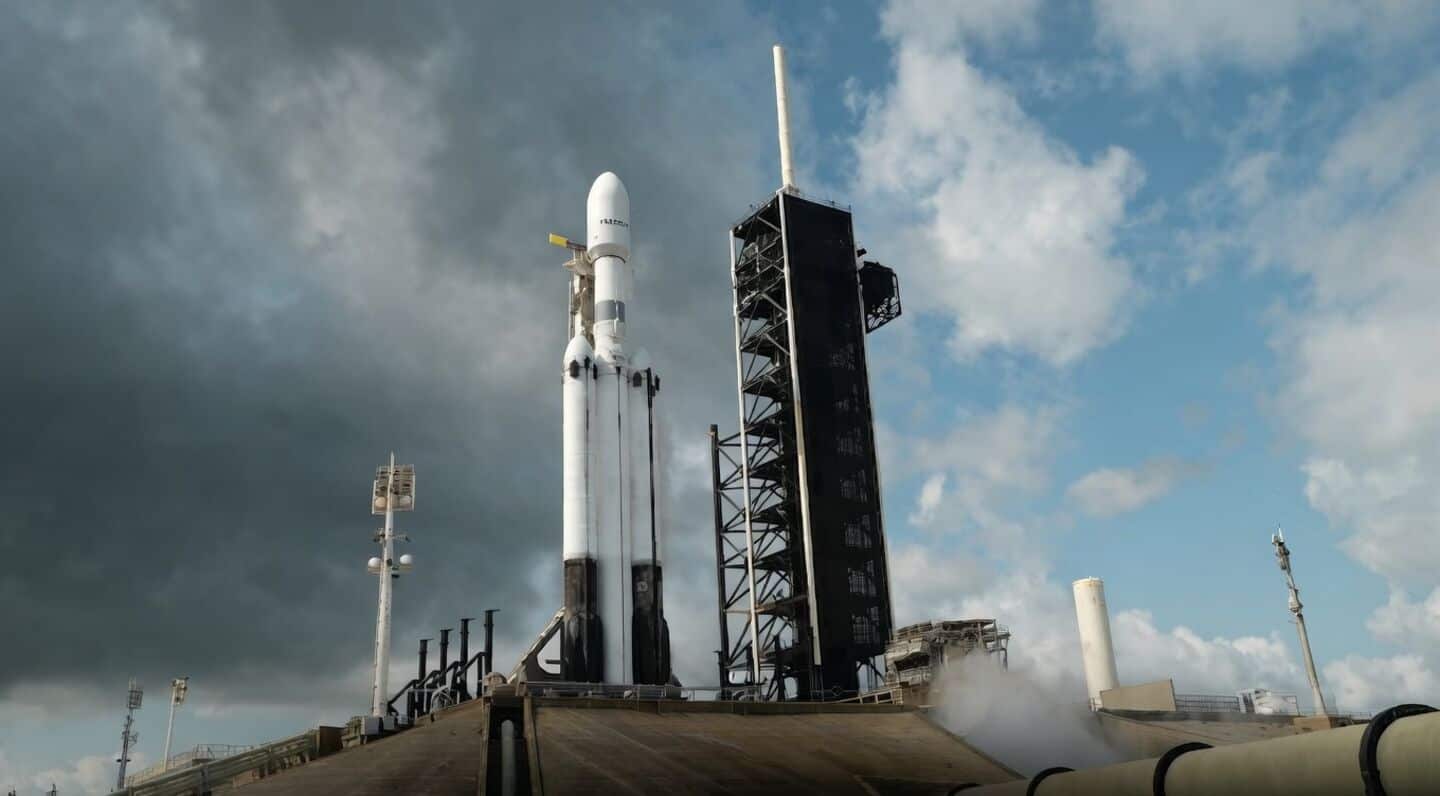
SpaceX scrubs 1st Falcon Heavy rocket launch in 18 months
What's the story
SpaceX has postponed the launch of its Falcon Heavy rocket due to inclement weather conditions. The mission, which was supposed to take off from NASA's Kennedy Space Center in Florida, was scheduled for today. This would have been the first flight of the triple-booster rocket in 18 months. No new launch date has been announced yet.
Mission details
Mission to place ViaSat-3 Flight 3 satellite into orbit
The Falcon Heavy mission was set to place the ViaSat-3 Flight 3 communications satellite into a geosynchronous transfer orbit.
The six-metric-ton satellite was supposed to separate from the rocket's upper stage nearly five hours after launch.
This would have been the 12th flight of a Falcon Heavy rocket since its debut in 2018, with two previous missions carrying ViaSat-3 satellites onboard.
Rocket specifications
Booster specifications and landing zones
SpaceX's Falcon Heavy rocket is a combination of old, new, and brand new boosters. The two side boosters will be flying for the second and 22nd time respectively.
They will separate from the center core, which has a tail number of B1098, and target landings at Landing Zone 2 (LZ-2) and Landing Zone 40 (LZ-40).
However, SpaceX won't attempt to recover B1098 as it will be expended into the Atlantic Ocean after its first and only flight.
Satellite deployment
Here are the orbit raising details
Dave Abrahamian, Viasat's VP of Satellite Systems, said the time for on-orbit commissioning will be shorter than that of the ViaSat-3 F2 satellite which flew on a United Launch Alliance Atlas 5 rocket.
He said orbit raising to the operating position at 158.55 degrees East along the equator shall take about two months.
Falcon Heavy is more powerful than Atlas 5, allowing it to drop off in a more favorable transfer orbit for electric propulsion.
Network expansion
How will the satellite benefit customers?
The third and final satellite in the ViaSat-3 constellation will cover the Asia-Pacific region, adding over one terabit per second (tbps) of capacity to the Viasat network.
Abrahamian said they have several airline customers in APAC who are eager for this capacity to serve their customers better.
He emphasized that these newer satellites offer flexibility with phased array technology and antennas onboard, allowing them to form beams wherever needed.