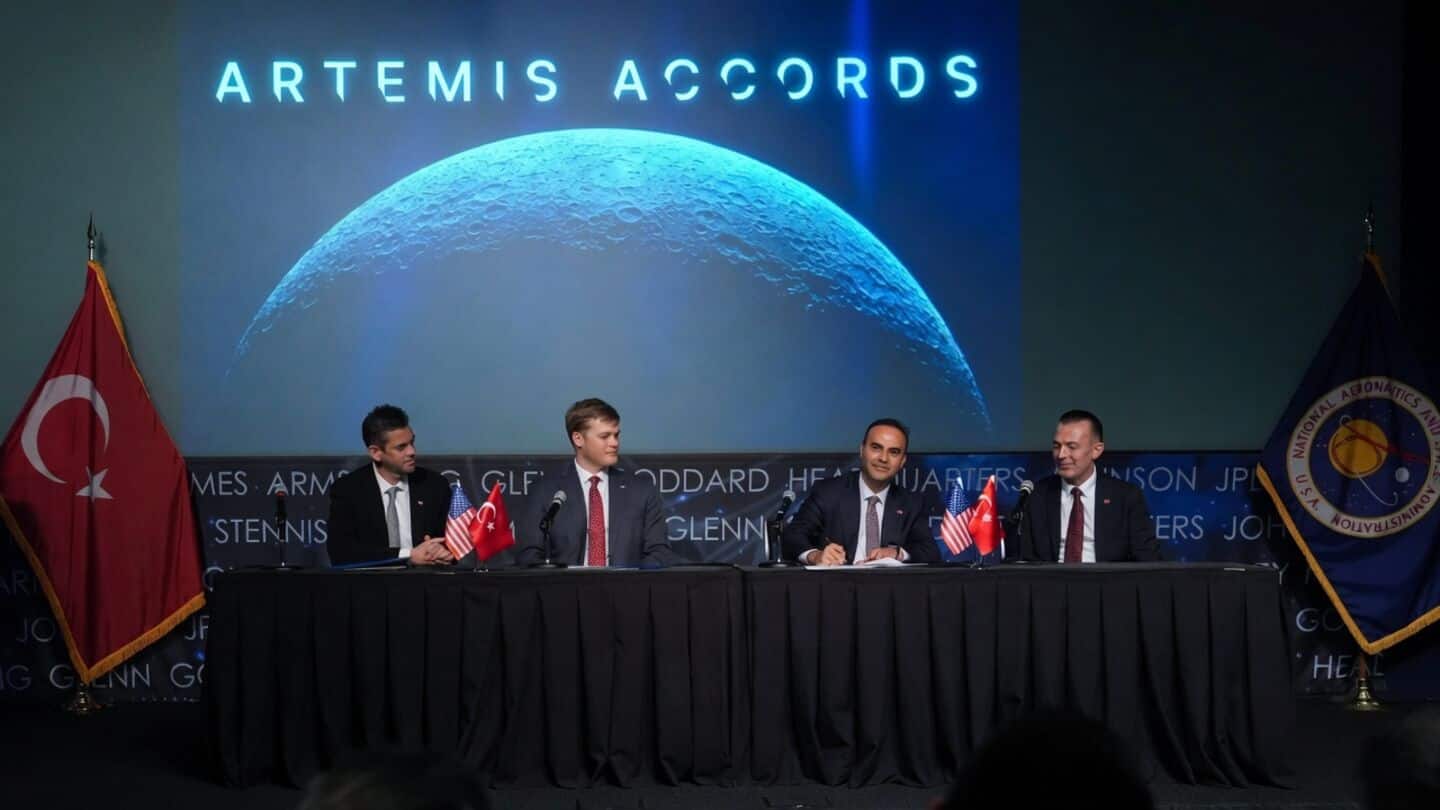
Turkey becomes 71st member of US-led Artemis Accords
What's the story
Turkey has officially joined the US-led Artemis Accords, becoming the 71st country to do so. The move was announced by NASA and marks a major step in promoting safe and peaceful exploration of the Moon, Mars, and beyond. Turkish Industry and Technology Minister Mehmet Fatih Kacir signed the agreement with US officials at a ceremony held at NASA headquarters in Washington.
Accord details
Understanding the Artemis Accords
The Artemis Accords, launched in 2020 by NASA and the US Department of State, lay down a set of non-binding principles for responsible activity in space.
The framework is based on the 1967 Outer Space Treaty and commits signatory countries to share scientific data, assist astronauts in emergencies, and make their space systems interoperable where possible.
It also emphasizes preserving sites/objects of historical significance on the Moon and other celestial bodies.
Space exploration
Turkey's space ambitions
During the signing ceremony, Kacir emphasized Turkey's ambitions and capabilities in space travel.
He said, "Our aim is to establish a sustainable presence in space and advance the peaceful use of space for the benefit of all humanity."
This commitment comes as Turkey has ramped up its space activities over recent years, looking to develop its own capabilities and strengthen its position in the global space sector.
Mission details
Unmanned lunar mission AYAP-1
Turkey is also working on its first uncrewed lunar mission, AYAP-1.
The project aims to send a spacecraft to the Moon, with plans for lunar orbit operations and a soft landing.
Furthering its space ambitions, Turkey will host the International Astronautical Congress in Antalya later this year, bringing together space agencies, companies, and researchers from all over the world.
Regional participation
Seventh West Asian country to join Artemis Accords
With its recent accession, Turkey becomes the seventh West Asian country to join the Artemis Accords.
The move comes after similar decisions by the United Arab Emirates, Saudi Arabia, Bahrain, Oman, Jordan, and Israel.
The growing membership highlights efforts by the US and its allies to establish common standards for an increasingly active space sector.