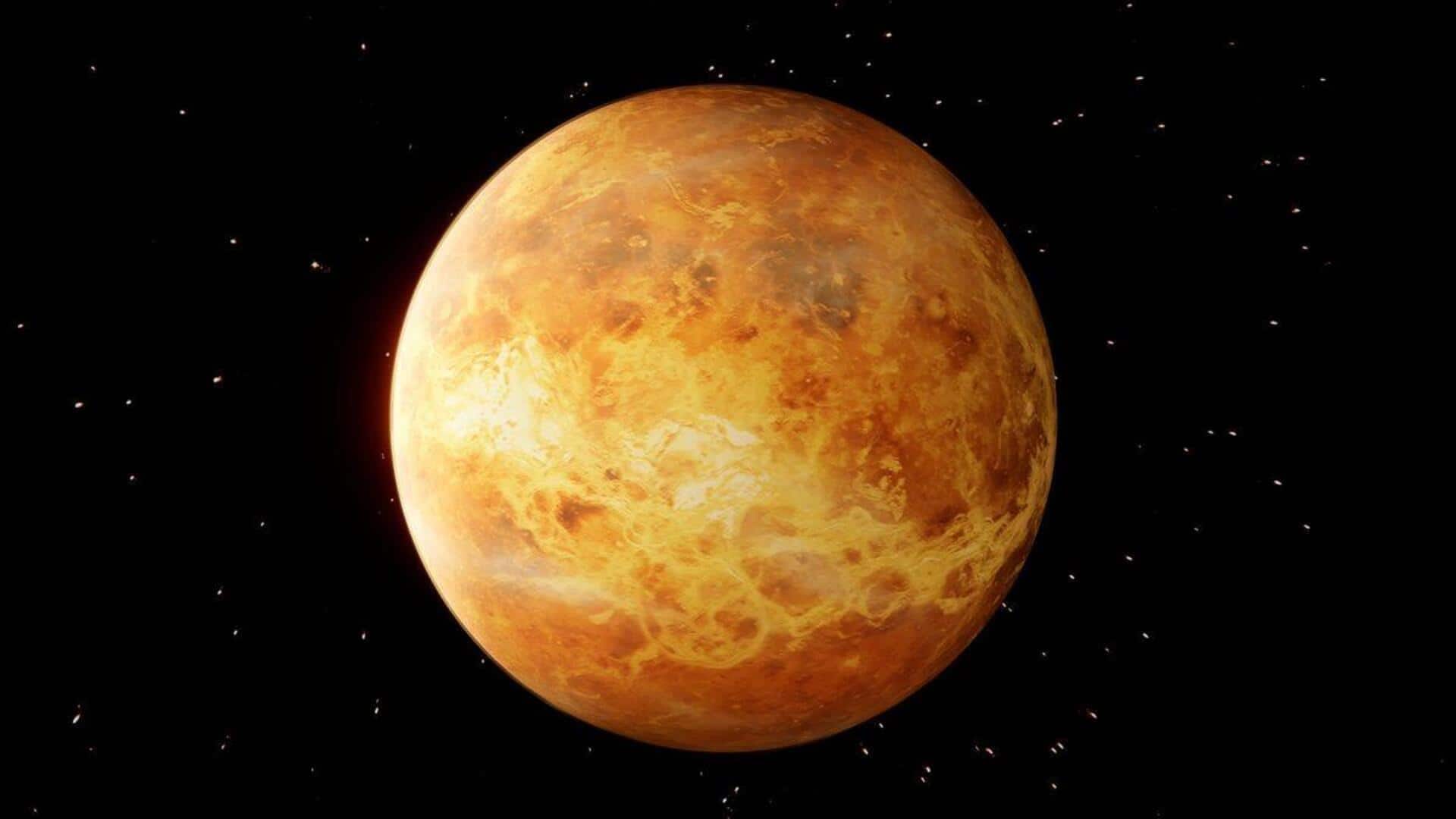
Venus makes a return to evening sky: How to watch
What's the story
Venus, the brightest planet visible to naked eye, is set to make a return in 2026. After being absent since early December last year, it will reappear as a stunning "evening star" for five months. The planet will be a prominent feature of the western sky during this period. Venus's orbit around Sun is almost circular and takes 13 Earth years to complete one revolution. This means that from Earth's perspective, it appears to complete five circuits around the sky.
Orbital path
Venus's journey since January
Venus crossed superior conjunction (when it appears to pass behind the Sun from Earth's perspective) on January 6. It remained invisible until mid-February, hidden behind the Sun's glare.
However, it slowly moved eastward and distanced itself from the Sun's position in the sky.
By March, Venus had climbed out of evening twilight and became the brightest "star" in the night sky.
The time between sunset and Venus's setting increased from nearly an hour to almost 100 minutes throughout March.
Planetary alignments
Venus will help find Uranus on April 23
On April 23, Venus will be a handy "pointer" to find Uranus.
On that night, the two planets will come close in the sky, with Venus shining at magnitude -3.9 compared to +5.8 magnitude of Uranus.
This close approach will make it easier for stargazers to spot Uranus through small telescopes or binoculars.
The seventh planet from the Sun appears as a greenish dot of light through good binoculars or small telescopes.
Conjunctions
Celestial meeting of Venus, Jupiter, Moon in June
In June, Venus will be part of a "celestial summit meeting" with Jupiter and the Moon.
On June 9, an hour after sunset, Venus will pair up with bright Jupiter in the west-northwest sky. The duo will be separated by only 1.8 degrees.
A thin crescent Moon will appear to the lower right of Jupiter on June 16 while Mercury will float directly below the Moon.
Planetary heights
Journey till August
By early June, Venus will be almost 30 degrees above the sunset horizon and set as late as 2 hours and 40 minutes after the Sun.
The planet's highest point at sunset will also coincide with this time.
On August 15, Venus will reach its greatest elongation - its greatest angular distance - from the Sun. It will be at its brightest near the end of summer while heading back toward the Sun.