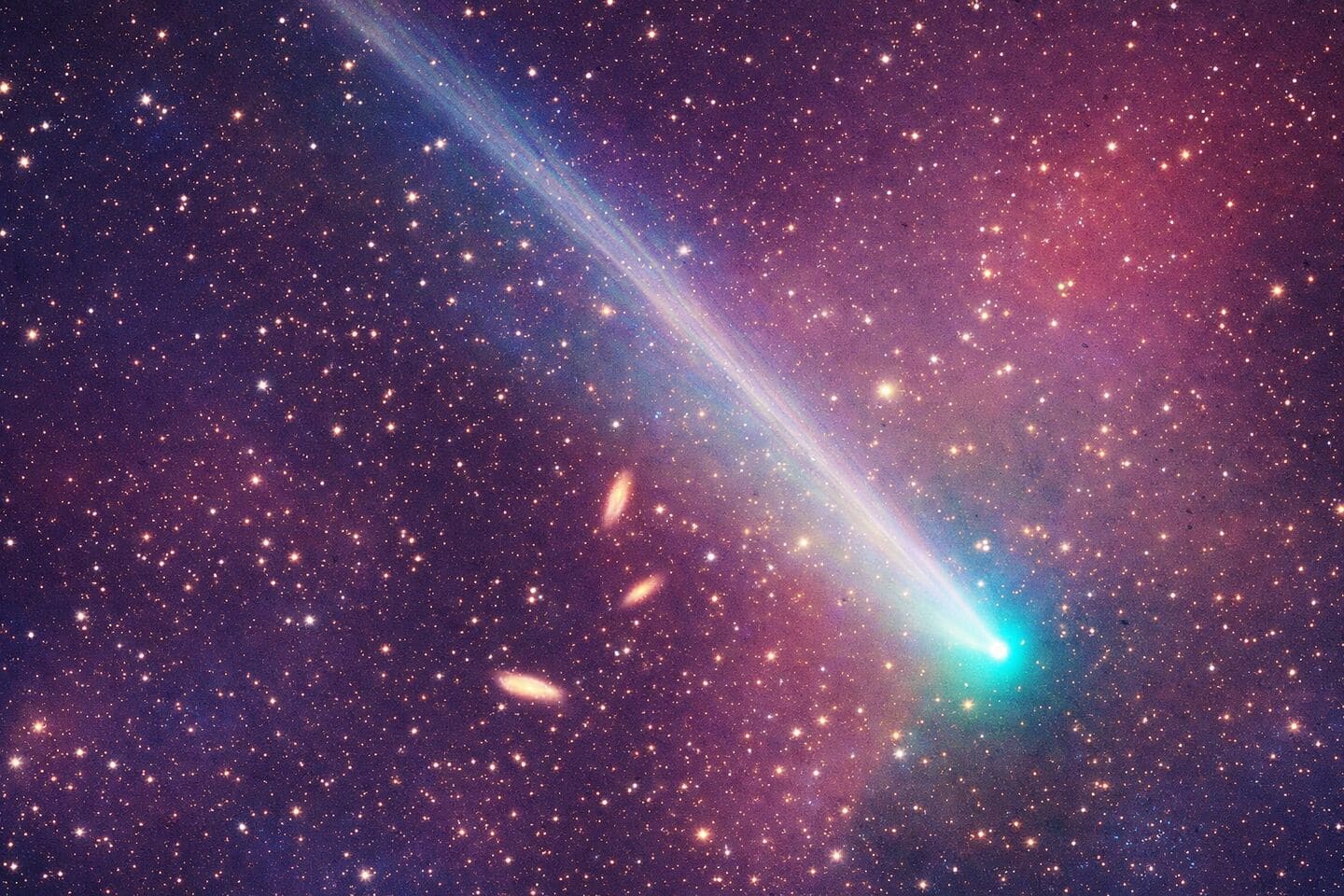
Comet from solar system's edge now visible: How to watch
What's the story
A rare celestial visitor, Comet C/2024 E1 (Wierzchos), is currently visible in Indian skies. The comet was discovered in March 2024 by Polish astronomer Kacper Wierzcho during a routine survey at Mt. Lemmon. It was first spotted as a faint 20th-magnitude object in the Draco constellation, marking the first time humanity has seen this ancient traveler from the farthest reaches of our solar system.
Celestial path
It is on a multi-million-year journey
Comet C/2024 E1 is a hyperbolic Oort Cloud comet on a multi-million-year inbound journey. It reached its closest point to the Sun, or perihelion, on January 20, 2026.
At this point, it was about 85 million km from the Sun.
The comet's trajectory indicates that it will be permanently ejected into interstellar space after its encounter with our star.
Cosmic origins
Trajectory and close approaches
The comet likely hails from the Oort Cloud, a distant region of icy bodies beyond Pluto.
Its unique trajectory suggests this could be humanity's last glimpse of it, as the Sun's gravity and planetary pulls will send it back into deep space forever.
The comet made a close approach to Venus on January 1, 2026, coming within about 0.191 astronomical units (AU) of our neighboring planet.
Celestial composition
Interesting facts about Comet C/2024 E1
The activity of Comet C/2024 E1 is mostly driven by carbon dioxide, not the more common carbon monoxide.
This was confirmed by observations from the James Webb Space Telescope in early 2025.
The comet's nucleus is estimated to be between 2-10km wide, smaller than previous estimates of about 13.7km.
As it neared the Sun, it made a coma (cloud of gas and dust) that grew to about three arcminutes wide and a tail stretching about one degree across the sky.
Viewing advice
How to spot the comet in the sky?
The comet peaked at around magnitude 6.5 to 7, making it barely visible with binoculars or a small backyard telescope.
This was a bit dimmer than earlier predictions but still impressive, considering the comet was over 93 million miles away.
As of February 2026, Comet C/2024 E1 is still visible in the evening sky at about magnitude +7, around 22 degrees away from the Sun after its closest approach.