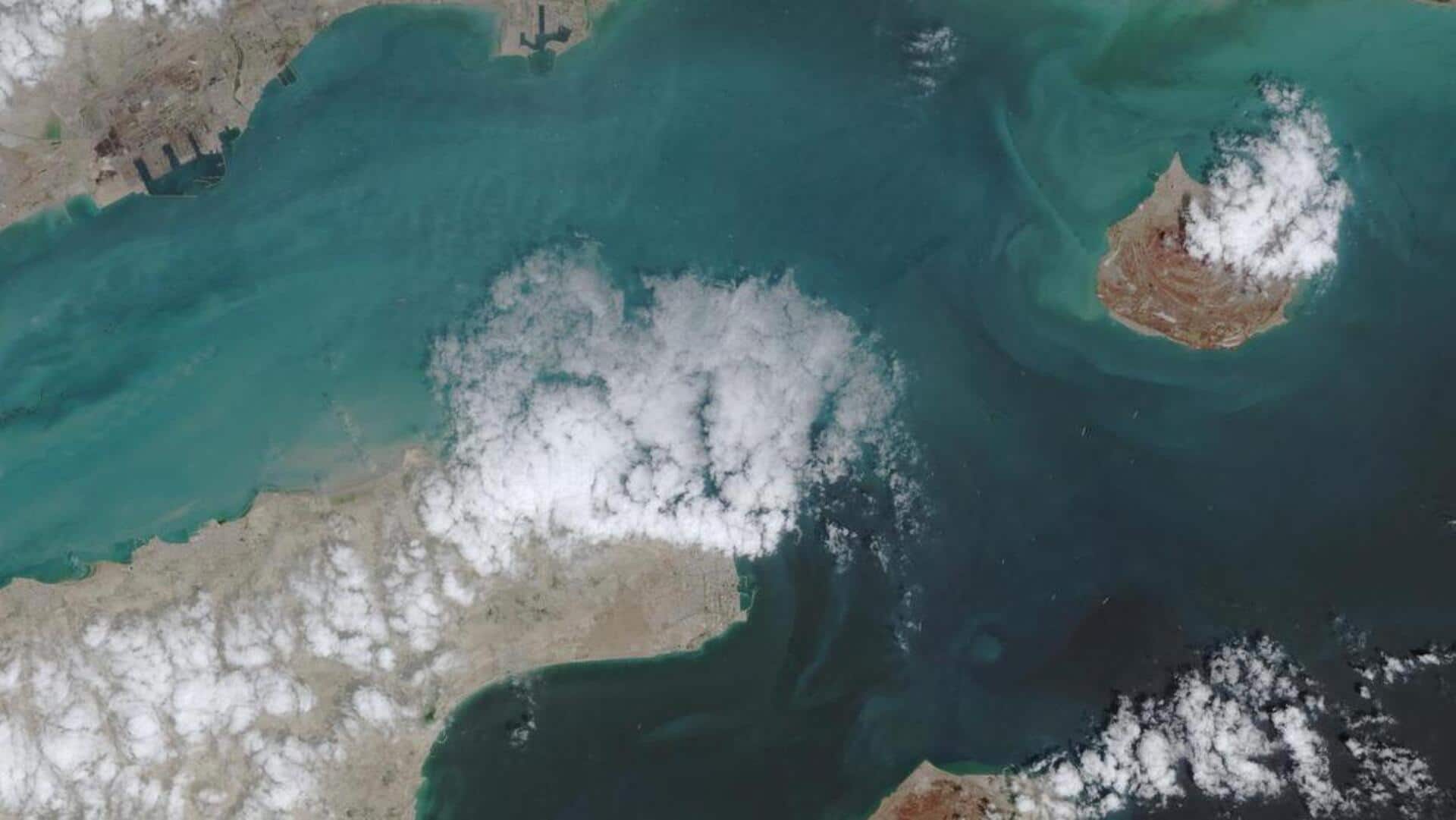
Iran is now looking beneath Hormuz to make money
What's the story
Iran is planning to impose fees on major technology companies for using subsea internet cables under the Strait of Hormuz, emboldened by its successful blockade of the Strait of Hormuz, reports said. The Islamic Republic has threatened to disrupt global internet connectivity if these firms don't comply. Iranian lawmakers last week discussed a proposal targeting submarine cables connecting Arab nations with Europe and Asia, CNN reported.
Proposal details
Licensing fees for submarine cable companies
The Iranian military spokesperson, Ebrahim Zolfaghari, announced on X last week that internet cables would be charged.
"We will impose fees on internet cables," he said.
According to Iran's Revolutionary Guards-linked media, Tehran's plan to extract revenue from the strait would require companies such as Google, Microsoft, Meta, and Amazon to follow Iranian law, while submarine cable companies would be required to pay licensing fees for cable passage, with repair and maintenance rights reserved exclusively for Iranian firms.
Economic implications
Disruptions could have far-reaching consequences on global connectivity
However, it remains unclear if these cables pass through Iranian waters or how Iran could enforce such regulations, as the companies are barred from making payments to Iran due to US sanctions.
Subsea cables are crucial for global connectivity, carrying most of the world's internet traffic.
Attacking them would have far wider implications than internet speeds: it would threaten everything from banking systems, military communications and AI cloud infrastructure to remote working, online gaming and streaming services.
Cables
Two cables run through Iranian territorial waters
Mostafa Ahmed, a senior researcher at UAE-based Habtoor Research Center, stated that while several major intercontinental subsea cables pass through Hormuz, international operators have purposefully avoided Iranian waters due to long-standing security concerns with Iran.
They have instead grouped the majority of the cables in a narrow band along the Omani side of the waterway.
However, according to Alan Mauldin, research director at TeleGeography, a telecom research company, two of those cables—Falcon and Gulf Bridge International (GBI)—pass Iranian territorial waters.
Warfare tactic
Threats to damage cables
Iran has not explicitly threatened to damage the cables but has hinted at punishing Washington's allies in the region.
The Islamic Revolutionary Guard Corps (IRGC) poses a risk to underwater cables with combat divers, small submarines, and underwater drones.
This could lead to a "digital catastrophe" across continents if any attack were launched on these vital infrastructures.
Legal stance
Iranian news outlets argue proposal in line with international law
Iranian news outlets have argued that the proposal to charge for subsea cables is in line with international law.
They cite the 1982 United Nations Convention on the Law of the Sea (UNCLOS), which includes provisions governing submarine cables.
Although Iran has signed but not ratified the convention, the legal community regards it as legally binding under customary international law.
Article 79 of UNCLOS allows coastal states to set conditions for cables entering their territory or territorial sea.