Long-standing myth about iconic Greek temple in Athens debunked
What's the story
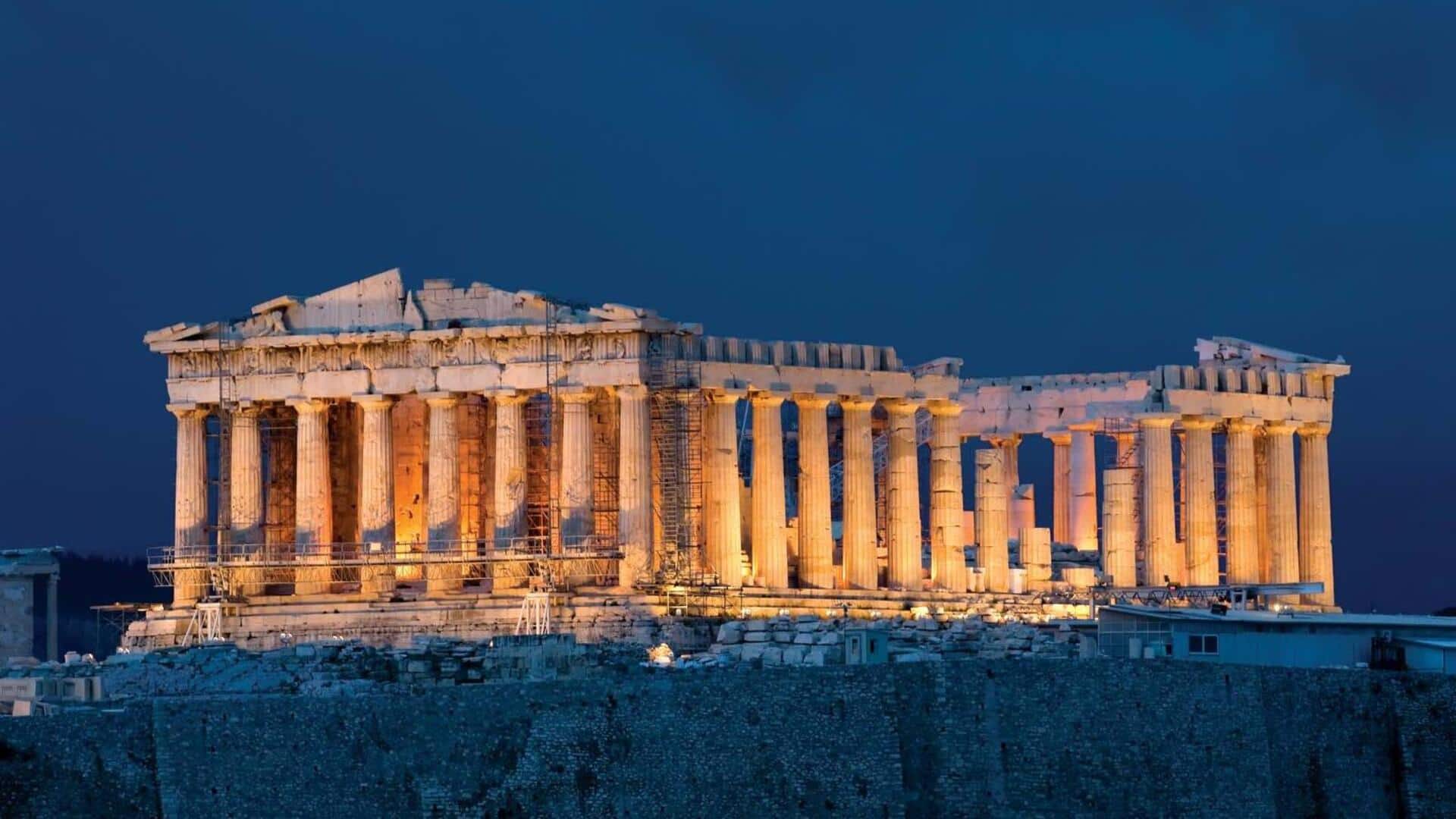
A mathematician from the University of Oxford has debunked a long-standing myth about the Parthenon, the iconic Greek temple overlooking Athens. The myth suggests that the building's subtle curves were designed to correct optical illusions and preserve its clean lines. However, Professor Alain Goriely's mathematical modeling and detailed investigation have shown that these so-called optical illusions are either nonsense or practically imperceptible. In short, they are an illusion in themselves.
Historical roots
Tracing the myth's origins
Goriely traces the Parthenon optical illusion myth back to 1st-century Roman architect and engineer Vitruvius.
He wrote about the temple some 400 years after its construction, and his account became a staple in architectural books.
Even today, AI chatbots continue to propagate this tale.
"I do think it might be the oldest myth that we have," Goriely said, "apart from religion."
Optical corrections
The sagging effect
One of the main claims Goriely challenges is about the Parthenon's base or stylobate.
Measurements show that its sides aren't horizontal but form a gentle arc that rises 6cm in the center.
Vitruvius claimed this was to correct an illusion making the base appear to sag in the middle.
The sagging effect has been attributed to two proposed tricks of light, neither of which Goriely found evidence for.
Column curvature
The bulges in columns
Another claim is that the bulges in the Parthenon's columns, known as entasis, correct an optical illusion making them look too narrow in the middle.
However, Goriely found no evidence for this either.
He noted that the columns at the Parthenon bulge by a mere 18mm, which is hardly noticeable from regular viewing distances.
Design rationale
Other supposed optical corrections
Goriely also considers other supposed "optical corrections" in his paper.
He suspects that the Parthenon's architects had other reasons for these design elements.
For instance, the curve of the base may have prevented rain puddles from forming, while curved columns could have looked more organic and visually pleasing to ancient Greeks.
Myth persistence
Why does this myth persist?
The reason behind the longevity of this myth is still unclear.
Goriely thinks it may have something to do with the perception of ancient Greece as an incredibly knowledgeable and ingenious civilization.
He ends his paper by inviting readers to question what they see and decide for themselves whether the theory of optical corrections holds up.