Why India-EU trade deal is risky for Japan, UK, US
What's the story
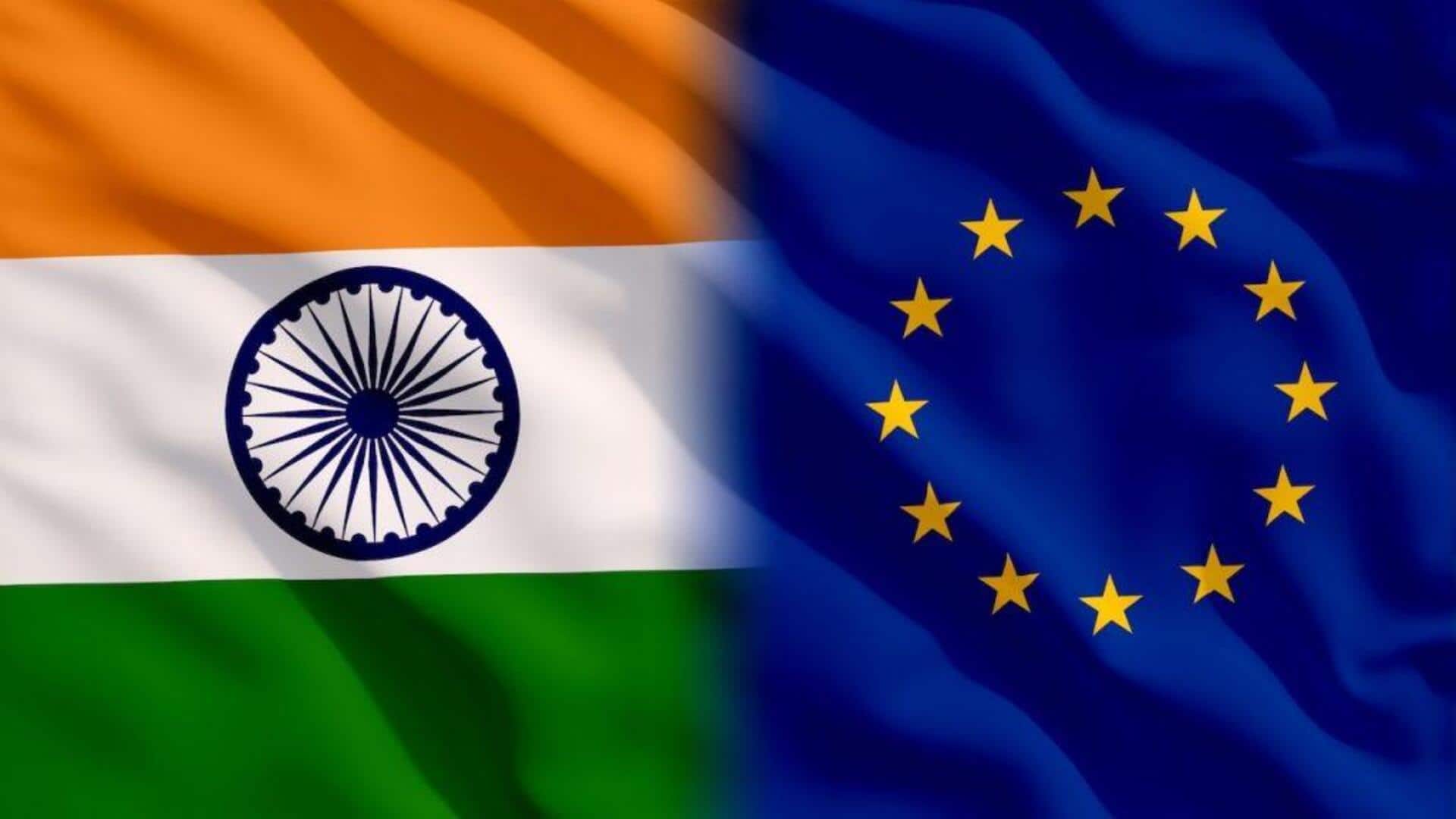
India's free trade agreement with the European Union (EU) is likely to up the ante for major exporters like Japan, the UK and US. An analysis by Moneycontrol has revealed that nearly $11 billion worth of trade could be at stake. Prime Minister Narendra Modi announced this landmark deal today during India Energy Week, referring to it as a significant partnership.
Deal details
PM Modi's vision for India-EU partnership
PM Modi described the India-EU trade agreement as a perfect example of cooperation between two major economic powers.
He said, "This agreement will bring major opportunities for the public in India and Europe."
The Prime Minister also emphasized on its global significance by highlighting that it represents 25% of the world's GDP and one-third of global trade.
Trade dynamics
Uneven impact on trading partners
The impact of the India-EU deal will not be uniform across all trading partners.
For instance, out of Japan's $48 billion exports to India, nearly $3.5 billion or over 17% are in product categories where EU suppliers could become more competitive with preferential access.
The UK is even more exposed with almost 20% of its exports to India (roughly $1.3 billion) in segments where EU firms are well-placed to displace existing suppliers.
US exposure
US trade could face competition
The US, despite exporting a lesser absolute value of goods to India than Japan or the UK, might still face competition in nearly $5.8 billion worth of trade. This is around 15% of its exports.
On the other hand, Russia seems relatively insulated with just over 1% of its exports to India exposed to potential EU competition.
Risk factors
High-value engineering goods at risk for Japan
Japanese exports at risk are mainly high-value engineering and industrial products such as machinery, electrical equipment, the engines, precision instruments and filtering systems.
These categories closely overlap with European strengths especially in Germany, France and Italy where companies are already well integrated with Indian manufacturing supply chains.
The UK's vulnerable segments include scrap metals, aluminum and paper waste among others.
Challenges
US faces competition in medical instruments, communication equipment
The US could face competition mostly in medical and surgical instruments, diagnostic reagents, communication equipment among others.
Many of these categories are already seeing rising EU participation globally.
Tariff preferences could further tilt sourcing decisions toward European suppliers.
For Japan, the UK and US, the challenge will not just be about trade losses but also about defending market share in high-value segments where the pricing, regulatory standards, and delivery timelines matter as much as tariffs.