
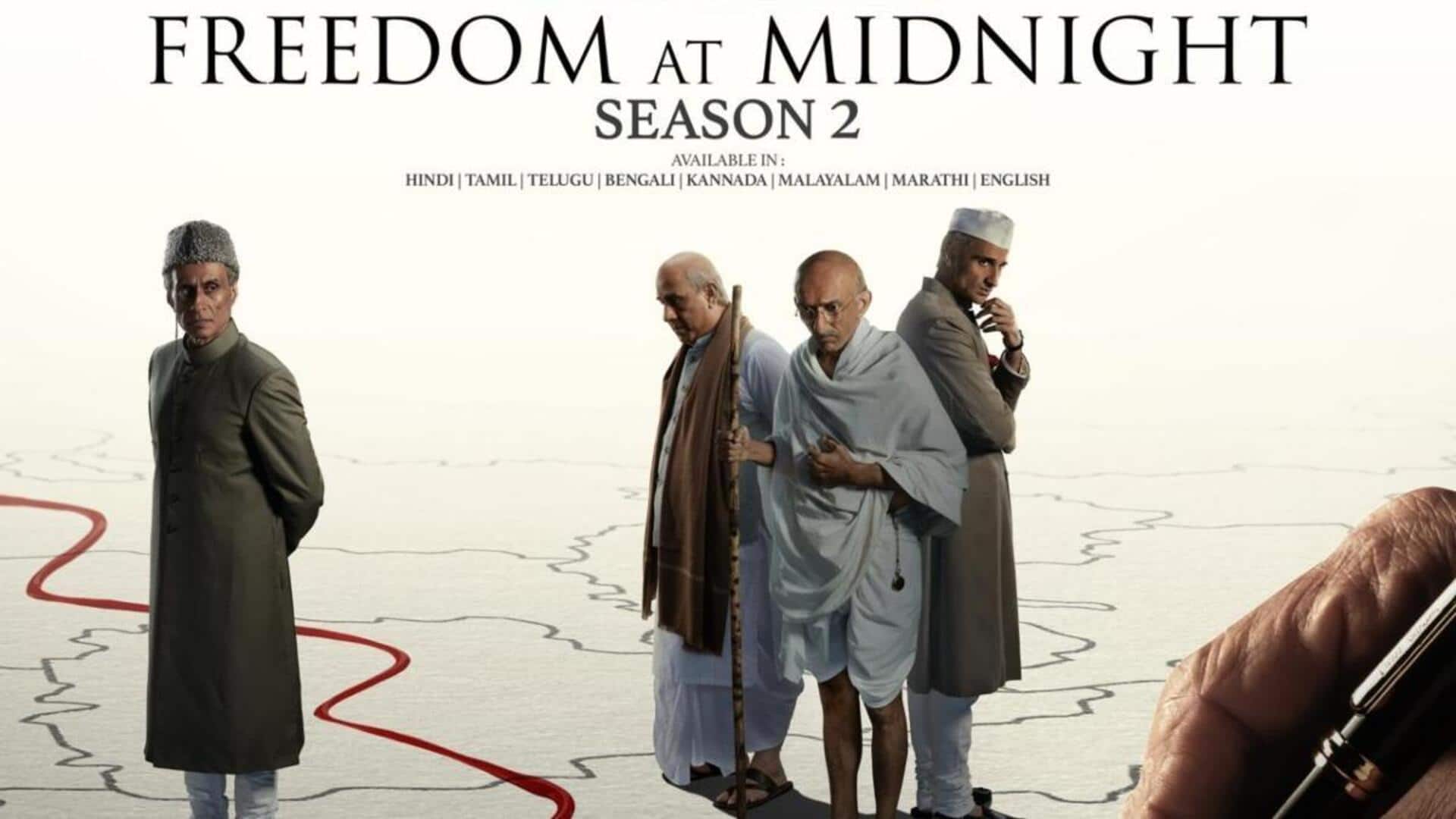
'Freedom at Midnight' S02 review: SonyLIV show is gripping, intense
What's the story
After a spectacularly successful first season, Nikkhil Advani's Freedom at Midnight has returned for a second outing. Based on the namesake book by Dominique Lapierre and Larry Collins, the show once again chronicles India's brutal, bloody Partition and its aftermath. Spread over seven episodes (45-50 minutes each), the SonyLIV series skillfully explores this complex, violent historical event that altered the country forever.
Plot
S02 covers a lot of ground
Picking up where it left off, S02 focuses on the administrative challenges of India's independence, and the contributions of Sardar Vallabhbhai Patel, Jawaharlal Nehru, and Mahatma Gandhi. It also captures the integration of the Princely States, Gandhi's fasts-unto-death, and his assassination in January 1948. The show shakes you up and asks: Do you truly realize the cost of a free India?
#1
The cast steals the show yet again
The ensemble cast is the most enticing aspect of the series. Chirag Vohra as Gandhi, Sidhant Gupta as Nehru, Rajendra Chawla as Patel, and Arif Zakaria as Mohammad Ali Jinnah keep you tethered to the show. Chawla and Zakaria emerge as the best performers and get under the skin of their characters so remarkably that you can't take your eyes off them.
#2
No complaints on the research front
Much like the first season, the second installment, too, works well due to its splendid, in-depth research. For a project that directly draws from India's sprawling, convoluted history, getting the research right is the utmost necessity. Freedom at Midnight achieves what historical projects should: it sparks curiosity, stimulates you intellectually, and encourages you to do your own research about the topic.
#3
Leaves you pondering over the cost of freedom
The show reminds you how the fate of two nations lay in the hands of a few men, and how the festering wounds may never be healed. The exuberance of the independence was fleeting, making everyone wonder: We won, but at what cost? It also devotes abundant time to Kashmir, underlining how the history of the paradise is one soaked in blood.
#4
Areas where it could have been better
Though the series focuses on the repercussions of the India-Pakistan Partition and how it ravaged people on both sides, it's not consistently impactful. We spend too much time with political leaders and not enough with the common man, so we struggle to see the story from their perspective. In this aspect, the series leaves much to be desired.
#5
Where are the women?
Women have historically borne the brunt of wars differently from men. However, FAM doesn't talk much about their dehumanization and rapes, even though this topic is at the forefront of the Partition discourse. Another nagging issue, which the series also received flak for earlier, is Gupta's (36) casting. He's an excellent performer, but too young to essay Nehru, who was 57 in 1947.
Verdict
Not perfect, but consistently watchable; 3.5/5 stars
Advani juxtaposes fictional scenes with historical archives, turning back the clocks and taking us on a fascinating trip to the past. Nehru's iconic Tryst With Destiny speech, particularly, is a standout. Overall, like the first season, the show struggles with pacing and consistency, but the subject is so ripe that you're hooked despite the narrative bumps. 3.5/5 stars.