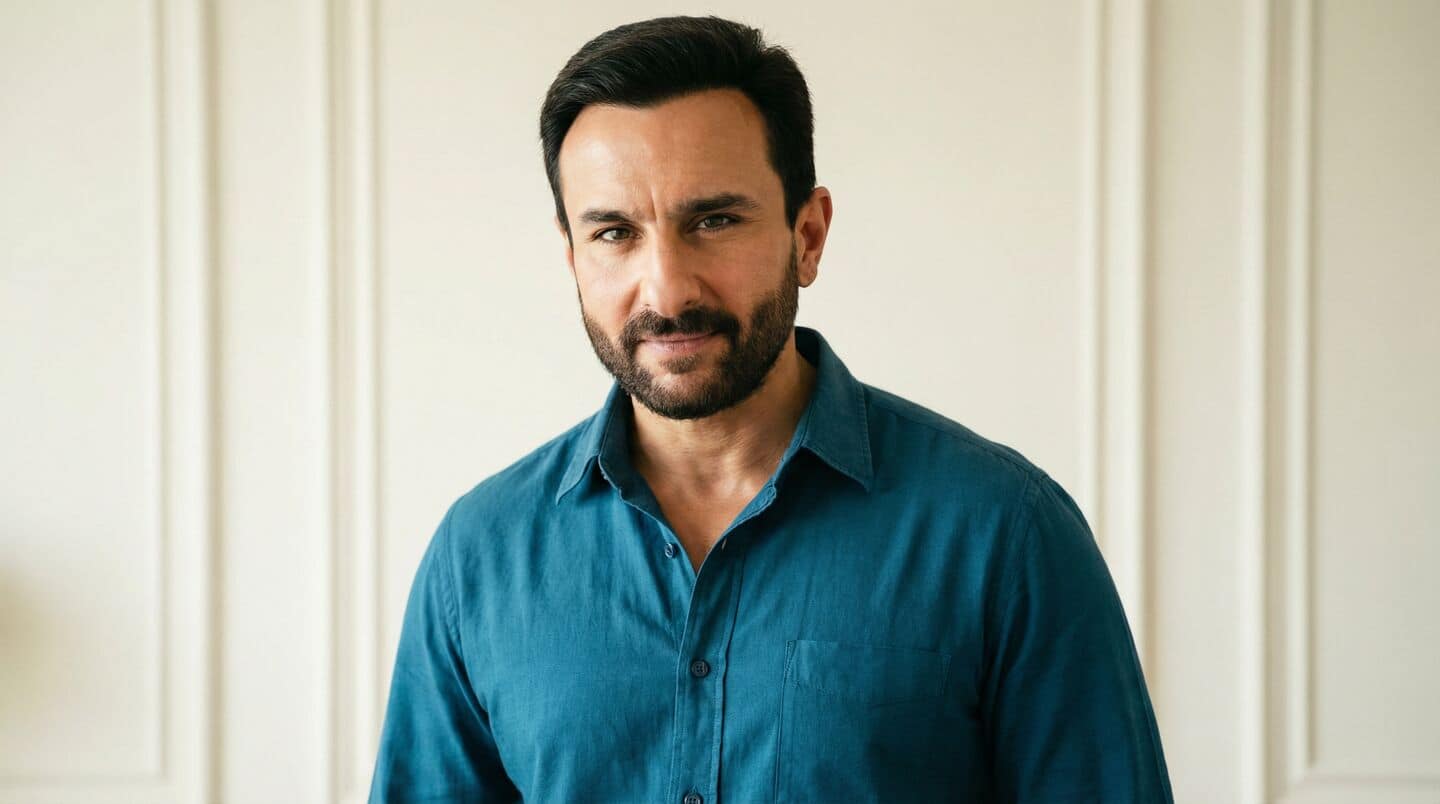
Saif Ali Khan thinks pay gap isn't related to gender
What's the story
Pay disparity has been a hot topic in the Indian film industry, with many actors and filmmakers often discussing the difference in earnings between male and female stars. Now, actor Saif Ali Khan has shared his views on this issue, saying that he believes actors who can draw audiences to theaters deserve higher pay for their box-office appeal. He appeared on his sister-actor Soha Ali Khan's podcast with brother-in-law-actor Kunal Kemmu recently.
Pay parity
Khan explained the economics of stardom
During the podcast, Khan said, "If the actors are of equal stature, they should be paid the same amount."
"But I also feel the economics work in a certain way. If you are putting people in seats in the theater, you get paid accordingly. Everyone understands that relationship."
He added that this system isn't biased toward any gender but is based on an actor's market value and ability to attract audiences.
Economic system
Is it gender-biased?
Khan further explained that the pay structure in Bollywood isn't gender-biased.
"It's not like just because you are a certain gender you deserve to be paid more or less. It's actually a very balanced economic system where people are clear that this person is a superstar because they are filling theaters."
"They know their worth, charge that price and get paid."
Salary calculation
Kemmu explained the 'maths' behind actors' salaries
Kemmu explained the "maths" behind how actors' salaries are calculated in the industry.
He said distributors used to estimate a film's recovery based on its star power.
"There is a maths to it...Earlier, distributors knew that if I have this actor, I can sell a territory for a certain amount of money and that becomes part of the recovery," he said.
Star power
On lopsided remuneration
Kemmu further explained that the total budget of a film, including production and marketing investment, is often based on the revenue a particular star can generate.
"When you get a star who can bring in a certain amount of money, their remuneration is calculated around that. But, of course, now some stars are charging so much that it has become lopsided- the actor is taking more than the film itself."
Changing dynamics
Leading ladies need to have similar blockbuster appeal
Kemmu also said that pay parity discussions would change if female-led films consistently performed as well as male-driven blockbusters like Pathaan or Jawan.
"If you are in a country where audiences are going and supporting a female-led action film the way they support something like Pathaan or Jawan, then there would be no conversation around this. It would automatically happen."
Industry changes
Earlier, female superstars existed but pay gap was there
Khan also spoke about how the industry has evolved over the years.
He mentioned that female stars from earlier eras, like his mother Sharmila Tagore and Sridevi, were incredibly popular but didn't get paid as much as their male counterparts.
"There was a time in the 1970s when huge movie stars like our mother Sharmila and later Sridevi were incredibly popular...Audiences loved seeing Dharam ji with Zeenat Aman, but they were not getting paid anywhere close to the same."
Evolving industry
Khan on how things have changed
Khan added that things have started to change in recent years.
"Now there is more parity. If people say they really like actors like Ananya Panday or Kareena Kapoor, they are getting paid more. The world is balancing out."
"Earlier, patriarchy was much stronger than it is now."
On the work front, Khan will next be seen in Netflix's Hum Hindustani and Priyadarshan's Haiwaan.