
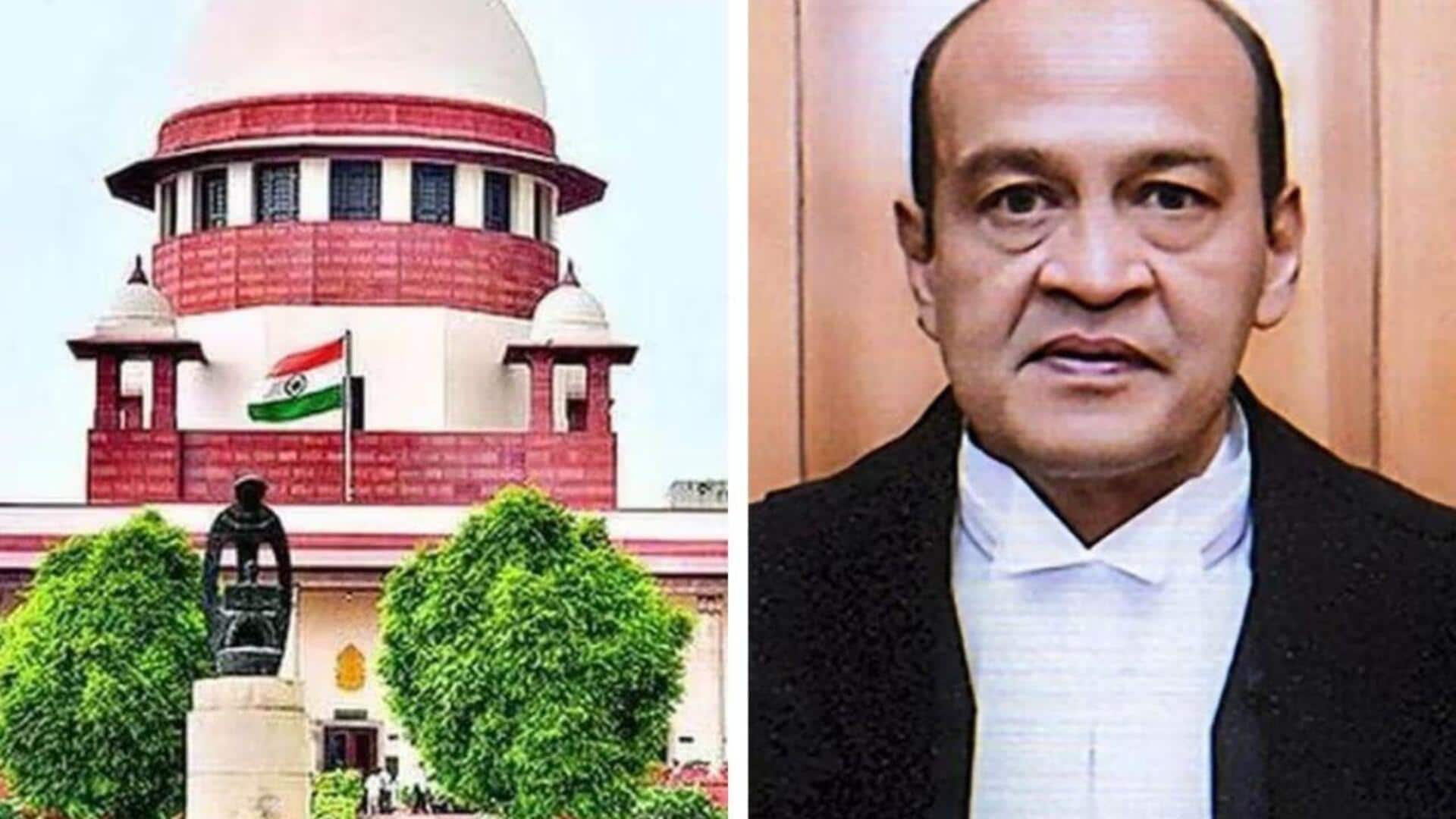
Supreme Court reserves judgment on Justice Yashwant Varma's plea
What's the story
The Supreme Court has reserved its judgment on a petition filed by Allahabad High Court Justice Yashwant Varma. The petition challenges the formation of an inquiry committee by Lok Sabha Speaker Om Birla under the Judges (Inquiry) Act, 1968. The committee was formed in connection with an impeachment motion against Justice Varma after unaccounted cash was found at his official residence.
Legal challenge
Petitioner's argument: Unilateral committee formation violated law
Justice Varma's petition argues that the impeachment notices were moved in both the Houses on July 21. Despite this, Speaker Birla constituted the inquiry committee without waiting for a decision from the then Rajya Sabha Chairman Jagdeep Dhankhar or holding a joint consultation as required by Section 3(2) of the Judges (Inquiry) Act, 1968. The relevant provision states that if motions are given on the same day in both Houses, no committee shall be constituted unless admitted in both Houses.
Rejection dispute
Rajya Sabha Deputy Chairman's rejection sparks controversy
The controversy deepened when the deputy chairman of Rajya Sabha rejected the impeachment motion on August 11, the court was told on Wednesday. It was only after that Birla formed the inquiry committee. Justice Varma's petition contends that this rejection was beyond his powers, and thus, Birla could not have unilaterally formed the committee. The petition also questions whether Dhankhar had admitted the motion on its first day, arguing that if he did, it would invalidate Deputy Chairman's later rejection.
Legal debate
Senior advocates argue over impeachment proceedings
Senior Advocate Siddharth Luthra, appearing for the petitioner, argued that Article 124 of the Constitution governs impeachment proceedings and Article 91 doesn't empower the deputy chairman to exercise discretionary powers of the Chairman. However, Dipankar Dustice Datta questioned if a vice president can perform the president's functions in their absence, then why not the deputy chairman for chairman. Senior Advocate Mukul Rohatgi, also appearing for Varma, reiterated that such actions aren't authorized under Judges (Inquiry) Act.
Defense presented
Solicitor General defends Lok Sabha Speaker's decision
Solicitor General Tushar Mehta defended the Lok Sabha Speaker's decision, arguing it was to avoid conflicting opinions from two separate committees. He cited a provision that if motions are given on separate days, the later one lapses. The SG argued no demonstrable prejudice was caused to Justice Varma due to this decision.
Case background
Impeachment notices and in-house inquiry committee
In July 2025, impeachment notices were submitted by 145 Lok Sabha members and 63 Rajya Sabha members. The Lok Sabha Speaker announced a committee in August, comprising Justice Aravind Kumar of the Supreme Court, Chief Justice Manindra Mohan Shrivastava of Madras High Court, and Senior Advocate B V Acharya. The issue arose after a large amount of cash was discovered at Justice Varma's official residence during firefighting on March 14. An in-house inquiry committee found prima facie evidence against him.