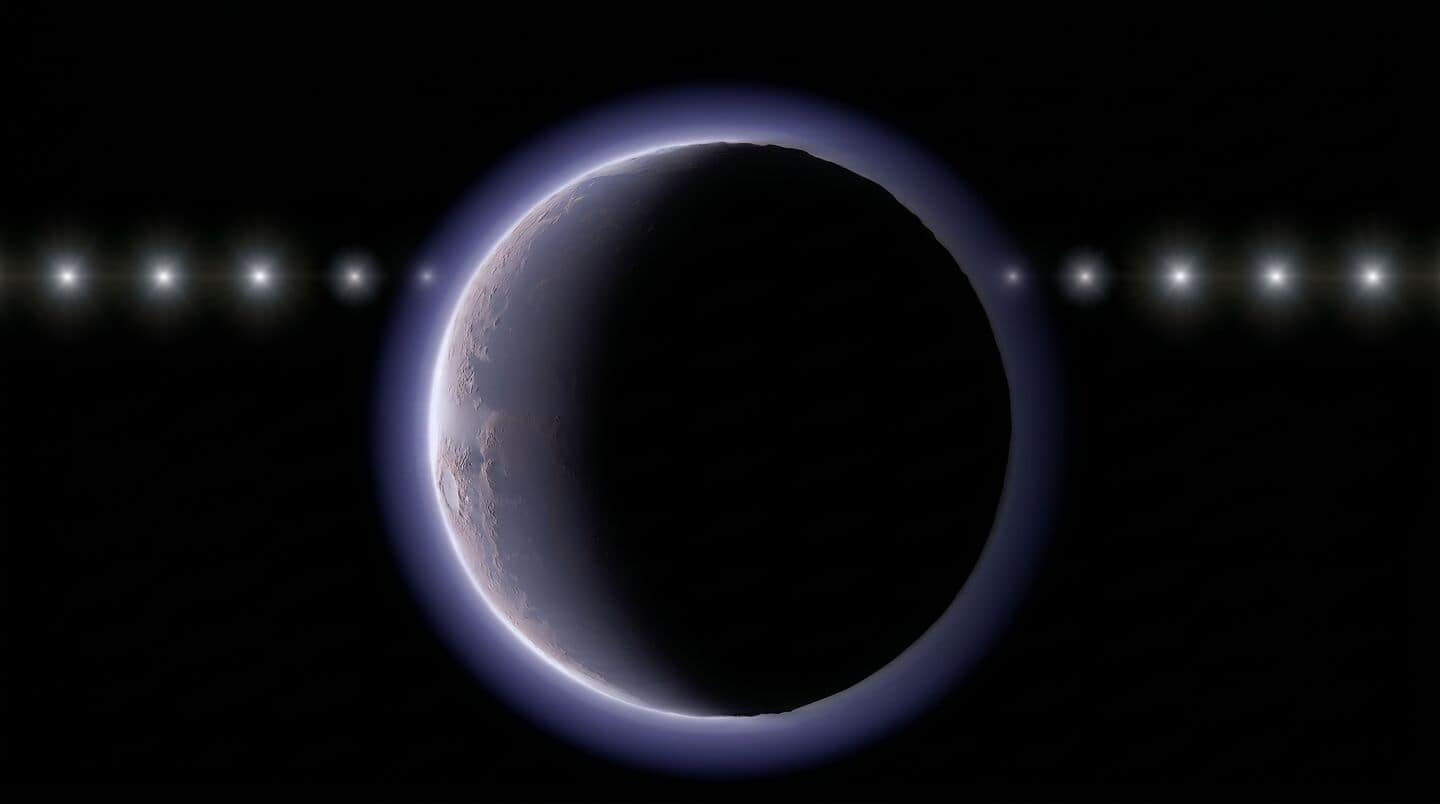
This tiny body in outer solar system has an atmosphere
What's the story
In a groundbreaking discovery, astronomers have found a thin atmosphere surrounding a small celestial body in the outer solar system. The object, known as (612533) 2002 XV93, is a trans-Neptunian object (TNO) located in the Kuiper Belt. This finding was published in Nature Astronomy and challenges previous assumptions that such small bodies can't retain atmospheres due to their size and weak surface gravity.
Observation technique
Stellar occultation revealed the presence of an atmosphere
The discovery was made by Dr. Ko Arimatsu and his team at Japan's National Astronomical Observatory during a rare observation opportunity.
They observed a stellar occultation, where a TNO passes in front of a bright star.
The gradual dimming of starlight indicated the presence of an atmosphere around 2002 XV93, which is only about 501km wide compared to Pluto's 2,377km.
Atmosphere origin
Possible origins of the atmosphere
The atmosphere of 2002 XV93 is estimated to be five million to 10 million times thinner than Earth's.
The researchers propose two possible origins for this atmosphere: cryovolcanoes on the icy body or an impact from another Kuiper Belt object like a comet.
If it's from an impact, the atmosphere might only last a few hundred years. But if it's replenished by cryovolcanic activity, it could persist much longer.
Ongoing research
Future observations will enhance our understanding of TNOs
Further observations of 2002 XV93 through more stellar occultation events or the James Webb Space Telescope will help astronomers understand the nature and evolution of its atmosphere.
Dr. Scott S. Sheppard from Carnegie Institution for Science said, "This was an exciting discovery to read about," as it shows that small objects like 2002 XV93 can have atmospheres.
Scientific implications
Implications for our understanding of solar system's outer regions
This discovery challenges the long-held assumption that the Kuiper Belt is a "cold dead place."
Instead, it suggests that these distant regions are active and have many building blocks for life.
The research team continues to search for atmospheres around other TNOs using stellar occultation observations.
Their findings may determine if 2002 XV93 is an exception or if other similar small objects also possess atmospheres.