Astronomers just spotted a blazar 8B light-years away from Earth
What's the story
Astronomers have discovered the most distant and earliest blazar, a high-energy source powered by a supermassive black hole. The discovery was made using Large-Sized Telescope (LST-1) prototype and Major Atmospheric Gamma-ray Imaging Cherenkov (MAGIC) telescope at Roque de los Muchachos Observatory in La Palma, Spain. The blazar, named OP 313, is located eight billion light-years away from Earth. Its light has taken eight billion years to reach us, revealing what the universe looked like five billion years after Big Bang.
Cosmic history
What is a blazar?
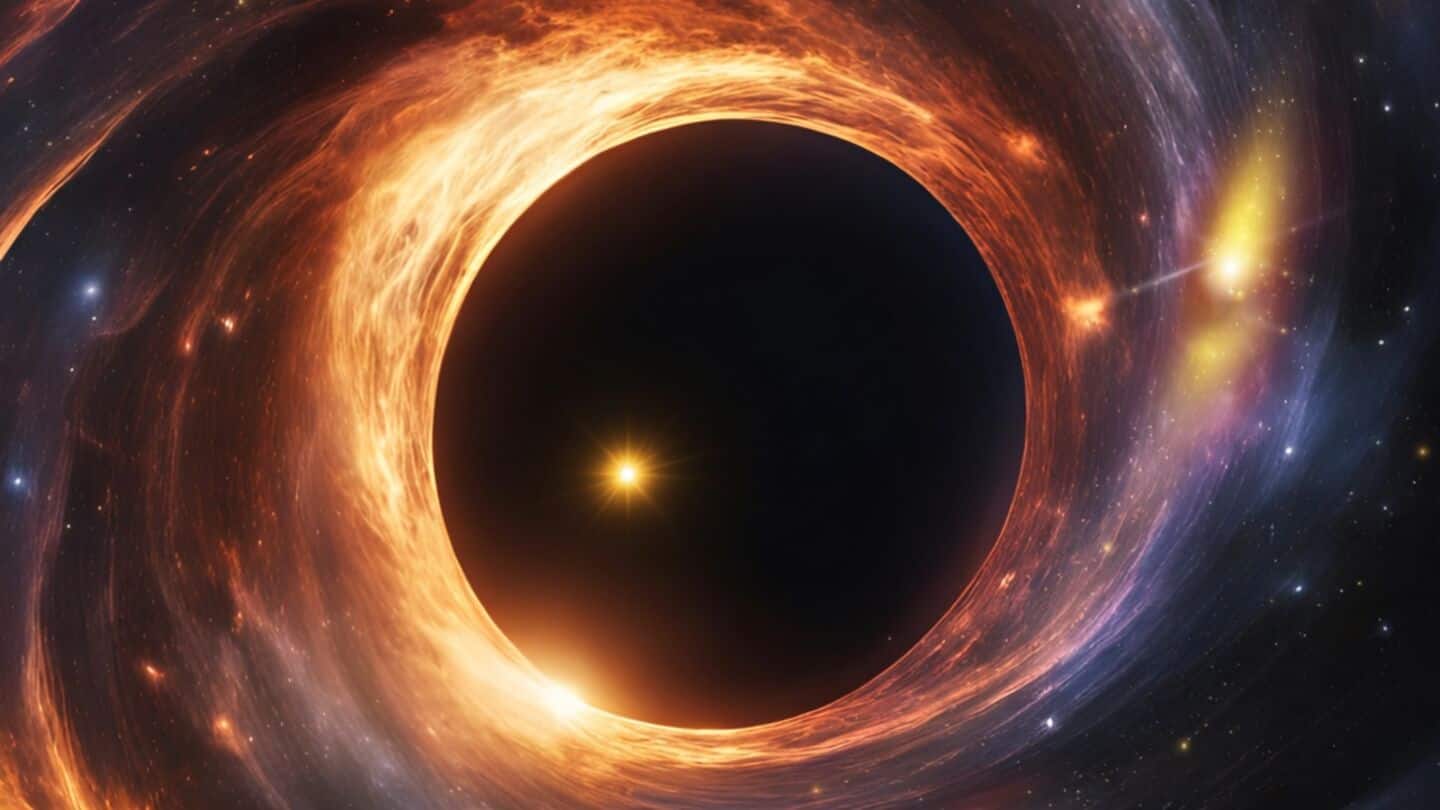
Blazar OP 313 is a body powered by a supermassive black hole, situated in an active galactic nucleus (AGN).
Its immense gravity causes the surrounding material to glow brightly, making AGNs brighter than all stars in their host galaxies.
The blazar's twin jets of plasma, emitted at nearly light speed from the black hole's poles, are directed straight toward Earth.
Particle accelerator
Blazar OP 313 was discovered in December 2023
The blazar OP 313 was first observed in December 2023 when it emitted a powerful burst of high-energy gamma-rays.
These rays were found to be coming from some eight billion light-years away, providing insight into how the supermassive black hole at its center acts as a cosmic particle accelerator.
As these gamma rays traveled through space, they interacted with the extragalactic background light (EBL), the cumulative radiation from all stars, galaxies, and AGNs throughout cosmic history.
Pair production
Discovery could advance understanding of quasars
When gamma rays interact with the EBL, they produce electron-positron pairs through a process called pair production. This reduces the number of gamma-ray photons in the signal.
The team used LST-1 and MAGIC to characterize this depletion, revealing that the intense gamma-ray emission was fueled by a dense population of 'relativistic' electrons accelerated by OP 313's central supermassive black hole.
These findings could significantly advance our understanding of quasars, some of the most powerful cosmic events ever detected by humanity.