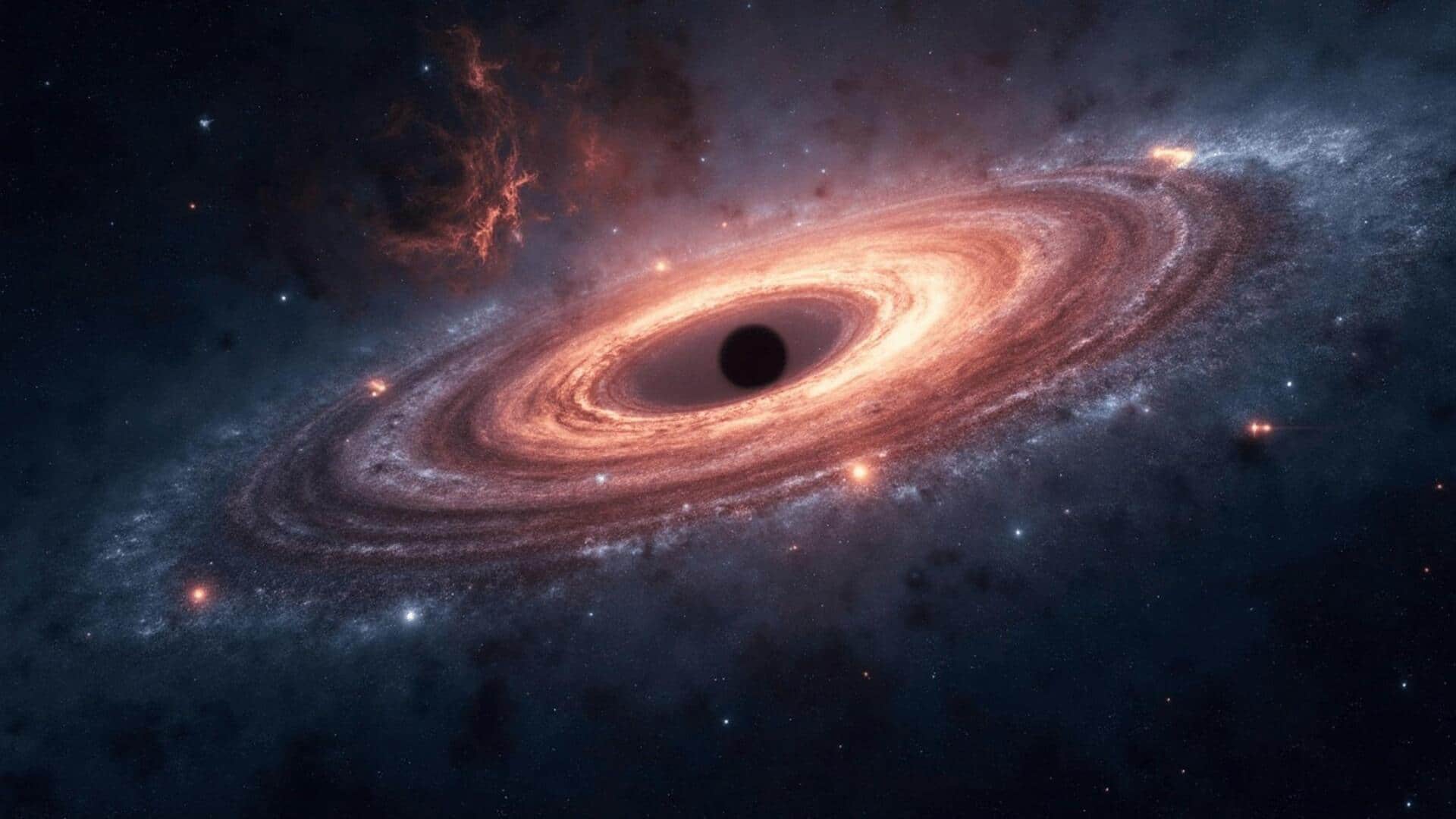
Is wind blowing from our Milky Way's black hole?
What's the story
After a 50-year-long quest, astronomers have finally found evidence of powerful winds emanating from Sagittarius A* (Sgr A*), the supermassive black hole at the center of our galaxy. The discovery sheds light on the physical processes occurring around supermassive black holes and within the heart of the Milky Way. The team was led by Mark Gorski and Lena Murchikova from Northwestern University.
Unsolved puzzle
What are black hole winds?
The concept of "black hole winds" stems from the idea that black holes generate energy by consuming matter, which then pushes material away.
This phenomenon has been observed in other actively feeding black holes, but not in Sgr A* till now, which consumes gas and dust at an incredibly slow rate.
The team used five years of data from the Atacama Large Millimeter/Submillimeter Array (ALMA) to study this wind.
Significant finding
First view of the imprint of a black hole wind
The team has now provided the first clear view of the imprint of a black hole wind.
"With new observations, this is the first time we've had a clean enough view to see the wind's imprint," said Gorski.
The evidence came in the form of a three-light-year-long cone-shaped cavity in a cloud of cold gas surrounding Sgr A*.
Wind impact
Hotter gas could either push or heat up cold gas
The cavity in the cold gas cloud is believed to have been created by hotter gas from a black hole wind. This could either push the cold gas ahead or heat it up.
"If you blow hot material from the black hole, it's not going to want to exist with the cold material," Gorski explained.
Stellar influence
Team ruled out stellar winds from nearby stars
The team also ruled out stellar winds from nearby stars as a possible cause for the cavity.
"It's a huge absence of material. We calculated how much energy was needed to create this cavity. It is more than can be provided by the stars in that area," Gorski explained.
This further supports their theory of a supermassive black hole's influence in shaping this feature.