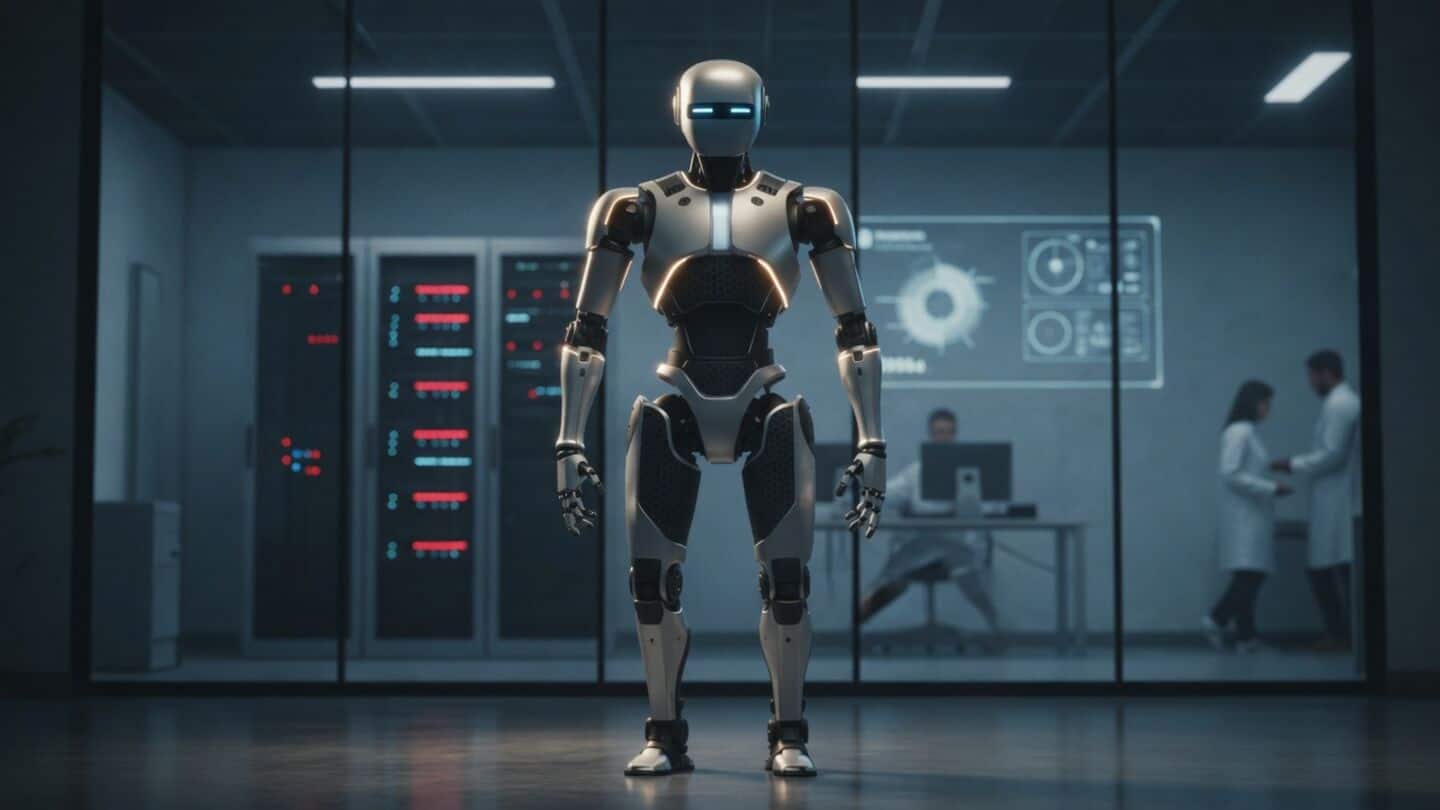
A 'ChatGPT moment' for robot brains is coming in 2027
What's the story
ACE Robotics, a Chinese start-up focused on embodied artificial intelligence (AI), has predicted a major breakthrough in humanoid robot brains by the end of 2027. ACE Robotics Chairman Wang Xiaogang said this development would be similar to the "ChatGPT moment" in AI usage. He made these comments while speaking to Reuters.
Technological advancement
Wang's predictions on embodied AI breakthrough
Wang said the expected breakthrough in embodied intelligence would be driven by "world models and environmental data capture."
However, he also noted that even if this inflection point is reached by late 2027, it could take another four to five years for widespread commercial adoption of these models across different sectors.
AI evolution
Understanding embodied AI models
Embodied AI models are critical to determining the intelligence and autonomous operation abilities of robots.
These physical simulation systems are different from large language models as they are specifically designed to help robots understand and navigate real-world environments in real time.
However, a major challenge remains: acquiring high-quality real-life training data for these models.
Company growth
ACE Robotics's rapid growth and future plans
Founded in July 2025, ACE Robotics has raised over $100 million in the first half of this year through several financing rounds.
The company plans to launch an initial public offering (IPO) "as early as permitted."
Its open-source Kairos-4B model is already ranked first globally by public benchmarks, outperforming world models such as NVIDIA's Cosmos 3 and Ant Group's Lingbot.
Strategic moves
Plans for commercial deployment of embodied AI models
ACE Robotics is ramping up its data collection by using people on real production lines fitted with lightweight sensors.
The company plans to deploy its embodied AI models in commercial settings such as unmanned retail stores, hotel services, and instant-delivery warehouses.
"We plan to deploy in at least 1,000 stores over the coming year, scaling to 10,000 stores in two years," Wang said.