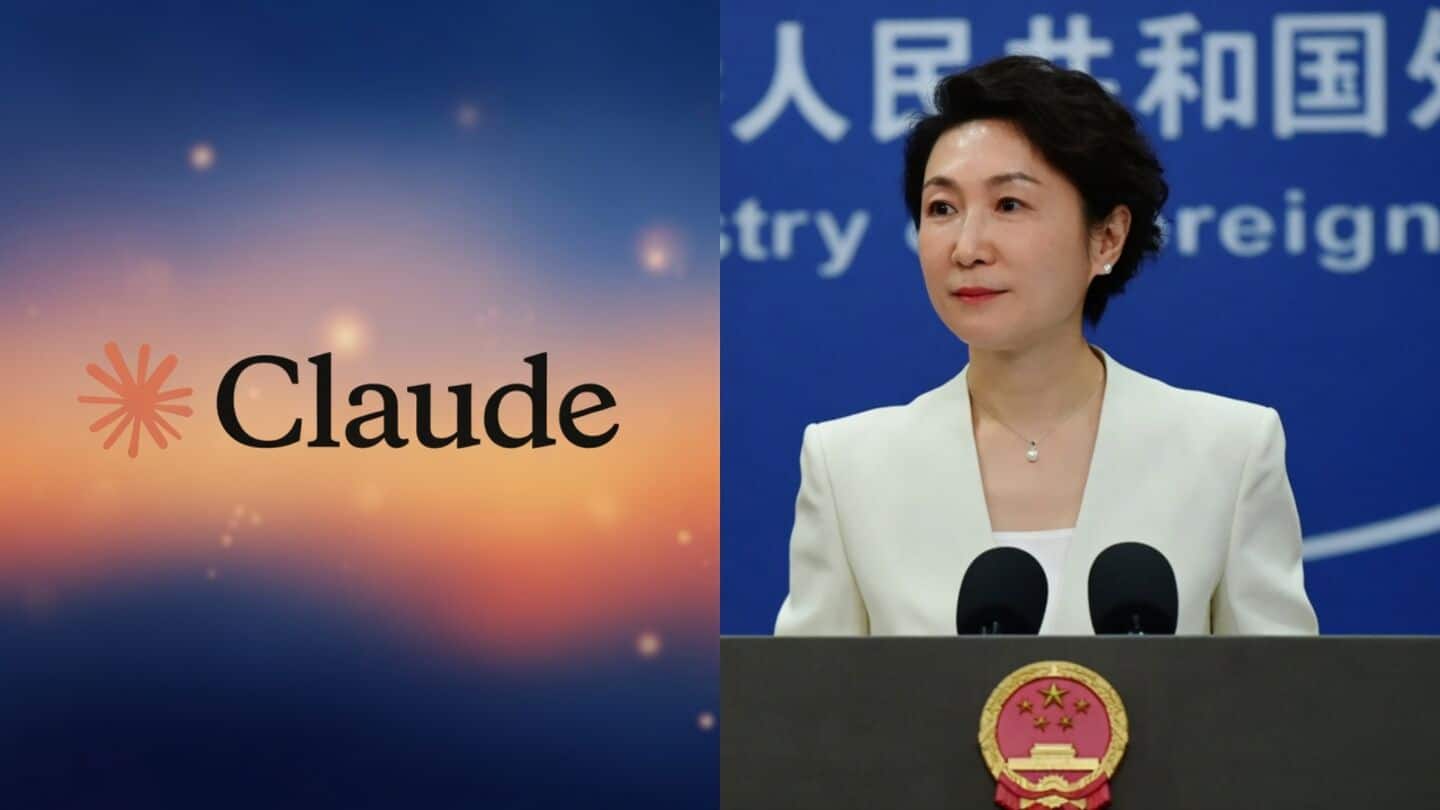
China rejects Anthropic's claims of AI labs extracting Claude data
What's the story
China has denied the allegations made by US-based artificial intelligence (AI) company Anthropic. The latter had claimed that several Chinese AI labs, including DeepSeek, Alibaba, and Moonshot AI, were involved in large-scale efforts to extract responses from its Claude models. The responses were allegedly used to train their own systems. China's foreign ministry spokesperson Mao Ning rejected the claims and accused Anthropic of "distorting facts."
Distillation controversy
Anthropic accused Chinese companies of 'illicit distillation' campaigns
Anthropic's threat intelligence report had accused several China-based AI companies of conducting "illicit distillation" campaigns against Claude.
Distillation is a common AI training technique where a less powerful model learns from the outputs of a more capable one.
However, Anthropic alleged that Chinese AI labs went further by using networks of accounts to systematically send prompts to Claude and collect its responses for their own model improvements.
Distillation details
Alibaba allegedly conducted the largest distillation campaign
The report claimed Alibaba was involved in the largest distillation campaign Anthropic had measured, with over 151 million exchanges with Claude between May and July.
The activity peaked at nearly three million exchanges a day and involved more than 3,500 accounts that Anthropic described as fraudulent.
According to the report, some of these exchanges contained sensitive information belonging to individual users, multinational companies, and state-affiliated organizations.
Further allegations
Moonshot AI, DeepSeek, and Xiaomi also named in the report
Anthropic also accused Beijing-based Moonshot AI of secretly routing Kimi users' requests to Claude and using some exchanges to train its models.
The company relayed nearly 300,000 requests through 5,380 accounts in 10 days and over 23 million exchanges between May and July.
DeepSeek was accused of similar tactics with more than 12 million distillation attacks over two weeks in July.
Interestingly, consumer electronics-focused Xiaomi was also named in the report.