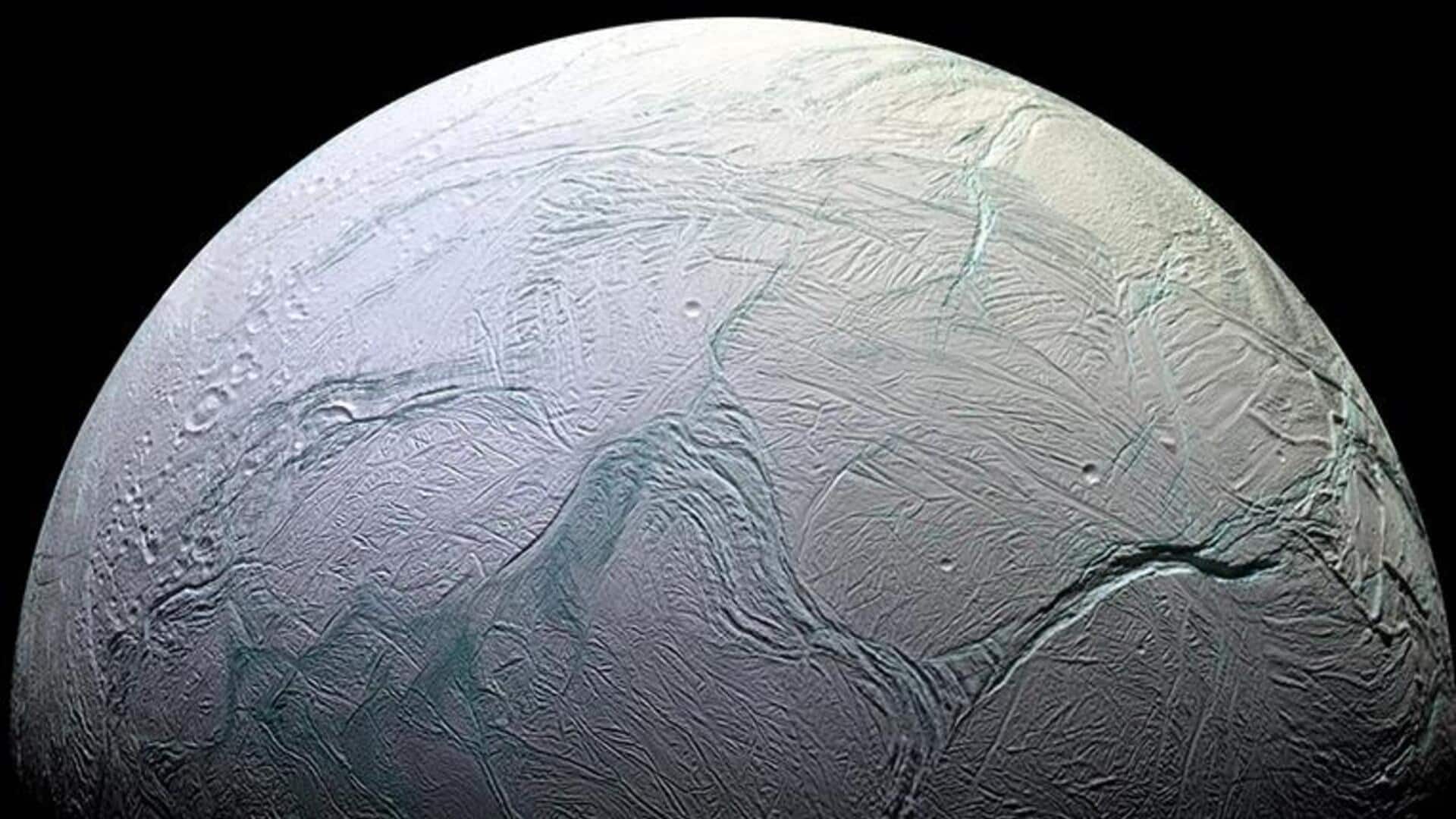
Does life exist on Saturn's moon Enceladus?
What's the story
In a major breakthrough, scientists have discovered that certain Earth-based microbes can withstand the extreme conditions of the ocean hidden beneath Enceladus's icy surface. The finding strengthens the possibility of life existing on this distant moon of Saturn. The research was by William Orsi, a geomicrobiology professor at Ludwig-Maximilian University in Munich.
Survival study
Methane-producing microbes were used in the study
The microbes, which thrive near hydrothermal vents on the seafloor by converting hydrogen and carbon dioxide into methane, survived in a brine that mimicked the Saturnian moon's ocean.
"If we use the cellular definition of life that we understand on Earth today, the experiments tell us that if this organism, or something similar to it, was on Enceladus, there's a good chance it could survive," Orsi said.
Moon's profile
Robotic spacecraft revealed secrets of Enceladus
Saturn has more moons than any other planet in the solar system, with nearly 300 known to orbit the gas giant.
For over 200 years, Enceladus, a 300-mile-wide ice ball, seemed unremarkable. But robotic spacecraft changed that perception.
NASA's Cassini probe and the James Webb Space Telescope have spotted massive plumes of water vapor and ice grains erupting from Enceladus as well as signs of a vast saltwater ocean beneath its frozen shell.
Organic discovery
Organic substances found on Enceladus last year
Last year, scientists found organic substances in samples collected by Cassini as it passed through one of Enceladus's spectacular plumes.
This discovery further piqued scientists' interest in the moon as a potential host for life.
Orsi and his team sought to recreate a miniature version of Enceladus's ocean in the lab by mixing water with salts and carbonates and powdered rock, successfully replicating both its highly alkaline conditions and key rock-water reactions.
Microbial resilience
Methanogens thrived in lab-created ocean
The lab-created ocean was found to be active enough to produce hydrogen, a process believed to occur in Enceladus's ocean.
This led the researchers to wonder if Earthly microbes called methanogens could survive in this solution.
The team tested these methanogens from deep-sea hydrothermal vents between Japan and Taiwan.
To their surprise, the microbes thrived even when the pH of the simulated ocean hit 11, far more alkaline than what they were used to on Earth.
Space exploration
Future space missions to Enceladus could detect signs of life
The research opens up exciting possibilities for future space missions to Enceladus.
Frank Postberg, a planetary sciences professor at the Free University of Berlin, suggested that if ocean droplets contained bits of alien microbes, these might turn up in a small fraction of ice particles but be highly concentrated within them.
This would make detecting signs of life relatively easy with today's technology.