Google just launched its most accurate AI weather model
What's the story
Google has unveiled its latest artificial intelligence (AI) model for weather forecasting, WeatherNext 3. The new system provides a clearer view of our changing atmosphere and more frequent predictions. It is part of a broader shift in meteorology, powered by deep learning techniques. Google plans to integrate this model into its search engine, Google Maps, and Gemini services.
Performance
Outperforming other models in tests
WeatherNext 3 has already outperformed its competitors in the Operational WeatherBench test, a tool developed by Brightband to compare AI forecasts.
It beats other deep-learning models from Microsoft, NVIDIA, and the European Center for Medium-Range Weather Forecasting.
The new model also outperforms traditional forecasts from the US National Weather Service and ECMWF.
Improvements
Addressing the shortcomings of AI forecasting models
AI forecasting models have been criticized for their wide area forecasts (15-25 square km), poor rain predictions, and reliance on formatted data sets from government agencies.
WeatherNext 3 tackles all three issues. It can predict down to a resolution of 5km, has improved rain evaluations by 60% over its predecessor WeatherNext 2, and can now produce hourly forecasts instead of the standard six-hour interval predictions.
Design upgrades
Design choices and tweaks for better forecasts
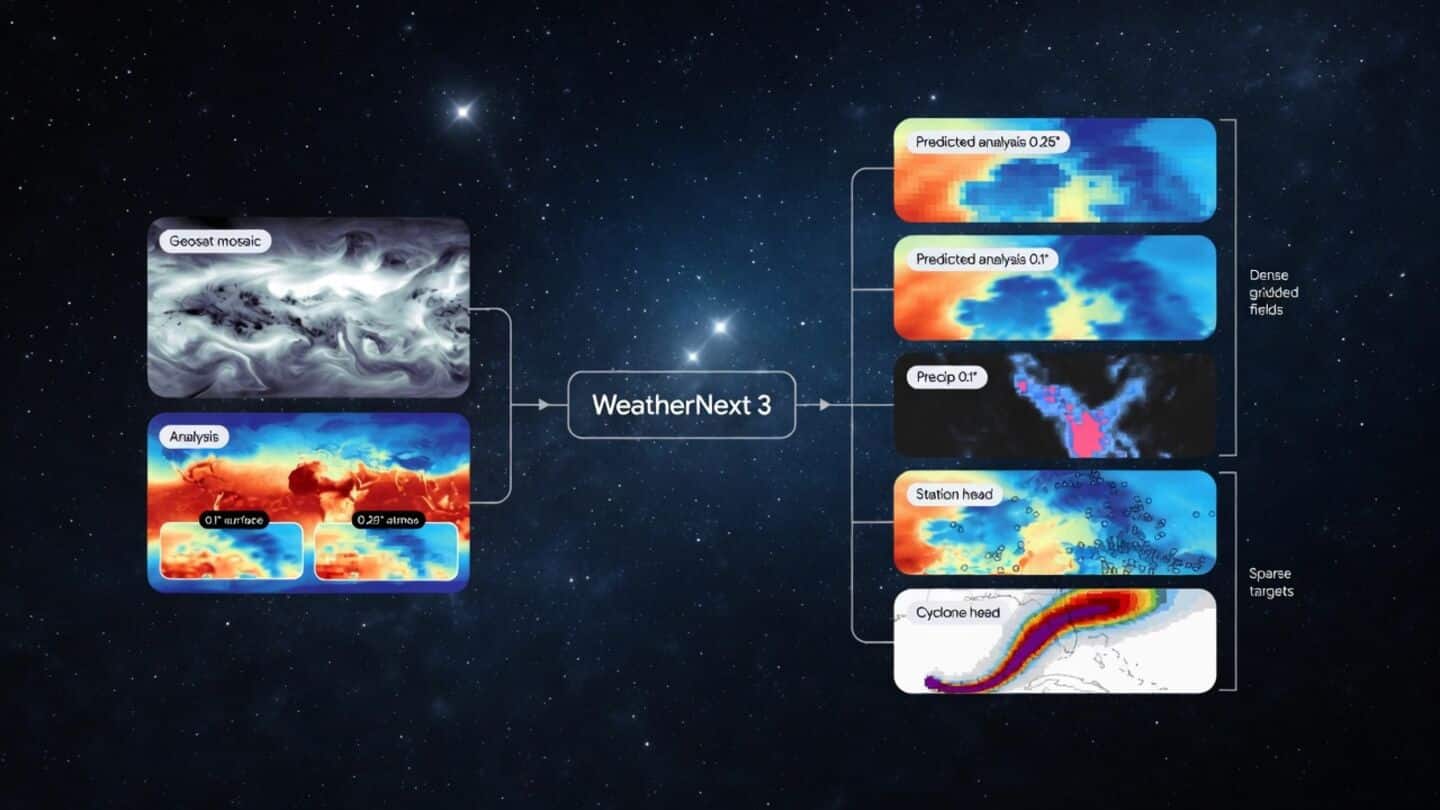
The improvements in WeatherNext 3 are due to specific design choices. The model is larger, with 2.4 times more parameters than its predecessor, and has been fine-tuned for more useful answers.
DeepMind researchers have also tweaked the model to visualize cyclone paths.
The new system has been trained to target forecasts at specific weather data stations for more granular predictions and evaluation against ground-truth data.
Data integration
Incorporating real-time satellite data for improved accuracy
WeatherNext 3 can ingest real-time weather satellite data on an hourly basis, enabling more frequent forecasts.
This is a major step forward as feeding AI models on raw empirical observations promises a more accurate forecast.
Google claims WeatherNext 3 is the "first" AI model to directly incorporate raw observations for high-resolution global forecasts.