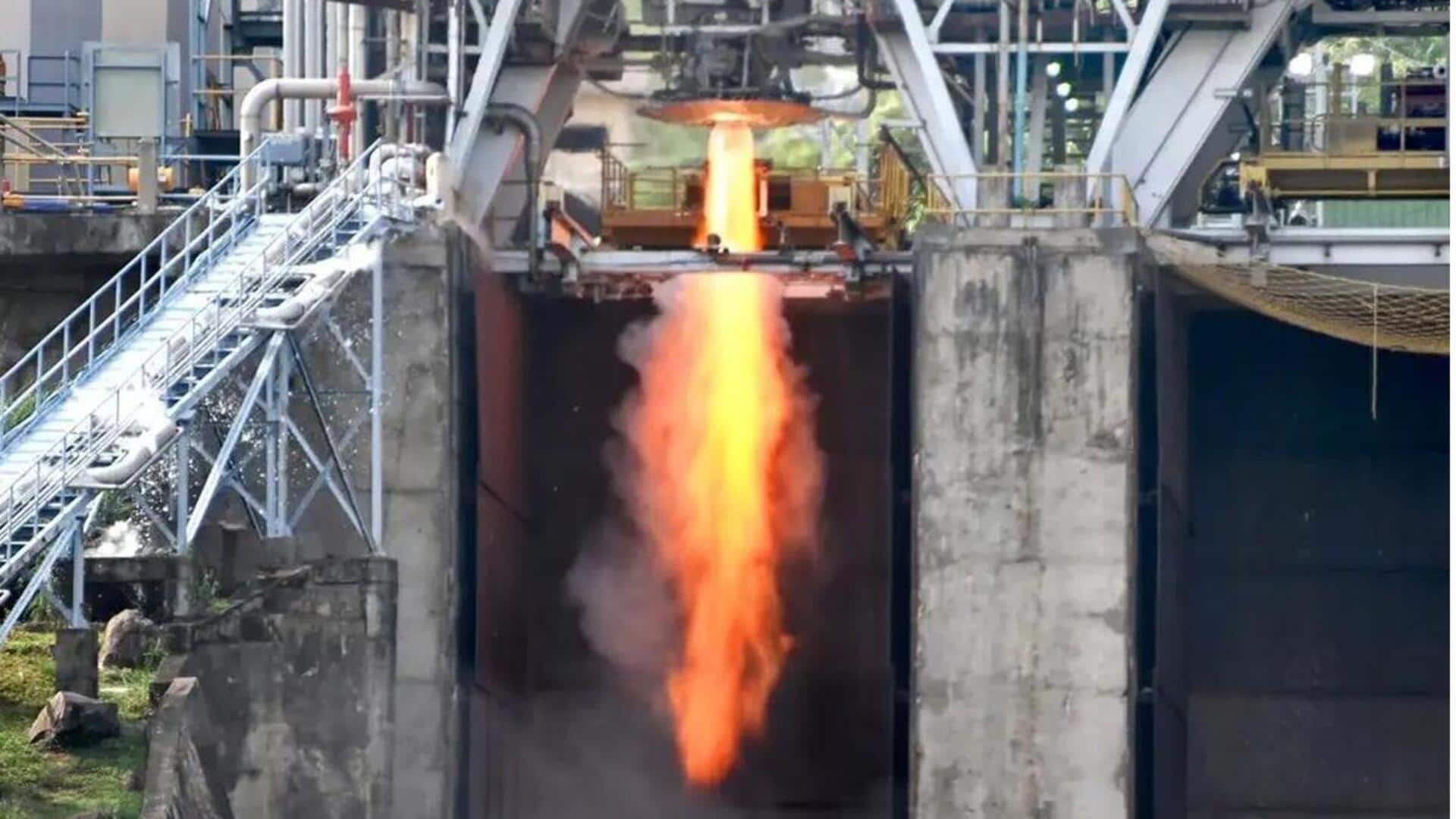
ISRO conducts successful hot test of CE20 cryogenic engine
What's the story
The Indian Space Research Organisation (ISRO) has successfully conducted a hot test of its advanced CE20 cryogenic engine at the ISRO Propulsion Complex in Mahendragiri, Tamil Nadu. The test lasted for nearly three minutes and generated an impressive thrust of 22 tons. This achievement is a significant milestone in India's space capabilities and will enhance the payload capacity of the LVM3 rocket for future missions like Gaganyaan.
Engine details
Engine used in India's historic Moon mission
The CE20 cryogenic engine is an integral part of the upper stage of the Launch Vehicle Mark 3 (LVM3) rocket. It has played a vital role in launching deep-space missions and heavy satellites.
Notably, it was used in the historic Chandrayaan-3 mission that successfully landed near the Moon's south pole in 2023.
The successful test of this advanced engine is expected to boost India's long-term plans for deep space exploration and upcoming lunar missions.
Test features
Test validated advanced systems integrated into upgraded engine
The successful test of the CE20 engine also validated other advanced systems integrated into the upgraded engine.
These include a multi-element igniter, which ensures ignition of the cryogenic fuel mixture, and a nozzle protection system that safeguards the engine from high temperatures.
The test closely monitored various parameters such as combustion stability, thrust generation, and fuel flow to ensure optimal performance under simulated launch conditions.
Mission impact
Boost for Gaganyaan mission
The successful hot test of the CE20 engine is a major step toward India's future space missions.
The enhanced engine will be the backbone of some of these missions, including the Gaganyaan mission that aims to send Indian astronauts into low-Earth orbit.
With this successful trial, ISRO is now better equipped to carry heavy payloads such as crew modules and satellites, further strengthening India's position in global space exploration activities.