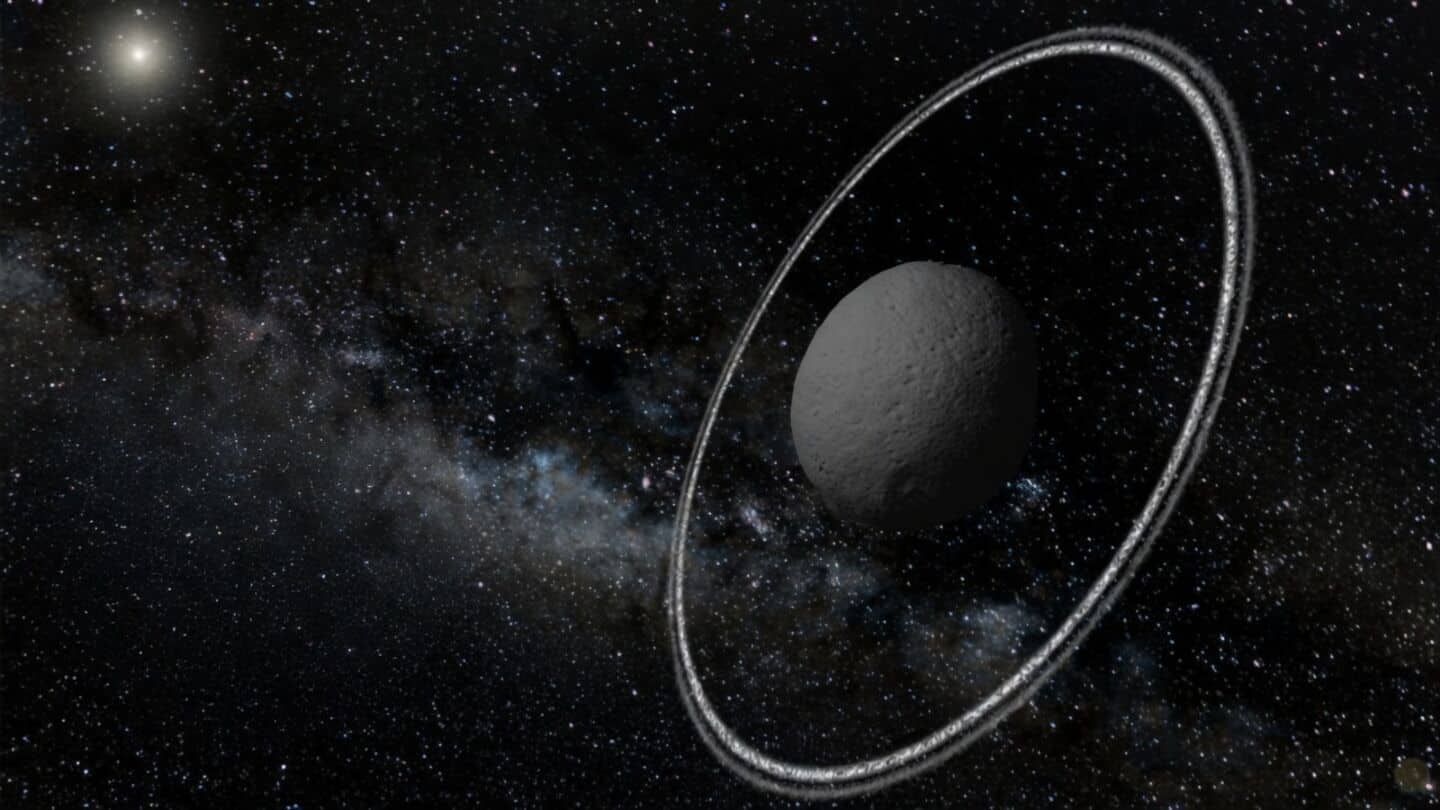
Rings of this tiny solar system body are changing
What's the story
The James Webb Space Telescope (JWST) has detected some unexpected changes in the ring system of Chariklo, a small celestial body in our solar system. The discovery was made by a team of researchers from the Institute of Astrophysics of Andalusia (IAA-CSIC). They started observing Chariklo with JWST in October 2022, using a technique called stellar occultation to measure changes in light when an object passes in front of a star.
Ring dynamics
Chariklo's rings changing in unexpected ways
Chariklo, a member of the Centaur family of asteroids, is located between Saturn and Uranus at a distance of about 17 times that from Earth to Sun.
Despite being only 250km wide, it has two thick rings.
The JWST observations revealed that these rings are changing in unexpected ways.
The inner ring is now more opaque while the outer one is less so, suggesting more complex physics than previously thought for this small body.
Ring evolution
Rethinking our understanding of ring systems
The changes in Chariklo's rings challenge the previous understanding of small bodies having relatively stable rings.
"Our results force us to rethink how they form, how they evolve, and what mechanisms maintain their stability," said team leader Pablo Santos-Sanz.
The research also opens a new avenue for studying the evolution of these systems and possibly other ring systems in the solar system.
Observation accuracy
A new frontier for JWST
The research marks a major milestone for the JWST, as it required precise knowledge of Chariklo's orbit, the star's position, and JWST's own trajectory around L2 Lagrange point.
"Achieving this required knowing with extraordinary precision the orbit of Chariklo, the position of the star, thanks to the European Space Agency's Gaia mission," said team member Yucel Kilic.
The occultation study allowed unprecedented detail in resolving Chariklo's rings despite even JWST being unable to directly image this small and distant asteroid.