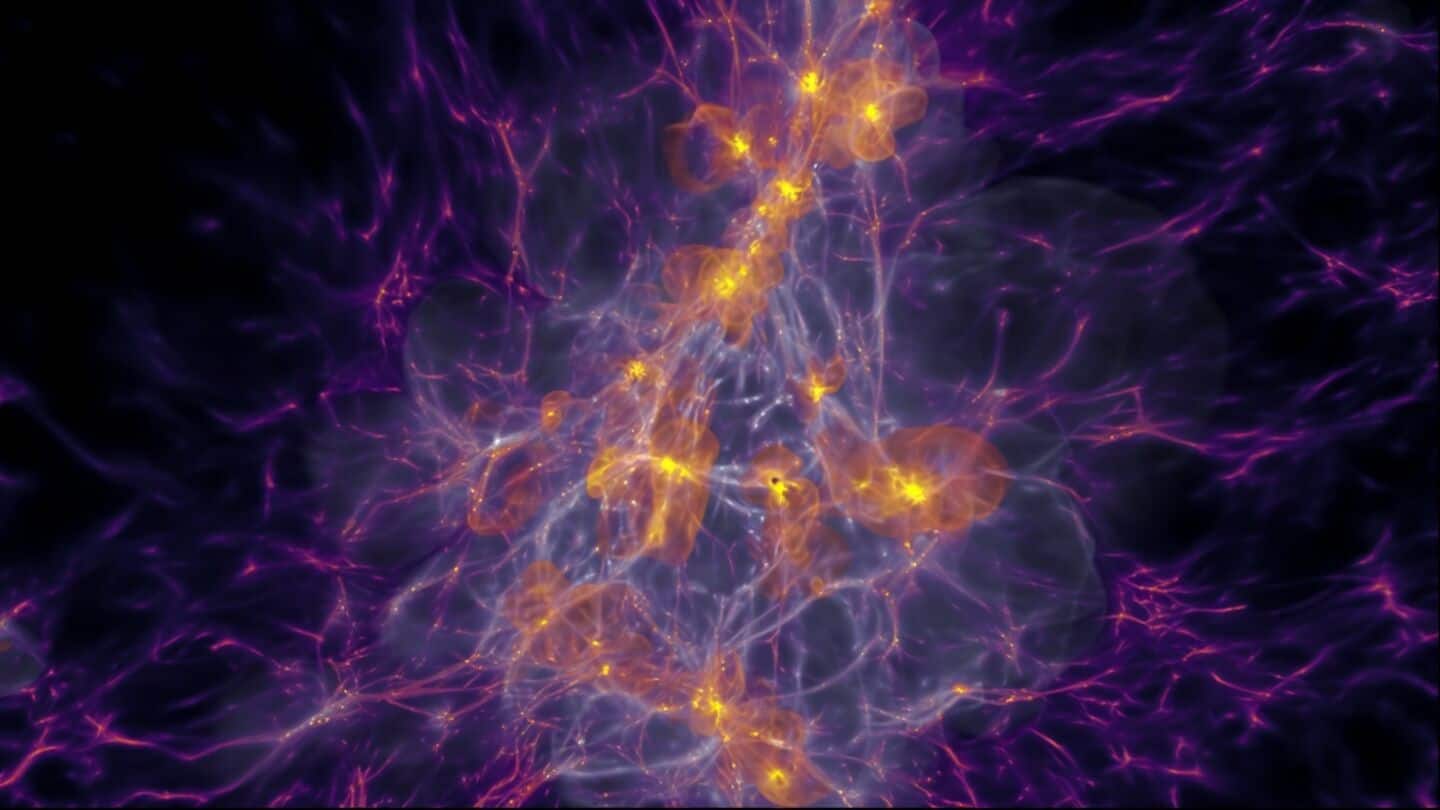
This simulation is improving our understanding of the first stars
What's the story
The MEGATRON simulation, the most detailed simulation to date of the early universe, is revolutionizing our understanding of the first stars. Launched in 2023 and running until 2030, this project uses data from the James Webb Space Telescope (JWST) to merge state-of-the-art cosmological simulations with complex models of radiation, chemistry, and galaxy formation. It helps researchers explore how Population III (POP III) stars illuminated the cosmic dark ages.
Stellar evolution
What are POP III stars?
POP III stars, primarily made up of hydrogen and helium, were the first stars to form in the universe's infancy.
These stars created heavier elements during their lifetimes, which astronomers refer to as metals.
When they died in supernova explosions, these POP III stars scattered elements like nitrogen, carbon, and oxygen into space.
These elements eventually became the building blocks for future generations of stars and planets, and possibly even life itself.
Simulation insights
Connecting the dots
Martin Rey from the University of Bath's Department of Physics emphasized the importance of understanding how these first stars formed and enriched their surroundings with elements.
He said, "MEGATRON allows us to test these ideas directly by comparing detailed simulations with observations from JWST and the chemical fingerprints preserved in ancient stars."
The initial results show how starlight, gas, and newly forged elements interact to connect JWST data on early galaxies with chemical fingerprints found in ancient Milky Way stars.
Cosmic evolution
Simulation's findings
The simulation tracked the evolution of a young galaxy that could become something like the Milky Way, starting with pristine hydrogen and helium gas.
It showed how stars shape the gas in and around galaxies over billions of years.
The findings suggest some cosmological models may underestimate the importance of starlight, radiation, and chemical changes in gas around galaxies to cosmic evolution.
Research continuity
Future of research
The team plans to continue using MEGATRON to strengthen the connection between astronomical observations and theory.
This will be crucial as JWST continues to reshape our understanding of early galaxies, and large-scale astronomical surveys provide more detailed information about ancient stars in our cosmic backyard.
Rey concluded that "MEGATRON provides a common physical framework for interpreting two of astronomy's most exciting new datasets: JWST's view of the earliest galaxies and the stellar fossil record."