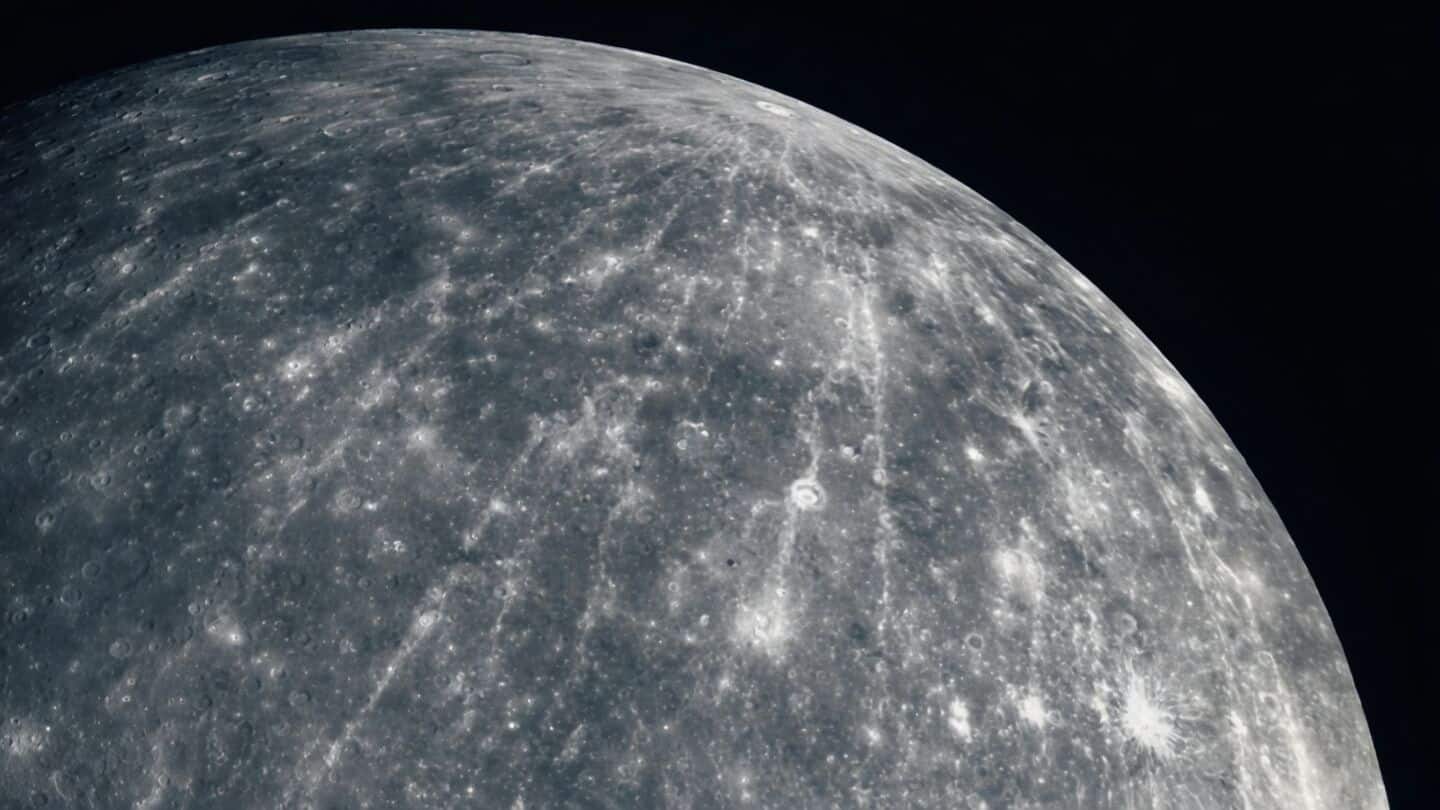
The smallest planet in our solar system is shrinking
What's the story
Mercury, the smallest planet in our solar system and the closest to the Sun, appears to be shrinking. The telltale wrinkles on its surface suggest that it was once a larger world. A new study published in Geophysical Research Letters indicates that Mercury may be shrinking more than scientists previously thought. This discovery could provide insights into the planet's evolution and reveal secrets about its mysterious interior.
Planetary origins
Why does Mercury have surface cracks?
Mercury was formed from gas and dust about 4.5 billion years ago.
The early solar system was a violent place, with many space rocks orbiting the Sun crashing into one another.
These collisions generated more heat, causing newly formed planets like Mercury to shrink over time as they lost their internal heat.
This process has left behind cracks on Mercury's surface, known as ridges and cliffs shortening structures.
Planetary scars
Impact craters and their role in understanding shrinkage
Like Earth's Moon, Mercury has also been hit by asteroids and comets, leaving behind impact craters. These scars are a testament to the planet's tumultuous history.
The debris from these impacts may have concealed the extent of Mercury's contraction over time.
The new study highlights this possibility, emphasizing that understanding Mercury's shrink rate can provide valuable insights into its evolution and interior structure.
Space probes
Missions to Mercury
Mercury's proximity to the Sun has made it difficult to study. Only two missions have visited this harsh world: NASA's Mariner 10 in 1974 and MESSENGER in 2011.
Mariner 10 discovered Mercury's surface wrinkles, while MESSENGER provided a more comprehensive view of the planet.
The new study used data from MESSENGER to create a global map of Mercury's surface roughness, revealing fewer wrinkles in rougher areas compared to smoother ones.
Shrinkage estimation
How much has Mercury shrunk?
The study estimated that Mercury may have shrunk by 10% to 30% more than previously thought, with a radius change of about 11.59km.
Earlier studies had estimated a radius change of between 0.6 to 1.93km and up to 6.92km.
The findings suggest that previous studies may have missed geological cracks on the planet due to their difficulty in rough areas or because they hadn't formed at all due to Mercury's rugged crust.
Core revelations
What does it mean for the planet's core?
Understanding how much Mercury has shrunk could provide insights into its core and what has happened inside as it cooled.
More shrinkage could mean a larger metal core, less light elements like silicon mixed into the metal core, or a higher starting temperature.
The BepiColombo mission, which recently began its arrival at Mercury after traveling for nearly eight years, will place two orbiters around the planet by year's end.