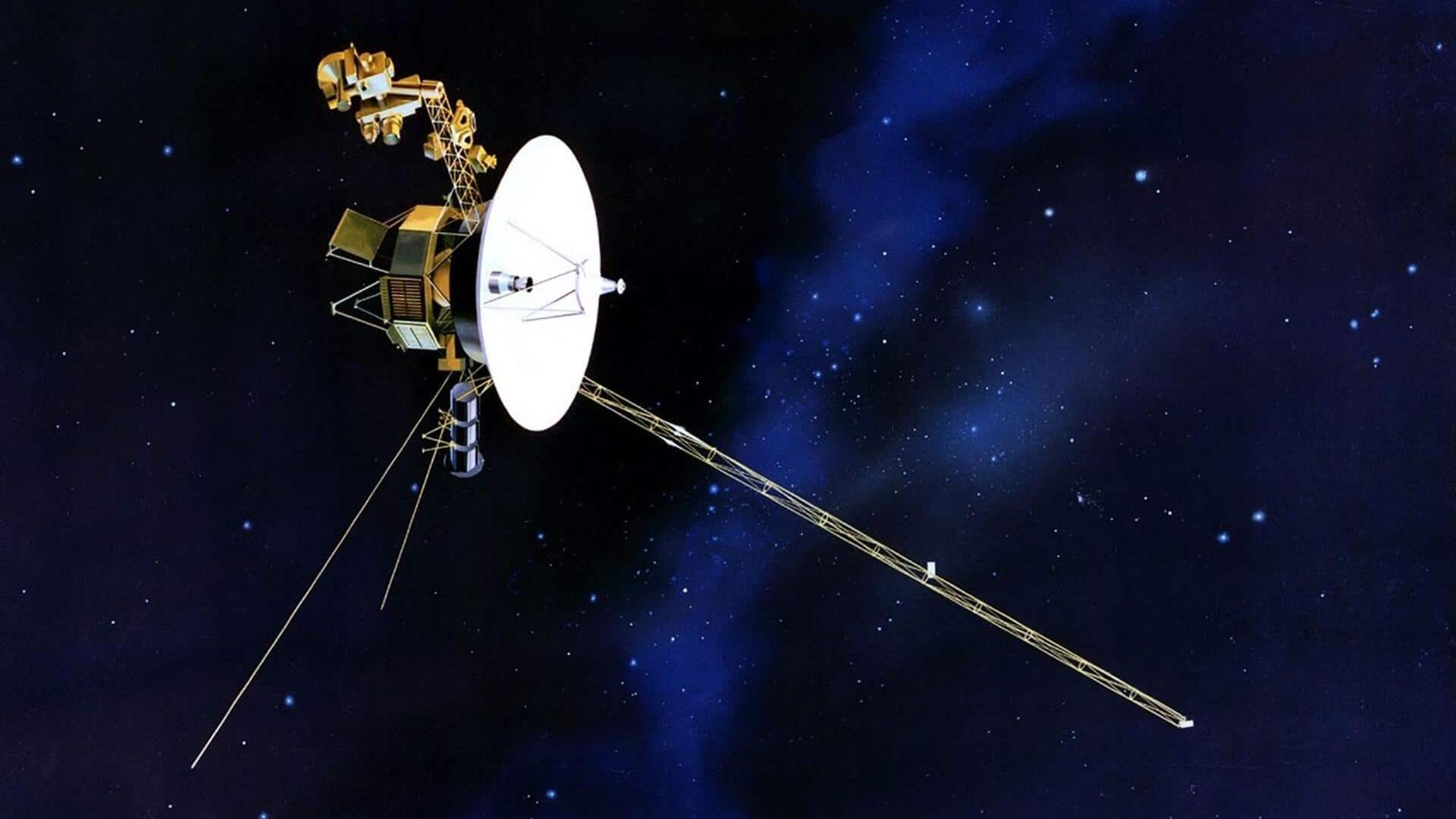
NASA's 48-year-old Voyager 2 probe to function for another year
What's the story
NASA has successfully extended the operational life of its Voyager 2 spacecraft by another year. The team achieved this by making a major adjustment, dubbed the "Big Bang," to the probe's power consumption. Launched in 1977 along with its twin Voyager 1, both probes are powered by a radioisotope thermoelectric generator that uses heat from plutonium decay. Their plutonium supply depletes at a rate of about four watts per year on each spacecraft.
Power conservation
How NASA pulled off this feat
To keep Voyager 2 running on its dwindling power supply, engineers have taken some drastic measures.
They have turned off a few non-science devices and employed "lower-power alternatives" that are still effective enough to keep the spacecraft warm in the far reaches of space.
"The spacecraft power margins have grown razor thin, requiring the team to conserve energy by shutting off non-essential devices and systems," NASA officials wrote.
Instrument shutdown
Instruments shut down to save power
The power reduction has had a noticeable impact on the science operations of both Voyager spacecraft.
Each probe has shut down two of its science instruments since 2024. While some were deactivated after their historic planetary flybys decades ago, others were turned off due to power constraints.
Voyager 2, which started with 10 instruments, now only has three left operational.
Extended operation
All 3 instruments will keep operating
Initially, it appeared that Voyager 2 would have to shut down another one of its three remaining instruments later this year.
However, the new power shifts will enable all three to operate "for at least another year," NASA said.
The same "Big Bang" power change will be implemented on Voyager 1 in the coming months.
A signal takes nearly 24 hours (or one light-day) to reach each spacecraft due to their distance from Earth.
Mission legacy
Journey of the 2 Voyager spacecraft
The two Voyager spacecraft were launched to explore the outer solar system gas giants: Jupiter, Saturn, Uranus, and Neptune.
They have sent back unprecedented images of these planets and their moons.
Voyager 1 entered interstellar space in 2012 while Voyager 2 followed suit in 2018.
Currently, Voyager 1 is Earth's most distant spacecraft at a staggering distance of about 25.5 billion kilometers away from us.