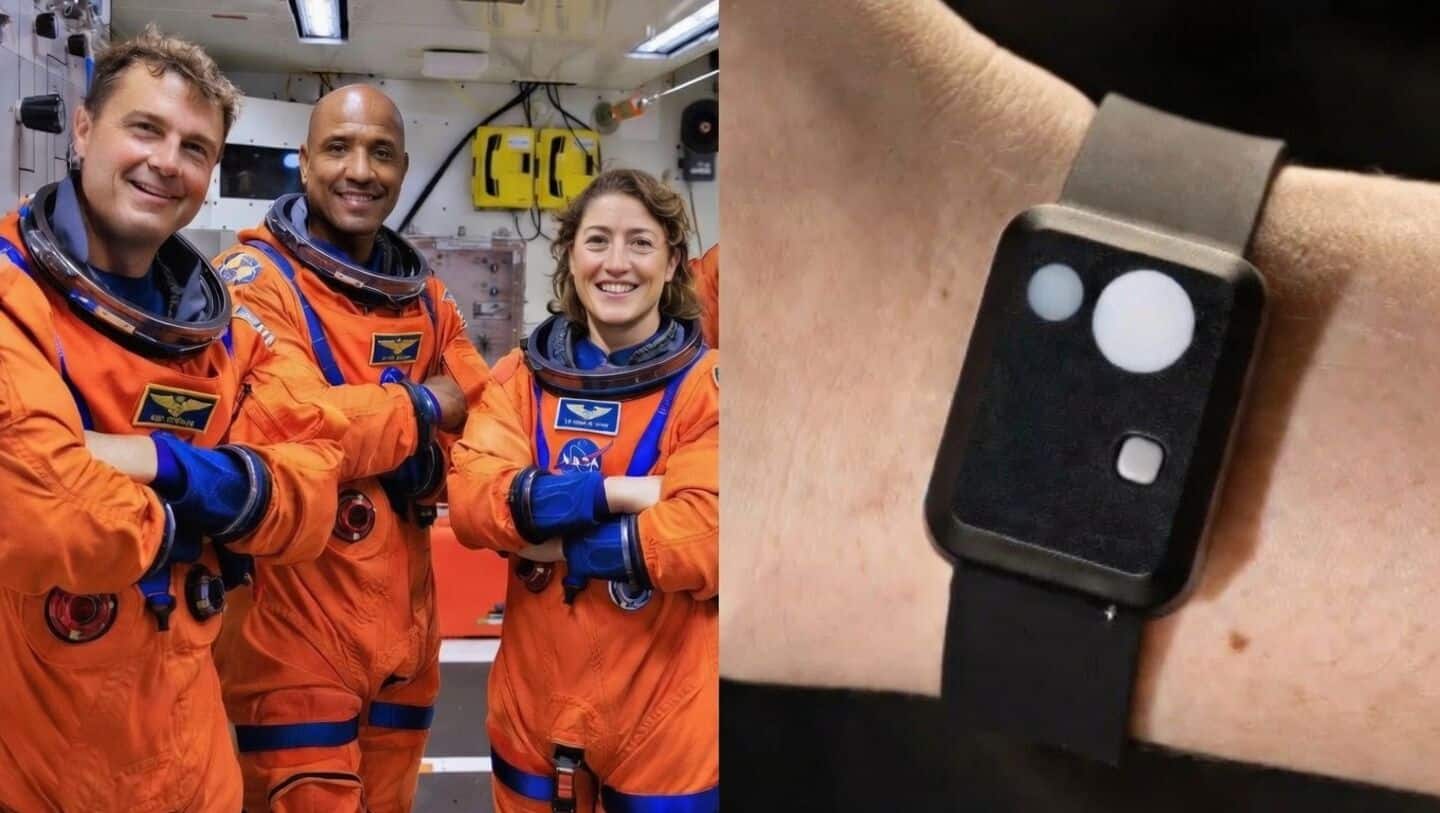
NASA to monitor Artemis II astronauts with this special wristband
What's the story
NASA's upcoming Artemis II mission, scheduled for April 2, 2026, will be a historic milestone in human space exploration. The mission will take four astronauts on a journey to the Moon and back. But this isn't just about flying around the Moon; it's also an opportunity to test new technologies and gather valuable data on human health in space. One such innovation is the use of special wristband monitors by the crew members during their journey.
Research initiative
Wristbands part of NASA study called ARCHeR
The wristbands are part of a NASA study called ARCHeR, which stands for Artemis Research for Crew Health and Readiness. These devices will monitor astronauts' sleep patterns, stress levels, cognitive performance, and teamwork dynamics. By collecting real-time physiological and behavioral data, the study aims to understand how isolation and confinement in deep space affect crew members.
Information gathering
Crew members will wear the monitors during the mission
During the roughly 10-day Artemis II mission, NASA astronauts Reid Wiseman, Victor Glover, Christina Koch, and Canadian Space Agency (CSA) astronaut Jeremy Hansen will wear wrist monitors. These devices will track their movement and sleep patterns among other vital data for NASA's Human Research Program. The study will also collect data on cognition, behavior, and team dynamics before and after the mission.
Space exploration
Research crucial for optimizing human performance for future exploration
Deep-space missions are longer and more psychologically taxing than those in low Earth orbit. This makes research like this crucial for optimizing human performance for future exploration. "Artemis missions will be the farthest NASA astronauts have ventured into space since the Apollo era," said Suzanne Bell, a NASA psychologist leading the investigation. The study will help clarify key mission challenges, how astronauts work as a team and with mission control.
Health tracking
The data collected will help in shaping protocols and interventions
The wristbands will allow crew members and flight controllers in mission control to monitor real-time health and behavioral data for crew safety. This will help scientists study how sleep and activity patterns affect overall health and performance. The results from each mission will be used to understand the combined effect of space hazards on well-being and performance, ultimately shaping protocols, interventions, and technologies for future Moon and Mars missions.