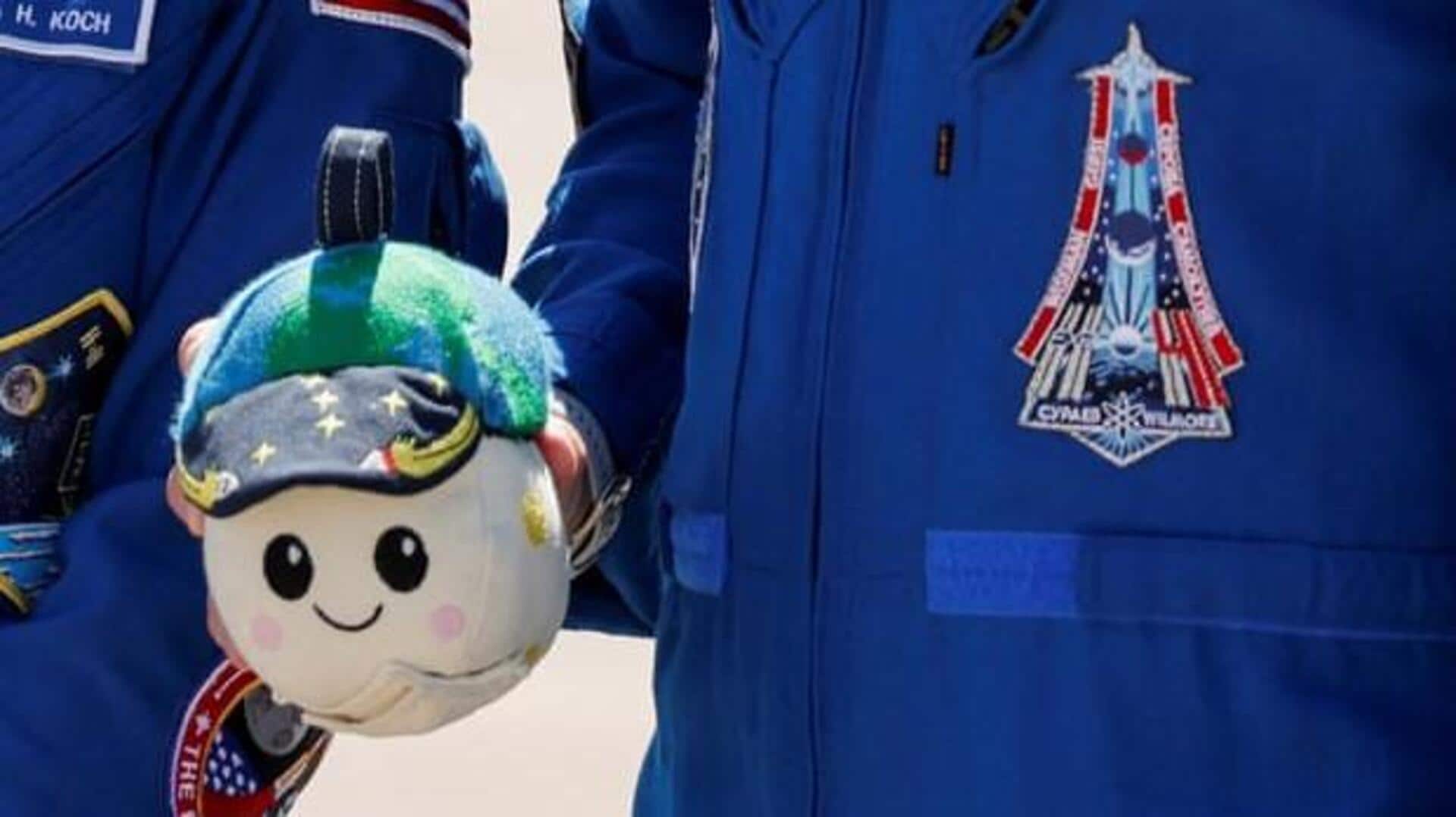
Why NASA's Artemis-II mission is carrying a plushie into space
What's the story
NASA's Artemis II mission, the first manned lunar mission in over half a century, has an unusual passenger - a small white stuffed animal. The brainchild of eight-year-old Lucas Ye from California, the toy is serving as an official zero-G indicator for the crew and Houston's mission control. This unique design aims to engage young minds globally with the Artemis program and inspire future generations to explore space.
Mission
Toy will float inside Orion spacecraft
The white plush toy was chosen through the Moon Mascot design challenge and will represent a new generation of explorers.
NASA's Office of STEM Engagement has found that involving children in designing mission hardware creates a lasting interest in pursuing future careers in space science and engineering.
The toy will float after Orion spacecraft completes its orbital insertion and Trans-Lunar Injection (TLI) phase, providing a visual telemetry cue to the four-member crew that they have crossed Earth's strongest gravitational pull.
Safety protocols
What did NASA say?
The Moon Mascot has undergone extensive quality assurance testing before being launched into space.
NASA says that anything going into the Orion spacecraft must be made from specially engineered materials rated for space applications, meeting the specific requirements for flammability and off-gassing within the closed, pressurized atmospheric environment.
This is to ensure that it is safe for astronauts to breathe aboard the Orion spacecraft and does not adversely affect its gaseous environment during the entire flight.
Design
A look at the plush toy
Lucas's plush toy features a baseball cap with a star-spangled visor and a crown resembling Earth's green-and blue-hued surface.
Some elements of the design pay tribute to the Apollo 11 Moon landing in 1969.
Its name, Rise, is also inspired by the Earthrise photograph taken by Apollo 8 astronaut William Anders in 1968.