NASA's experiment to deflect an asteroid in 2022 was successful
What's the story
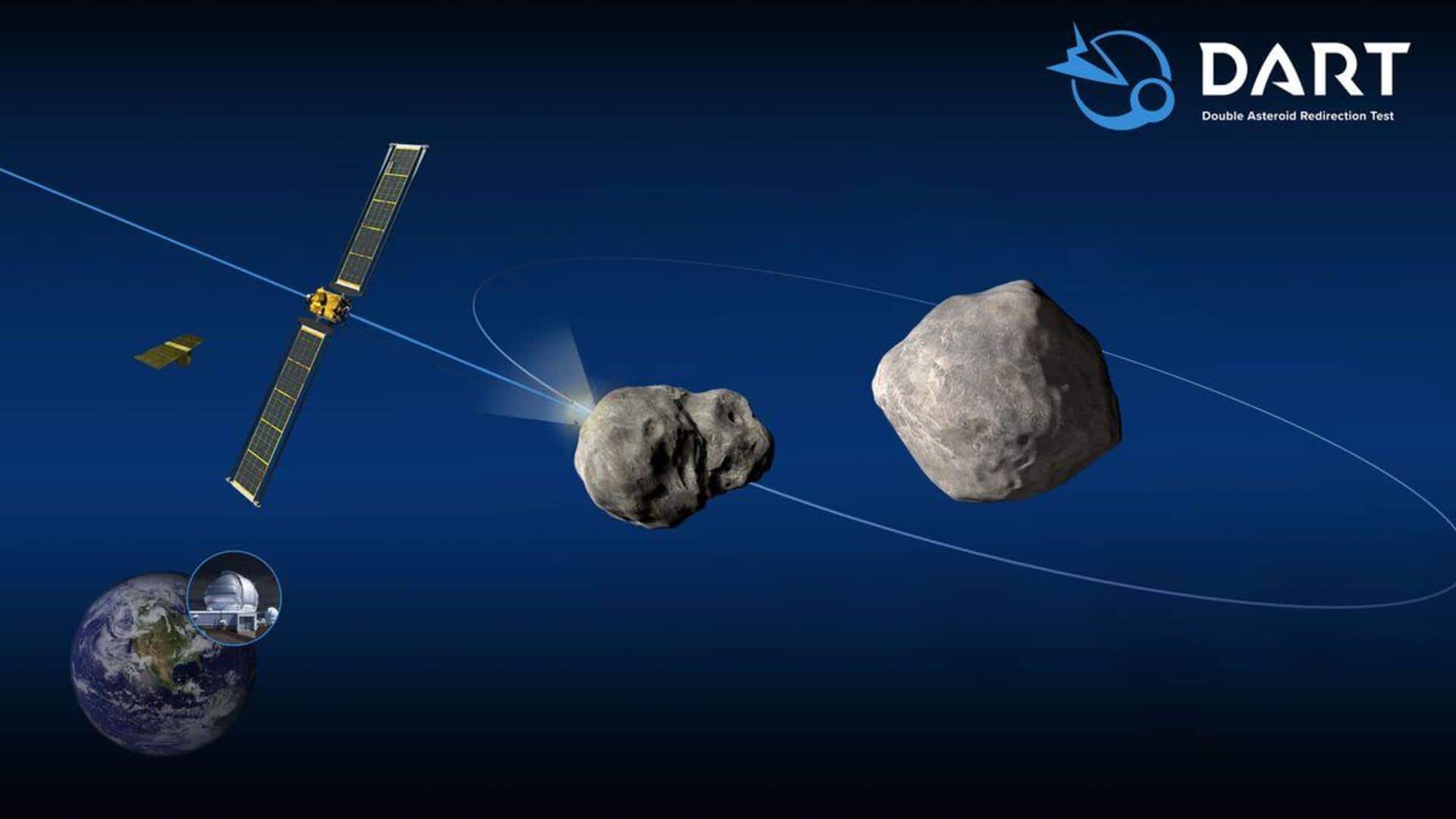
In a groundbreaking planetary defense experiment, NASA crashed a spacecraft into the asteroid Dimorphos in 2022. The mission, known as the Double Asteroid Redirection Test (DART), aimed to determine if humanity could protect Earth from potential cosmic threats like asteroids. New observations confirm that this ambitious test was indeed successful, altering not just Dimorphos's orbit but also that of its larger companion Didymos.
Impact assessment
Changes in orbital period
The binary system of Dimorphos and Didymos, which orbit each other while also circling the Sun, was a perfect test case for NASA's experiment.
The latest data shows that the time taken by Didymos and Dimorphos to complete one solar orbit (about 770 days) has permanently decreased by less than a second after DART's impact.
The change in orbital speed was about 1.7-inch per hour, according to Dr. Rahil Makadia, lead author of the study published in Science Advances.
Long-term implications
Potentially life-saving impact
Dr. Makadia emphasized the long-term significance of such small changes in an asteroid's motion, saying it could be the difference between a dangerous object hitting or missing our planet.
The DART mission is the first instance of a human-made object changing the trajectory of a celestial body in its solar orbit.
This success opens up possibilities for future planetary defense strategies against potential Earth-bound asteroids.
Orbital alteration
Ejected material and orbital changes
The study also highlights that the amount of material ejected from the asteroid system during DART's impact, increased the orbital speed of both space rocks.
This reduced their total orbit time by 0.15 seconds.
To measure this change, astronomers used ground-based observations of Didymos and data from stellar occultations (when an asteroid passes in front of stars) between October 2022 and March 2025.
Steps
Global effort
The study's findings relied on 22 stellar occultations observed by volunteer astronomers around the world.
Steve Chesley, a senior research scientist at NASA's Jet Propulsion Laboratory, stressed the importance of these observations in calculating how DART changed Didymos's orbit.
He said, "This work is highly weather dependent and often requires travel to remote regions with no guarantee of success."
Upcoming research
Impressive achievement
Patrick Michel, principal investigator of the European Space Agency's follow-up Hera mission, was surprised at how such a small change in the orbits of both asteroids could be measured.
He said, "We knew that such a tiny change could occur, which poses no risk to the Earth, but actually measuring it was another challenge that the team tackled extremely well."
More observations and measurements of the DART's effect will be shared once Hera arrives in orbit around the asteroid system.