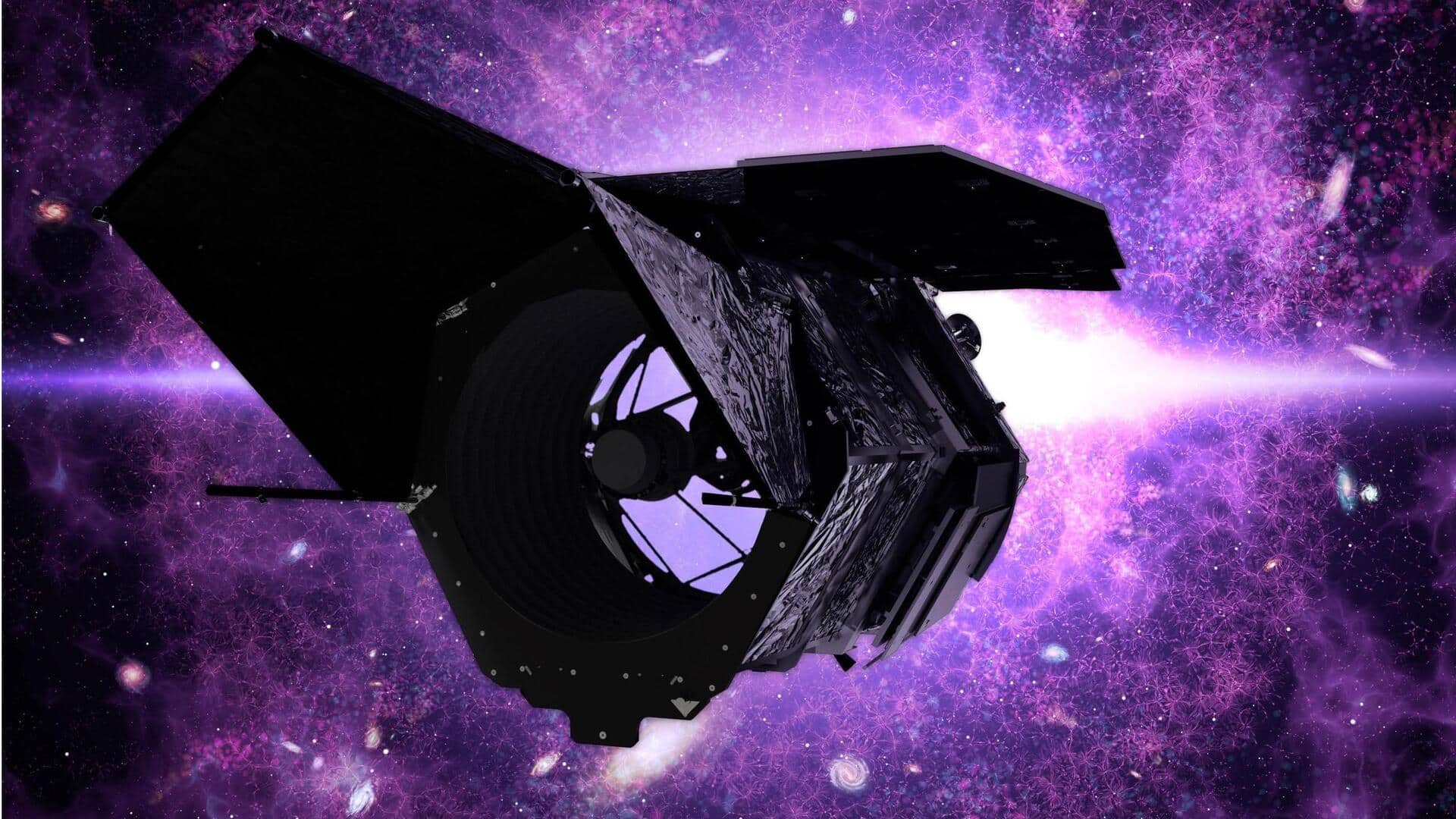
NASA's Roman telescope to launch this Sunday: Why it matters
What's the story
NASA is gearing up to launch its next flagship space observatory, the Nancy Grace Roman Space Telescope. The $4 billion project will be launched from Florida's Kennedy Space Center on Sunday. The telescope will be deployed into orbit using a SpaceX Falcon Heavy rocket. The launch comes nine months earlier than originally planned, according to officials at the US space agency.
Advanced capabilities
Successor to Hubble and Webb telescopes
The Roman Telescope is a successor to the Hubble Space Telescope, which was launched in 1990, and the James Webb Space Telescope that went into space in 2021.
Its wide-field surveys will examine the structure, composition, and evolution of the universe like never before.
"Roman's vast reach will allow us to find the weird, the rare and the unusual," said Julie McEnery, Roman's senior project scientist at NASA's Goddard Space Flight Center in Maryland.
Cosmic exploration
Main survey will include over 2B galaxies
The main survey of the telescope will take over a year and include over two billion galaxies.
This data will help scientists understand how structures in our universe, stars, galaxies, clusters of galaxies, have evolved.
"We'll also measure how our universe has expanded over time," McEnery said.
These observations are expected to provide clues about the elusive dark matter and dark energy that make up most of the universe's content.
Gravitational lensing
Will test Einstein's theory of general relativity
The Roman Telescope will also help map how galaxies cluster and how matter bends light through a phenomenon called gravitational lensing. This could help test whether Einstein's theory of general relativity remains valid across billions of light-years or if modifications to gravity are required.
Planetary exploration
Will conduct comprehensive search for exoplanets
The Roman Telescope will also conduct one of the most comprehensive searches for exoplanets, or planets outside our solar system.
It is expected to discover thousands of new worlds and provide the first statistical census of planetary systems similar to ours.
The telescope will also demonstrate new technology for directly imaging some relatively nearby exoplanets.
After launch, it will travel toward Lagrange Point 2, about a million miles from Earth.