NVIDIA's next-gen AI racks hit production snag
What's the story
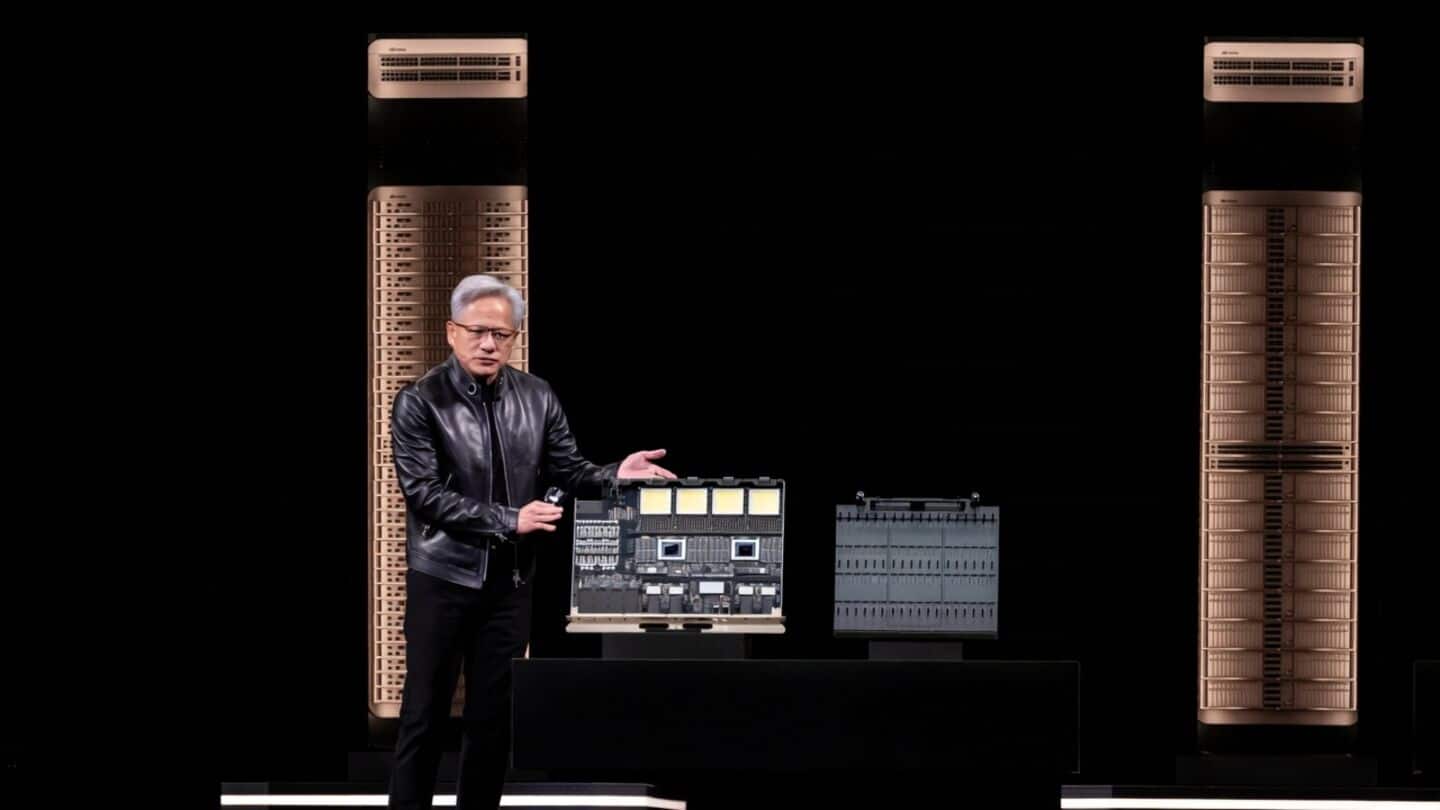
NVIDIA's highly anticipated Kyber rack-scale architecture, designed to house its Rubin Ultra AI chips, has been postponed by over a year to 2028. The delay is primarily due to manufacturing challenges with a critical circuit board at the core of the system, as per SemiAnalysis.
Technological marvel
Kyber system is designed to integrate multiple GPUs
The Kyber system is a server cabinet that integrates 144 of NVIDIA's most powerful chips into a single unit.
This design enables these chips to operate as one massive computer, providing the computational power required by AI companies to train and run their most advanced models.
The innovative design features vertically mounted graphics processing units in compute trays, increasing density and reducing latency.
Production hurdles
Launch of Kyber system was originally planned for 2027
The launch of the Kyber system was originally planned for 2027, alongside NVIDIA's next-generation rack-scale system, Vera Rubin Ultra.
However, the production of a specialized multi-layer printed circuit board that connects electronic modules within a system has proven to be difficult.
This has led to the delay in the launch of this AI architecture.
Alternative strategy
Backup plan rejected by cloud customers
NVIDIA's backup plan of combining two of its current-generation racks for similar power has also been scrapped.
The design was rejected by cloud customers as awkward and costly to operate.
This leaves NVIDIA without a proven solution to expand the scale-up world size for Rubin Ultra, potentially giving competitors like Advanced Micro Devices and Google an edge in the high-end market.