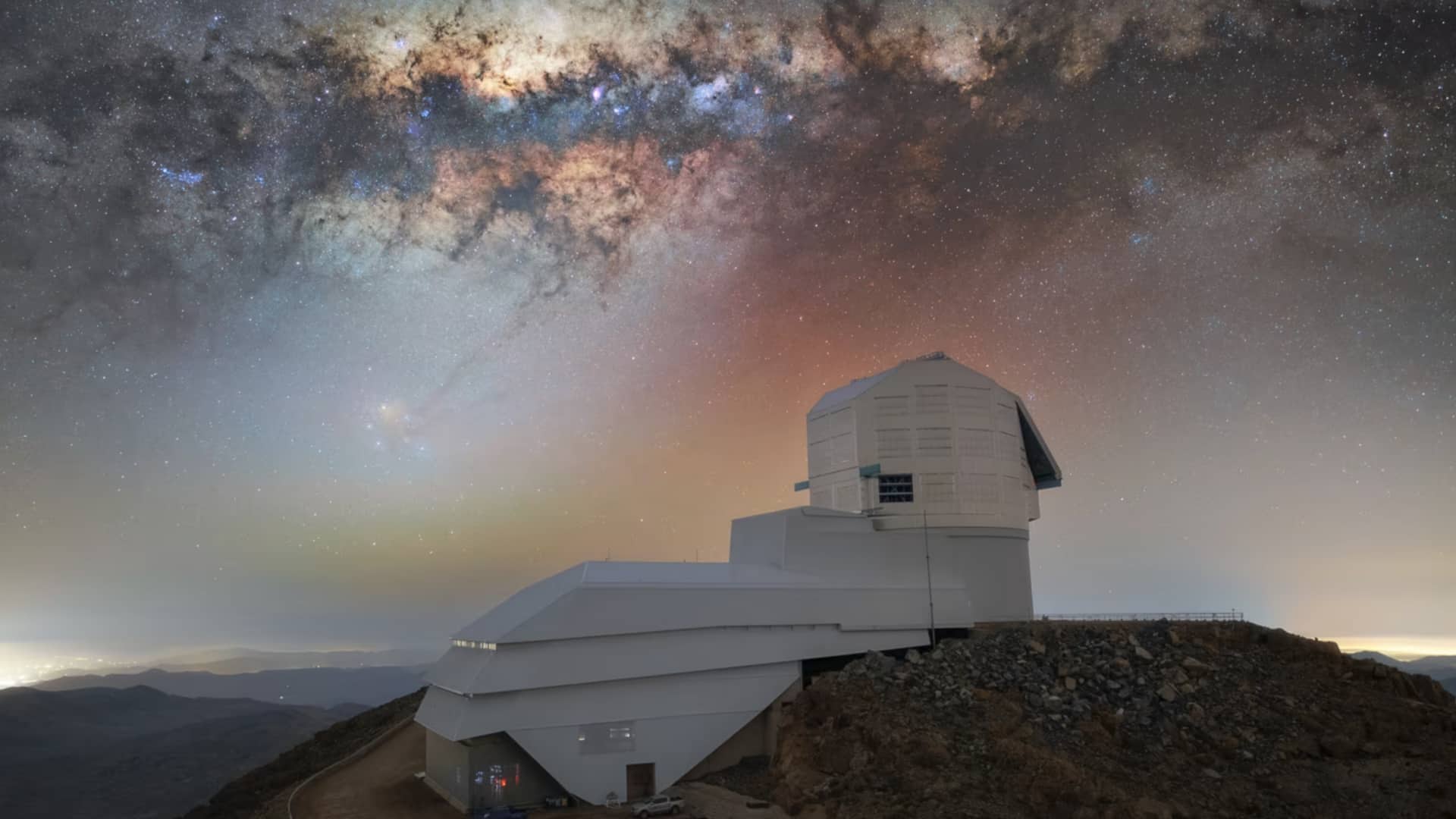
How world's largest camera will help unravel dark matter
What's the story
The Vera C. Rubin Observatory in Chile has officially begun its ambitious Legacy Survey of Space and Time (LSST) project. The observatory, which houses the world's largest digital camera, will take detailed images of the southern sky every 40 seconds for the next decade. The goal is to create a time-lapse panorama of intergalactic evolution and solve some of the universe's biggest mysteries, including dark matter.
Project launch
The observatory will scan the sky every few days
The decision to officially begin the LSST was made after a long period of system optimization and an operational review.
The observatory's camera will take thousands of images each night, completing a full scan of the southern sky every few days.
Over its decade-long survey, it will revisit the same spot in the night sky hundreds of times, creating a living image of how each patch evolves.
This long-term effort will enable scientists to study rare events like never before.
Project details
Camera can take images in 3,200MP resolution
The LSST project features an 8.4-meter-wide mirror and the largest digital camera ever built with 3,200-megapixels. The camera alone weighs about 3,000kg.
It will use a series of colored filters to scan the sky every night and create a living image of how celestial objects like asteroids and supernovae morph and move over time.
The "color-rich" images of exploding stars, black holes, and cosmic collisions will also guide other observatories around the world to collect holistic observations of these events.
Project objectives
LSST will help us understand dark matter
The LSST project aims to create a new inventory of our solar system and the Milky Way, while also trying to solve the mystery of dark matter by observing distorted light from distant galaxies.
The $800 million Rubin Observatory is jointly funded by the US National Science Foundation and the Department of Energy.
It is located on top of Cerro Pachon mountain in northern Chile, an ideal location for stargazing due to its dark skies and dry air.
Technological assistance
AI and machine learning will help in data analysis
As the observatory's time-lapse unfolds, researchers will use AI and machine learning to filter the data and detect notable changes over time.
The system is expected to send about seven million alerts every night for interesting movements, explosions, or phenomena.
When complete, the final dataset will contain billions of objects with trillions of measurements.
"This is the first time so much astronomical data will be available," said an observatory news release.