Our solar system could become 'bigger' one day
What's the story
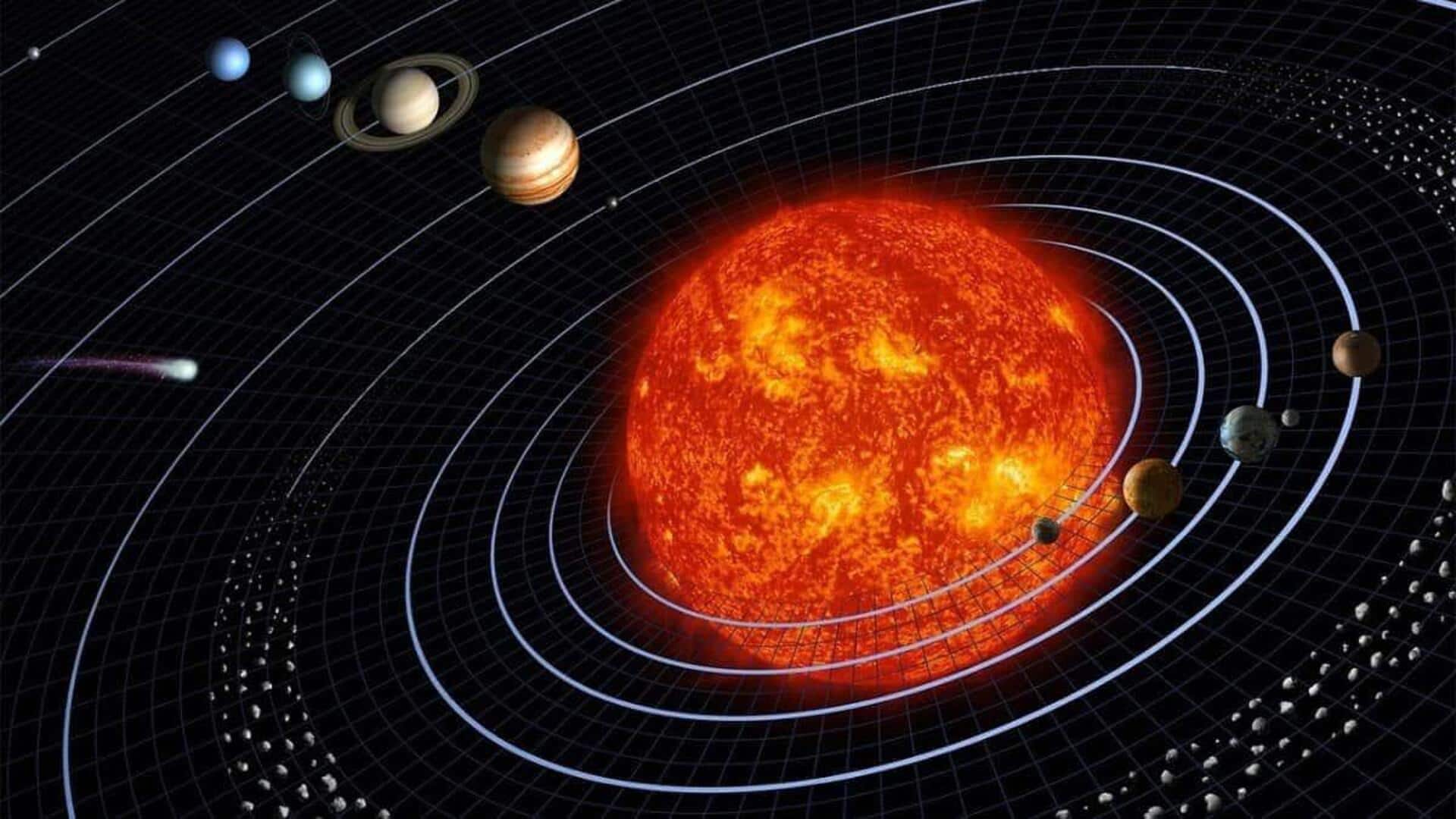
Leading space scientists Jim Green and Ed Belbruno have proposed a new theory that could redefine the edge of our solar system. The duo suggests that measurements of the Milky Way's gravitational field, including its dark matter, redraw the Sun's frontier. They argue that this gravitational frontier extends to nearly 3.8 light-years from the Sun or roughly 241,000 astronomical units (AU).
Gravitational influence
Green and Belbruno's groundbreaking research
The proposed theory places the "edge" of our solar system on par with distances between neighboring stars.
Green, a former NASA chief scientist and past director of the agency's Planetary Science Division, and Belbruno, a professor of mathematics at Yeshiva University, published their findings in the August 2026 issue of ROOM - The Space Journal of Asgardia.
They note that the boundary isn't defined by sharp line but is instead determined by "a complex dance among forces, energies and trajectories."
Cosmic gateways
Lagrange points as interstellar portals
The theory also suggests that the gravitationally stable Solar Lagrange points L1 and L2 could act as "portals" for future interstellar visitors.
This could include recently discovered objects like comet 3I/ATLAS.
Green told Space.com, "Discovering the solar-galactic center L1 location is important since slow moving objects that enter this region can be captured by our Sun and become part of our solar system."
Research implications
Green in talks with New Horizons team
Green is in talks with the New Horizons spacecraft team to observe these newly calculated L1 and L2 locations.
He said, "Even accumulated dust in this region could verify many of the calculations we have made including the extent of the dark matter in our galaxy."
Belbruno's work on permanent capture into the solar system and weak stability boundaries published in 2024 has also contributed to this theory.
Cosmic discoveries
Implications for understanding interstellar interactions and alien civilizations
Green and Belbruno also highlight the recent discovery of interstellar objects like comet 3I/ATLAS in 2025.
These objects pass through our solar system on hyperbolic trajectories, opening a new window into the materials and processes that shape planetary systems throughout the galaxy.
The ROOM article also presents some compelling ideas about possible distant alien civilizations.