India's answer to SpaceX wants to launch rockets every month
What's the story
Skyroot Aerospace, the first Indian private company to successfully launch a rocket into orbit, is now looking at the next phase of its journey. The company's co-founder and CEO Pawan Kumar Chandana has said that their main focus is on building a reliable commercial launch business. The ultimate goal? To achieve one rocket launch every month. Chandana told CNBC-TV18, "The next phase is to reliably reach orbit... and then get to commercialisation."
Expansion strategy
Plans to ramp up production at newly opened campus
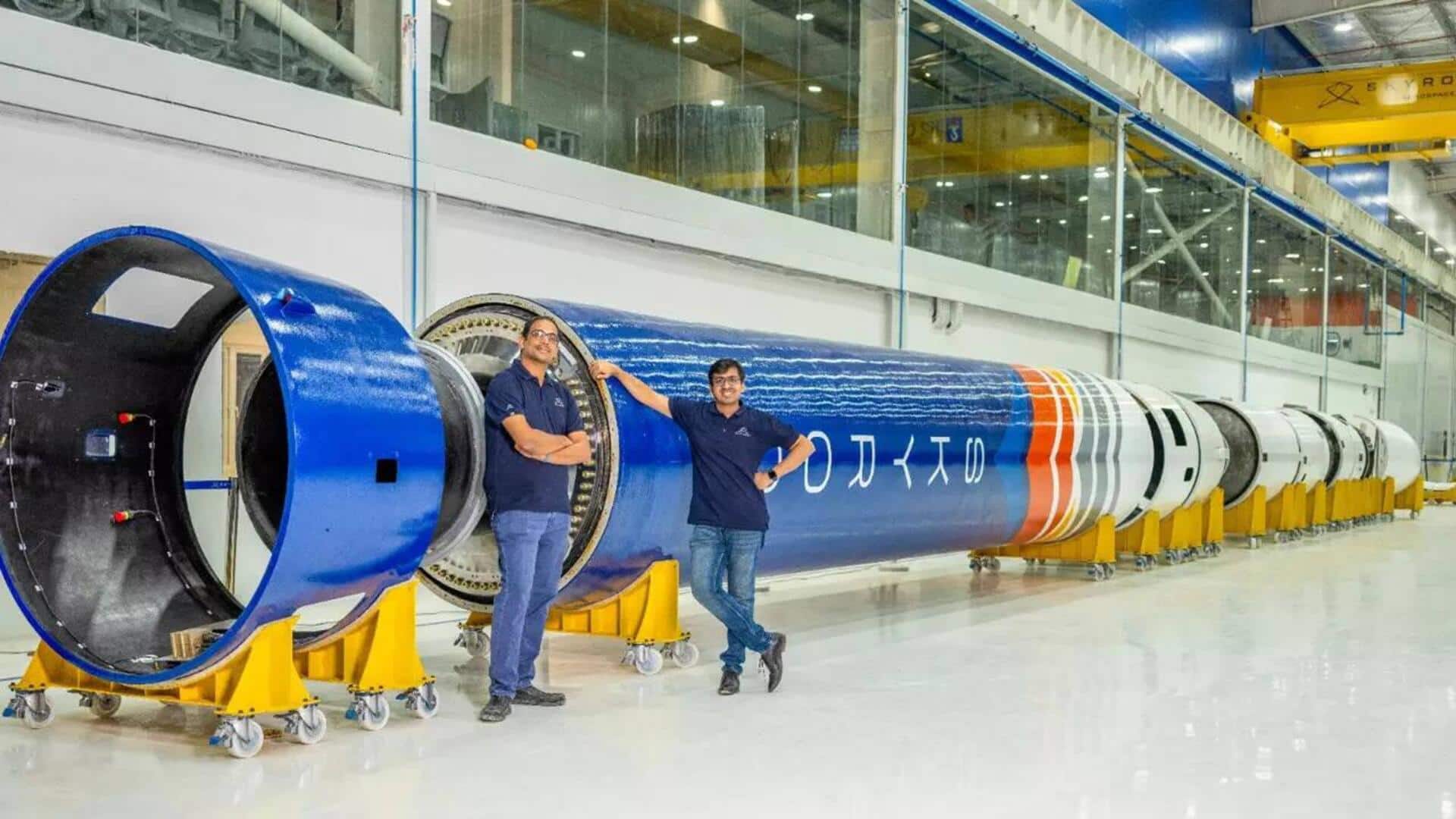
Skyroot intends to spend this year and the next one increasing production at its newly opened Infinity Campus.
The facility is already capable of manufacturing one rocket every month, but Chandana says they are still working toward that goal.
He expects the successful Vikram-1 mission to speed up manufacturing as many of the rocket's systems have been validated in flight.
Future developments
Skyroot is working on Vikram-2
Skyroot is also working on Vikram-2, a next-generation launch vehicle that can carry one ton of payload to orbit. This is nearly three times the capacity of Vikram-1.
Chandana said the target is to launch Vikram-2 by the end of 2027.
Despite its historic success with the Vikram-1 mission, Skyroot isn't rushing toward an initial public offering (IPO).
The CEO said their immediate focus is on scaling up business and proving reliable launches before thinking about a stock market listing.
Milestone moment
Major milestone for India's private space industry
Chandana described the Vikram-1 mission as a rare global achievement, noting that very few private space companies without prior launch heritage have reached orbit on their first attempt.
He said, "We launched India's first privately developed rocket to orbit in the very first attempt."
This successful launch also marks a major milestone for India's private space industry.
Chandana said India is now only the third country in the world where a private company has successfully put satellites into orbit.
Market position
Concerns over ISRO scientists leaving for private sector dismissed
Skyroot credits its cost advantage to India's established space ecosystem, a domestic supply chain of over 400 companies, and technologies like 3D-printed engines and carbon-composite structures.
Chandana said their philosophy has always been to combine frugal engineering with uncompromising precision.
He also dismissed concerns over scientists leaving the Indian Space Research Organisation (ISRO), saying the numbers remain very small compared to the organization's workforce, and movement between public/private sectors is healthy for India's growing space industry.