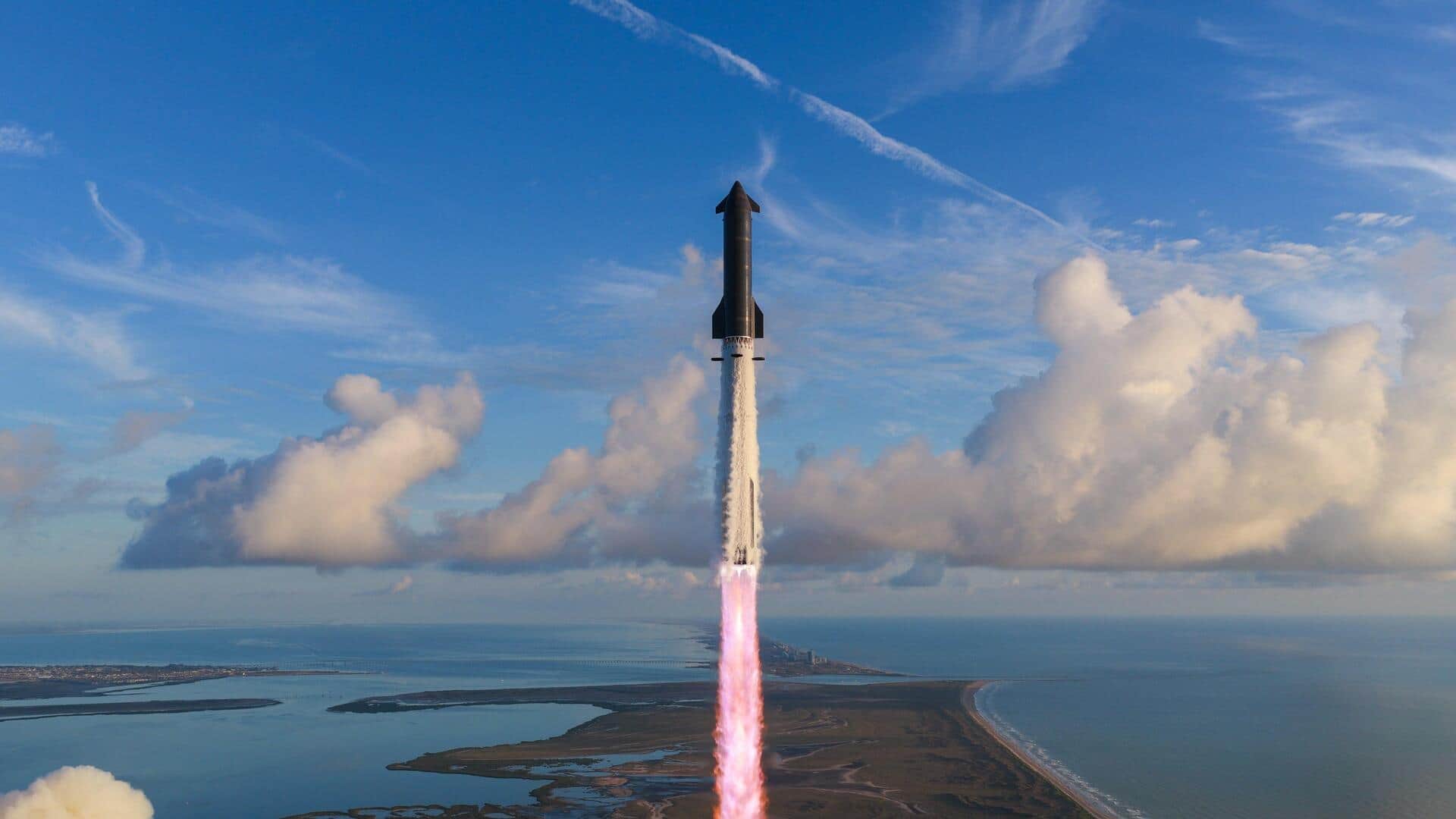
SpaceX Starship reaches orbit for first time despite engine glitch
What's the story
SpaceX has successfully launched its massive Starship into orbit for the first time. The mission, which took off from Texas, was primarily aimed at delivering 26 of the most advanced Starlink satellites to space. However, it ended prematurely as a safety precaution after one of the engines shut down early in the flight.
Flight details
Starship re-entered Earth's atmosphere over the Pacific Ocean
The Starship spacecraft re-entered Earth's atmosphere over the Pacific Ocean and splashed down north of Hawaii three hours after liftoff.
SpaceX had initially planned a 10-hour flight with six complete orbits around Earth to demonstrate its readiness for NASA's Artemis moon program.
However, due to an early engine failure, the mission was cut short as a precautionary measure.
Satellite deployment
Starship deployed Starlink satellites
Despite the early engine failure, SpaceX's Starship managed to deploy the 26 advanced Starlink satellites into orbit.
The event was celebrated by the SpaceX team at Starbase launch site in Texas.
The company later said the decision to end the flight early was taken "out of an abundance of caution."
Mission trajectory
Starship's 14th full-scale launch from Texas
This was Starship's 14th full-scale launch from Texas in three years.
The goal was to have SpaceX complete six global orbits at an altitude of 275km over nearly 10 hours, ending with a Pacific splashdown near Chile.
However, after achieving the correct orbit and cruising at 28,000km/h, flight controllers decided to return it several hours earlier after just a couple of laps.
Safety measures
SpaceX hopes to catch next Starship with giant mechanical arms
SpaceX is taking a cautious approach with Starship, especially after the July Indian Ocean recovery.
The company hopes to catch the next Starship with giant mechanical arms at the launch pad. If successful, they plan to refly it by year's end or early next year.
SpaceX is also working on certifying Starship for orbital flight, a key step toward Moon and Mars travel.