Astronomers detect first ever radio signal from a distant exoplanet
What's the story
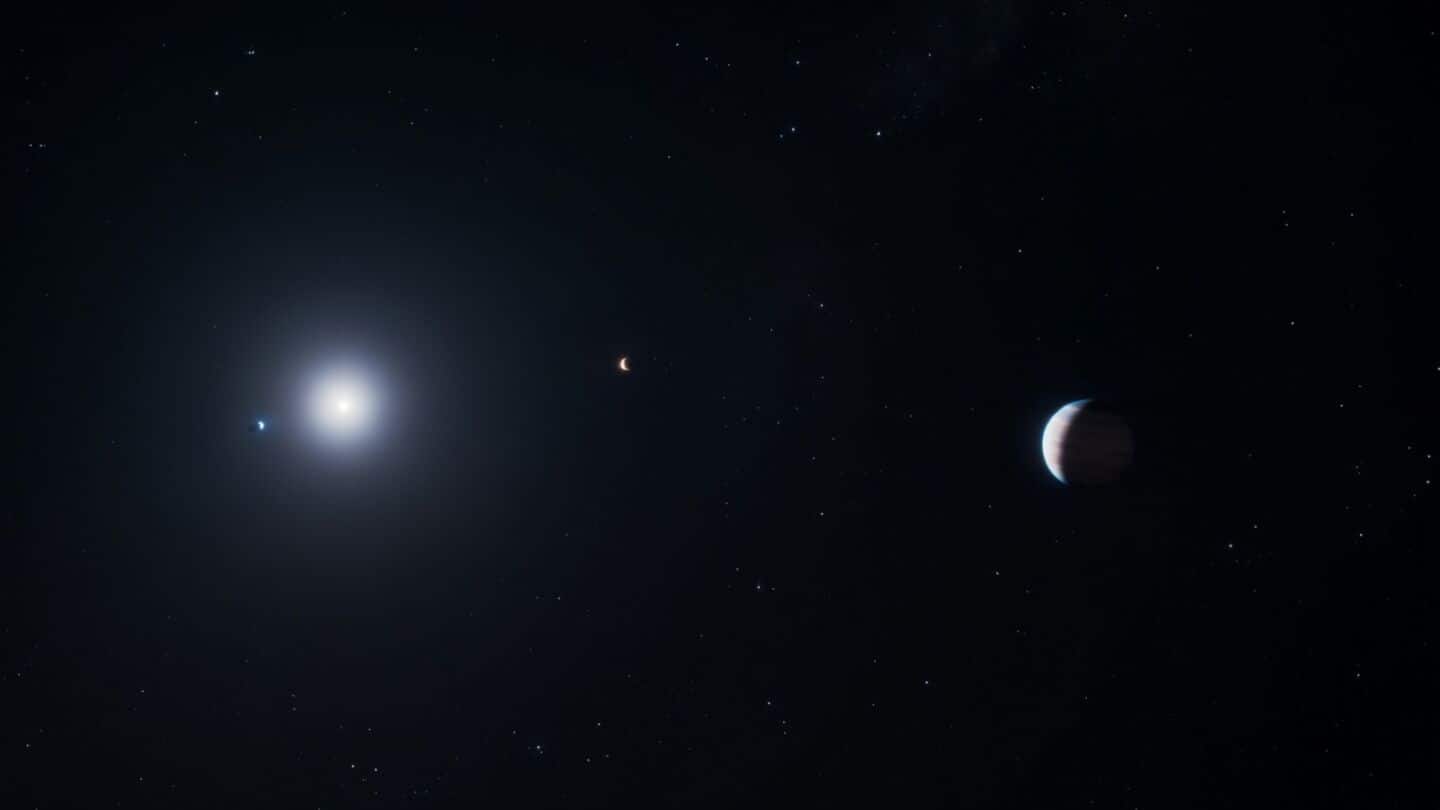
In a groundbreaking discovery, astronomers have detected the first-ever radio emission from a planet outside our solar system. The signal was traced to the exoplanet Beta Pictoris b, located 63 light-years away. The detection is not evidence of intelligent life, but rather points toward a massive magnetic field around the gas giant.
Magnetic connection
Radio emission linked to magnetic field processes
The radio emission from Beta Pictoris b is tied to processes associated with its magnetic field. The detection was made using MeerKAT, an array of 64 radio telescope dishes in South Africa.
Edo Berger, a Harvard University professor and coauthor of the study, said auroras like Earth's northern lights are responsible for this phenomenon.
He emphasized, "In order to see radio waves that extend all the way to the frequencies that we observed, you need an incredibly strong magnetic field."
Magnetic strength
Beta Pictoris b's powerful magnetic field
Not all planets have a magnetic field, but those that do are protected by a natural shield against disruptive energy.
Beta Pictoris b's magnetic field is at least 200 times stronger than Jupiter's.
Berger said this planet's magnetic field is powerful enough to produce auroras and radio waves.
"As these very high-energy particles are spiraling inside the magnetic field, along with the aurora they also produce radio waves," he explained.
Magnetic mystery
Discovery challenges previous assumptions
The discovery of the radio signal from Beta Pictoris b challenges the assumption that exoplanets with magnetic fields would have radio emissions similar to those of Jupiter.
Berger said they were surprised by the detection, as they expected only to find sources if the magnetic field was incredibly strong.
"This was really unexpected for us," he admitted.
Review status
Paper under peer review
The paper detailing this discovery is currently under peer review, a process where independent experts evaluate a research paper before it gets published in a scientific journal.
Berger expressed confidence in the detection's quality, having recorded the radio emission multiple times at different frequencies.
"We recorded it multiple times at multiple frequencies. It's there every single time," he said, dismissing initial doubts that the signal could be coming from a star instead of Beta Pictoris b.