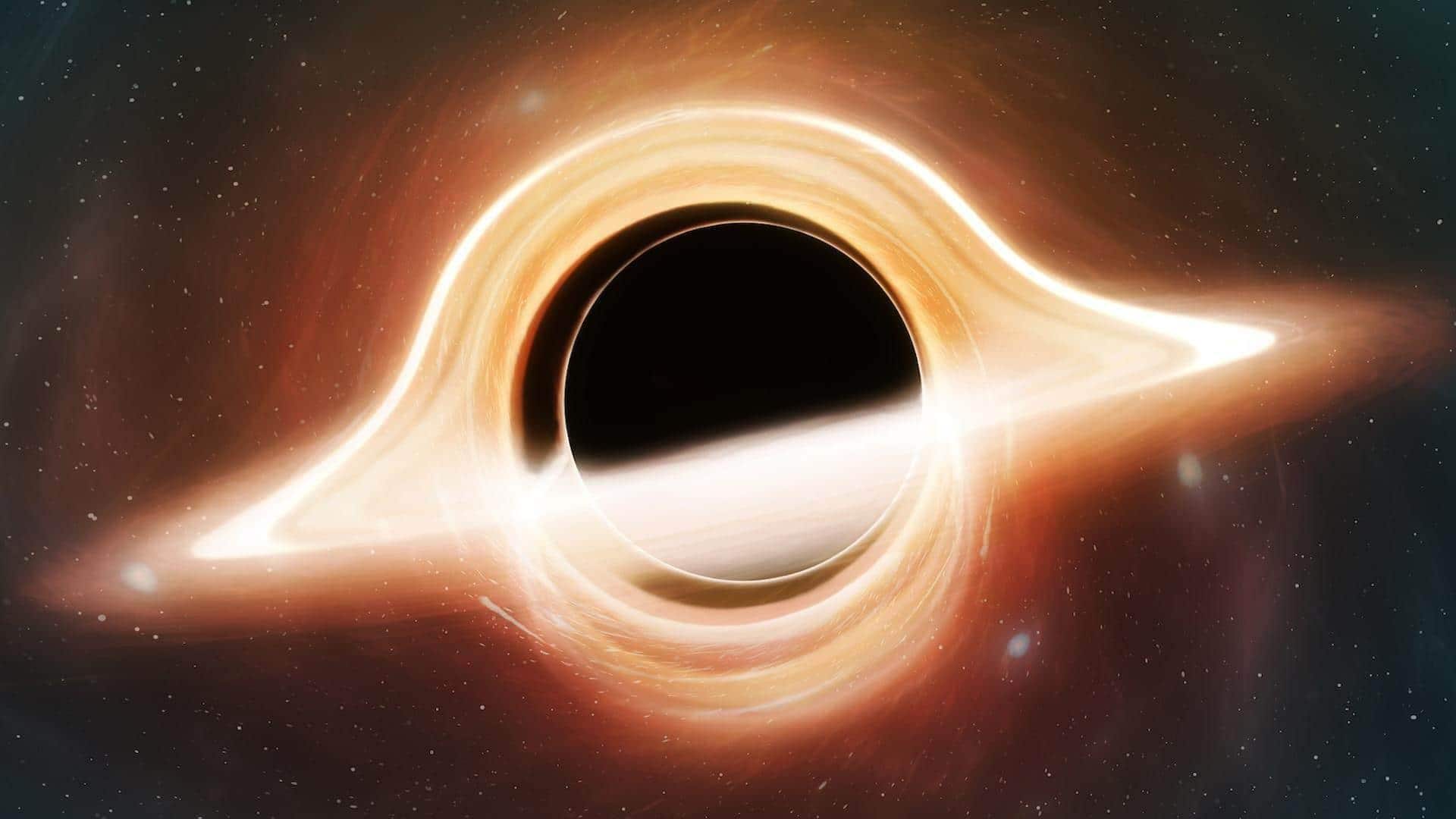
We finally know when black holes 'burp'
What's the story
A team of scientists has solved the mystery of when black holes "burp," the phenomenon where these cosmic entities emit jets after consuming stars, ejecting material across vast distances in space. The research was published in the journal Nature Astronomy by Dr. Adelle Goodwin and Dr. Andrew Mummery from the Institute for Advanced Study.
Cosmic consumption
Black holes are messy eaters
Dr. Goodwin, an astrophysicist at Curtin University, explained that black holes are "actually very messy eaters."
She noted you have to get really close to a black hole to reach its event horizon, the point of no return.
This is where stars are destroyed further out than that, leading to a stretching effect known as "spaghettification."
Stellar destruction
The black hole burp
When stars get too close to black holes, only about half of them are eventually consumed. The rest is ejected back into space in powerful jets and outflows.
These can be so massive that they "can influence the entire evolution of a galaxy," Dr. Goodwin said.
This process is what she referred to as a "black hole burp."
Unsolved puzzle
Timing of the burp
The timing of these burps had long been a mystery for astrophysicists.
It was observed that sometimes they would occur a year after the black hole destroyed the star, while at other times, it could take three or five years after.
This unpredictability made it difficult to study these cosmic events in detail.
Research findings
Distinct phases in black hole feeding cycle
In their study, Dr. Goodwin and Dr. Mummery used radio telescopes to observe 20 tidal disruption events, when stars are consumed by supermassive black holes.
They discovered that these black holes emit powerful jets in two distinct phases during their feeding cycle.
The first phase occurs when the black hole is consuming material at a very high rate, while the second phase happens hundreds to thousands of days after the star's initial consumption.
Future predictions
Size doesn't matter
The study also revealed that black holes seem to emit jets at the same point in their feeding cycle, regardless of their size.
This discovery could help scientists predict when these jets will be emitted, refining observation windows and saving valuable telescope time.
Dr. Goodwin said, "We can really start to understand not just when the jets are launched, but also how strong they are and whether that is then dependent on the black hole properties."