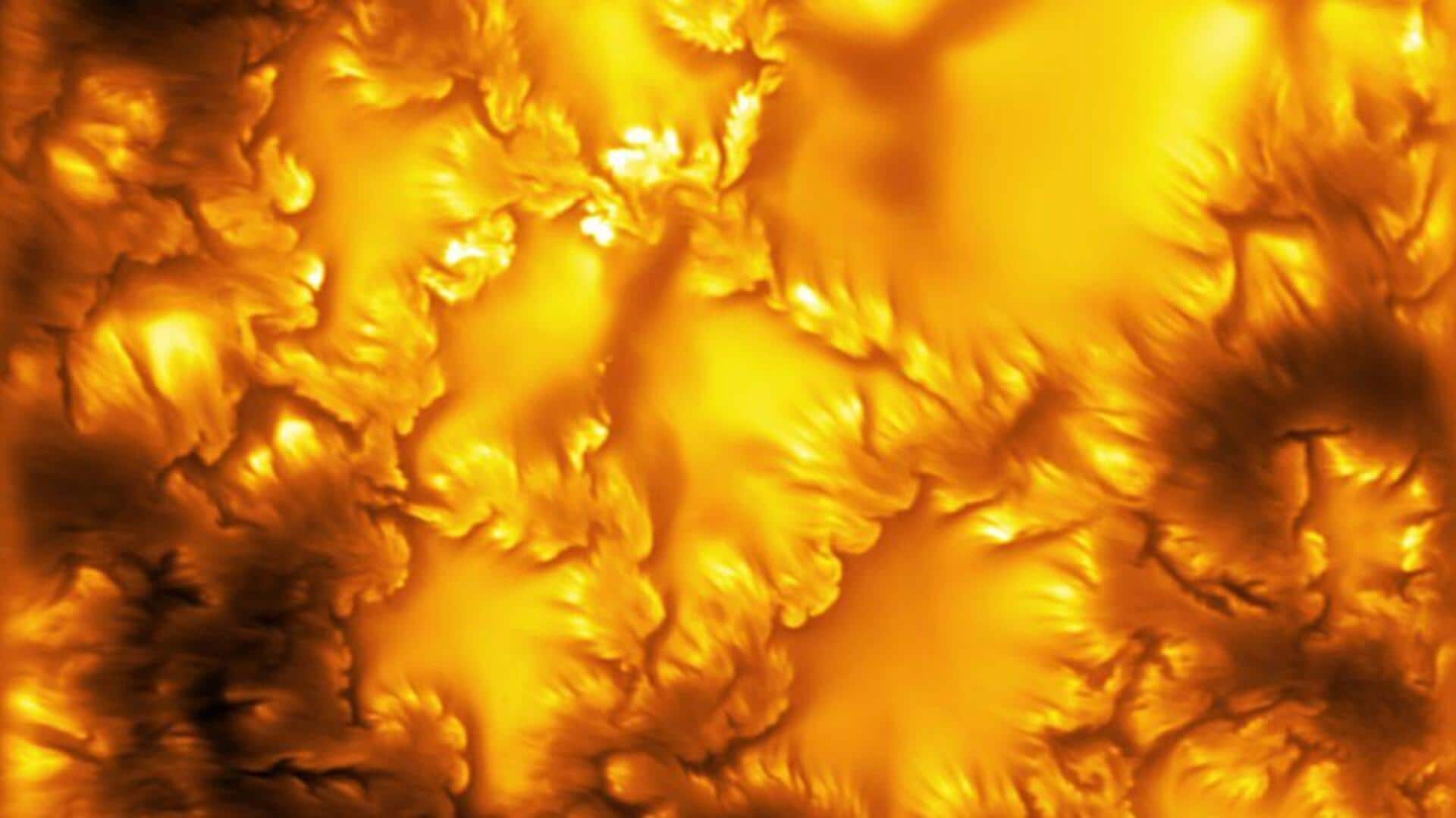
This is the most detailed look at the Sun ever
What's the story
The Inouye Solar Telescope, the world's most powerful solar telescope, has captured unprecedented images of our Sun. The high-resolution pictures show golden bands and swirling vortices on the star's turbulent surface. These features are smaller than 20km across and were observed in a magnetically active region near a sunspot. The findings could explain why the Sun's corona is millions of degrees hotter than its surface.
Telescope insights
Inouye Solar Telescope's location and capabilities
The Inouye Solar Telescope, a facility of the US National Solar Observatory (NSO), is located on the Haleakala volcano in Maui.
Its previous observations revealed the Sun's surface as a mosaic of granular structures each about as big as France.
These images captured details as small as 30km across. However, the latest set of images are much finer and reveal tiny whirlpool-like structures on the Sun's surface.
Scientific significance
First confirmation of Kelvin-Helmholtz instabilities on the Sun
The small whirlpool-like structures were identified as signatures of Kelvin-Helmholtz instabilities (KHIs).
These occur when fast-moving plasma slides past slower-moving fluid, creating shear at the interface.
This process sets up small disturbances in the Sun's plasma that grow into spiraling vortices resembling breaking waves.
KHIs have been observed on Earth and in the atmospheres of Jupiter and Saturn, but this is their first confirmation on the Sun.
Vortex implications
Implications for understanding solar phenomena
The swirling vortices are now seen as a key factor in the formation of tangled magnetic field lines on the Sun.
These twisted lines create tension that is suddenly released when they break, causing explosive events like solar flares and coronal mass ejections.
The new findings could help scientists understand these phenomena better.