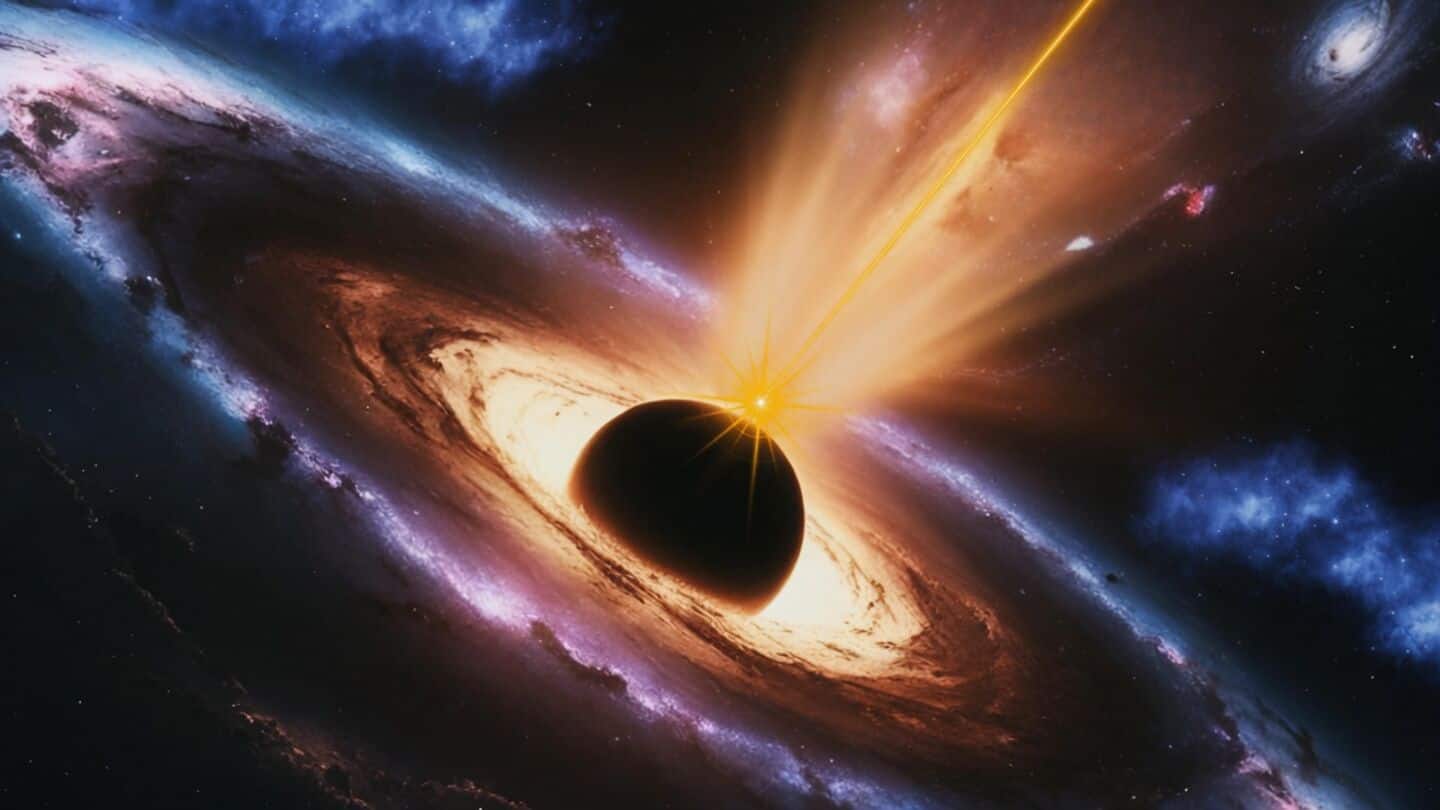
Supermassive black hole found burping radio jets after a 'meal'
What's the story
Astronomers have witnessed a supermassive black hole at the center of the Perseus Cluster, a massive collection of thousands of galaxies, belching out radio jets 300 days after devouring a heavy cosmic meal. The observation was made using NASA's X-ray spacecraft Swift and radio observations. The black hole is located in NGC 1275, the brightest galaxy in the Perseus Cluster and is about 225 light-years away from Earth.
Cosmic dynamics
Understanding supermassive black holes
The supermassive black hole was first observed flaring in X-rays, indicating an increase in its matter-accretion rate.
These actively feeding black holes are found in regions known as active galactic nuclei (AGNs). Their immense gravity heats surrounding matter, making it glow brightly.
The emissions are enhanced by material funneled to the poles of the central black hole, which is then blasted out as powerful twin jets across the electromagnetic spectrum, especially radio waves.
Observation challenges
Swift's role in the research
Studying NGC 1275 and its central supermassive black hole is no easy task.
The ideal spacecraft for observing X-ray emissions is Chandra, but it doesn't observe this galaxy often enough to track its long-term behavior.
However, NASA's Neil Gehrels Swift Observatory has collected extensive data on NGC 1275 since its launch in 2004.
Team leader Sarah Ketchum from the University of Michigan said they created a model that removed cluster emission from archival Swift data, revealing changes in X-ray flux.
Research significance
Significance of NGC 1275
Ketchum emphasized that Swift's capabilities were crucial for studying NGC 1275, the perfect laboratory for disk-jet coupling.
Other galaxies with AGN have shown evidence of gas accretion traced in X-ray light and gas ejection in jets traced in radio light.
However, NGC 1275 shows the impact of black hole jets on large spatial scales better than any other system.
Flare analysis
Strongest X-ray flare from NGC 1275 ever observed
In February 2023, Ketchum and her team witnessed the strongest-ever X-ray flare from NGC 1275.
The flaring was so extreme that they had to rule out a tidal disruption event (TDE) as its cause.
TDEs occur when a star's orbit brings it too close to a supermassive black hole's immense gravitational influence.
Instead, they suggested that the flaring was likely caused by an increase in the rate of matter accretion onto the black hole.
Mass estimation
Estimating black hole mass and jet travel time
Using Swift data, the team estimated the radius over which the AGN emits radiation.
This allowed them to estimate the black hole's mass at the center of NGC 1275 as between 100 million and 1 billion times that of our Sun.
They also found tentative evidence of a 300-day delay between X-ray flaring and radio wave emission, indicating how long it takes plasma to travel from the base of a jet to a knot created when it hits surrounding gas/dust.