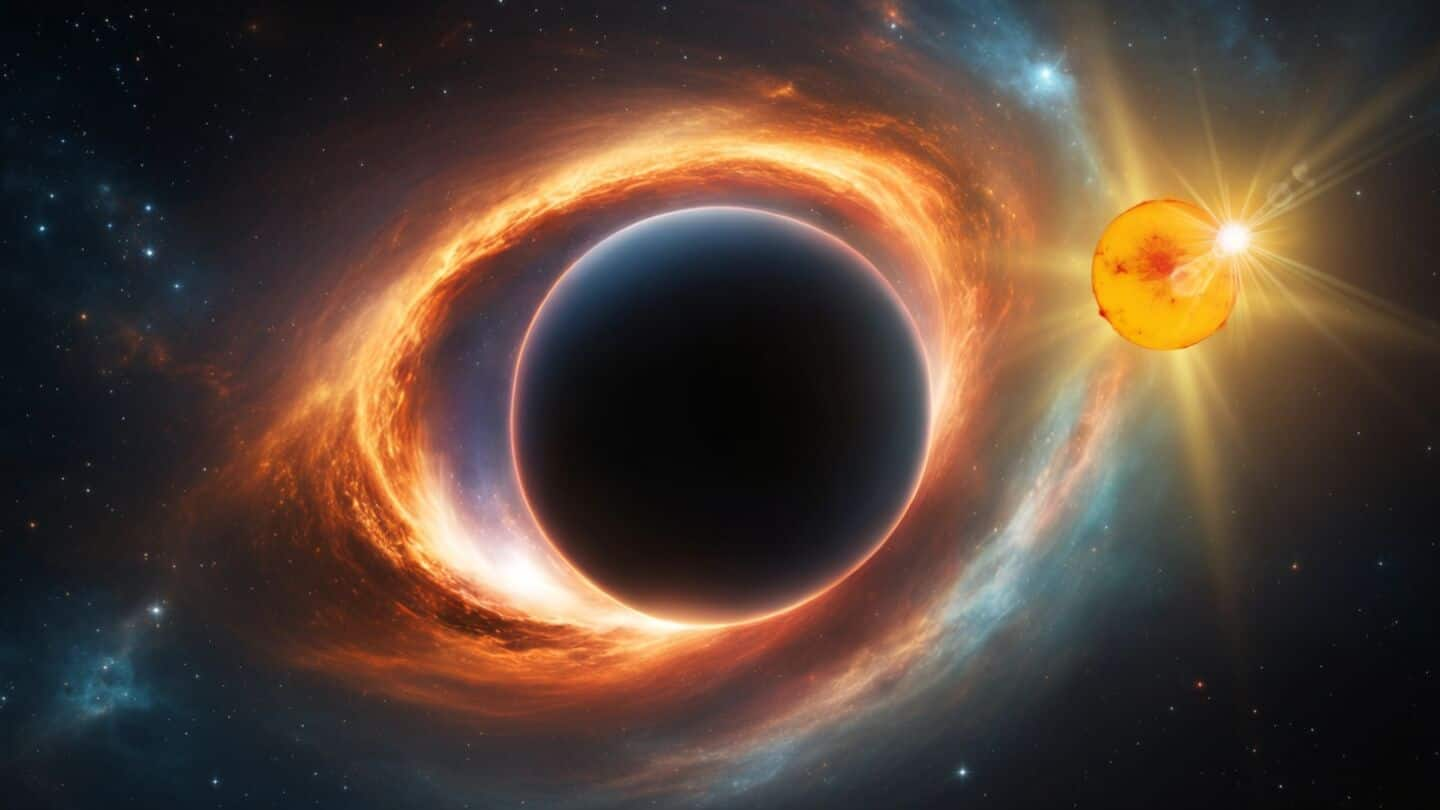
You can now help astronomers find 'missing' black holes
What's the story
A group of UK-based astronomers is enlisting public help to find "missing" black holes in the Milky Way. The project, dubbed Black Hole Hunters, calls for volunteers with a computer and some spare time to sift through data collected by NASA's Transiting Exoplanet Survey Satellite (TESS). By identifying specific patterns that may indicate a "missing" black hole, these volunteers can expedite a search process that would otherwise take years.
Cosmic mysteries
What are black holes?
Black holes are formed when massive stars, about 20 times heavier than our Sun, exhaust their fuel and collapse. This creates a void with gravity so strong that not even light can escape.
Although they are invisible, these cosmic giants can be detected by their effect on nearby objects' light.
The Black Hole Hunters project is looking for one specific instance of this phenomenon.
Search strategy
How to identify a black hole
The Black Hole Hunters project uses data from TESS, which primarily looks for planets outside our solar system.
It does this by observing tiny, continuous changes in a star's brightness over time, an ideal method for detecting black hole magnification events.
Automated algorithms first scan the TESS data, looking through millions of potential stars for the most obvious black hole candidate locations.
Volunteer contribution
Role of human volunteers
Artificial intelligence often gets confused by the complexities of the universe, such as stellar flares and natural star pulsations that can lead algorithms astray.
This is where human volunteers come in. Each graph is shown to multiple volunteers, and their answers are combined to average out individual mistakes.
The crowdsourced shortlist of promising signals allows astronomers to focus follow-up observations on specific stars.
Project progress
Citizen science in astronomy
Since its launch on the Zooniverse platform, Black Hole Hunters has attracted nearly 23,000 volunteers who have made over 12 million classifications.
Before this, the team conducted a similar search with data from SuperWASP, a ground-based survey that monitored stars for planetary signs from 2004 to 2016.
The results of that study are still being analyzed and will be published soon.