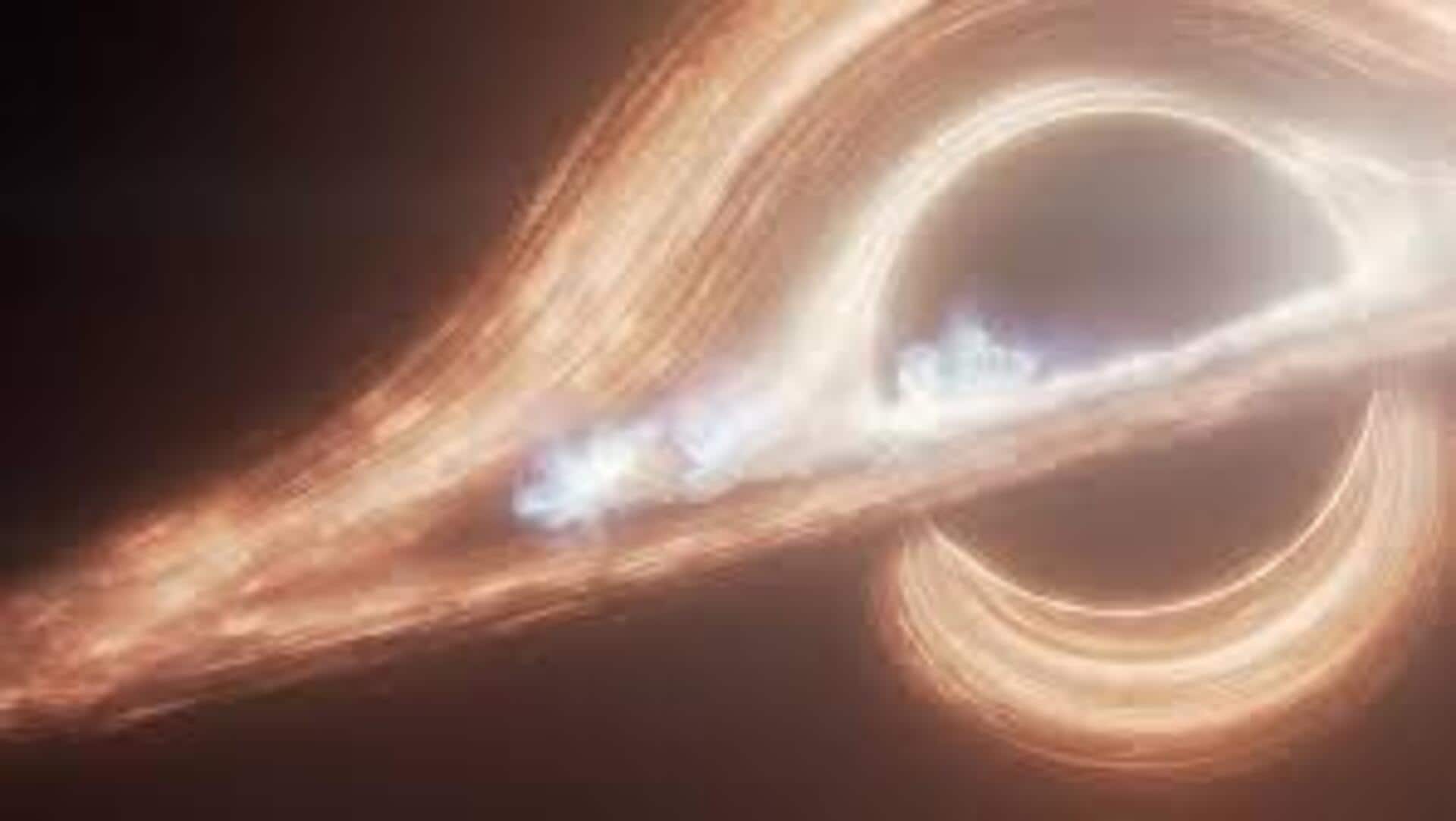
Black hole at center of Milky Way might be windy
What's the story
Astronomers have discovered evidence of a cosmic wind emanating from Sagittarius A*, the supermassive black hole at the center of our Milky Way. The finding, published in The Astrophysical Journal Letters, could explain why this particular black hole has remained so quiet for over five decades. The study was led by Mark Gorski, a research assistant professor at Northwestern University in Evanston, Illinois, and Lena Murchikova, an assistant professor of physics and astronomy at Northwestern.
Black hole mystery
The mystery of the quiet black hole
Sagittarius A*, a supermassive black hole weighing about four million times more than our Sun, has been a cosmic puzzle for over 50 years.
According to the laws of physics, all black holes should not only consume matter but also expel some in the form of wind or jets. However, Sagittarius A* has remained unusually silent.
Despite decades of research, scientists have only found evidence of wind eruptions dating back over 20,000 years but nothing more recent.
Wind evidence
Evidence of a hot gas wind
After five years of observations, Gorski and Murchikova believe they have found signs of the elusive wind.
They created a highly detailed image of Sagittarius A*'s surroundings with the Atacama Large Millimeter/Submillimeter Array or ALMA radio telescopes in Chile.
In this image, they discovered a large, cone-shaped cavity devoid of cold gas that could only have been sculpted by a wind of hot gas coming directly from the black hole itself.
Wind analogy
Hot gas wind leaving a signature
Gorski likened the black hole wind to a hair dryer, saying it blows hot turbulent air into colder, denser material.
The study suggested that the hot gas in the black hole's wind left a clear signature by sweeping away surrounding cold gas.
This discovery is similar to outflows previously observed from supermassive black holes at the centers of other galaxies.
These outflows play a crucial role in how a black hole injects energy into its host galaxy and regulates its growth.
Wind confirmation
Using X-ray to confirm the presence of cold gas
The researchers used NASA's Chandra X-ray Observatory to confirm that the cold gas in the region was being shaped by hot plasma from the galactic center.
Gorski said, "If the cold gas were in front of or behind the hot plasma, there wouldn't be a strong correlation."
He added, "While we did not directly detect the particles moving in the wind, we were able to deduce the direction and energy of the wind."
Research prospects
Future plans for research team
The researchers plan to extend their map of cold gas to a larger area, hoping to understand its full impact on how much gas gets consumed by Sagittarius A*.
They also want to create a "movie" showing how clouds move toward the black hole.
This discovery not only provides insight into black hole-driven winds but also shows that supermassive black holes can launch winds into their host galaxies even during quiet periods.