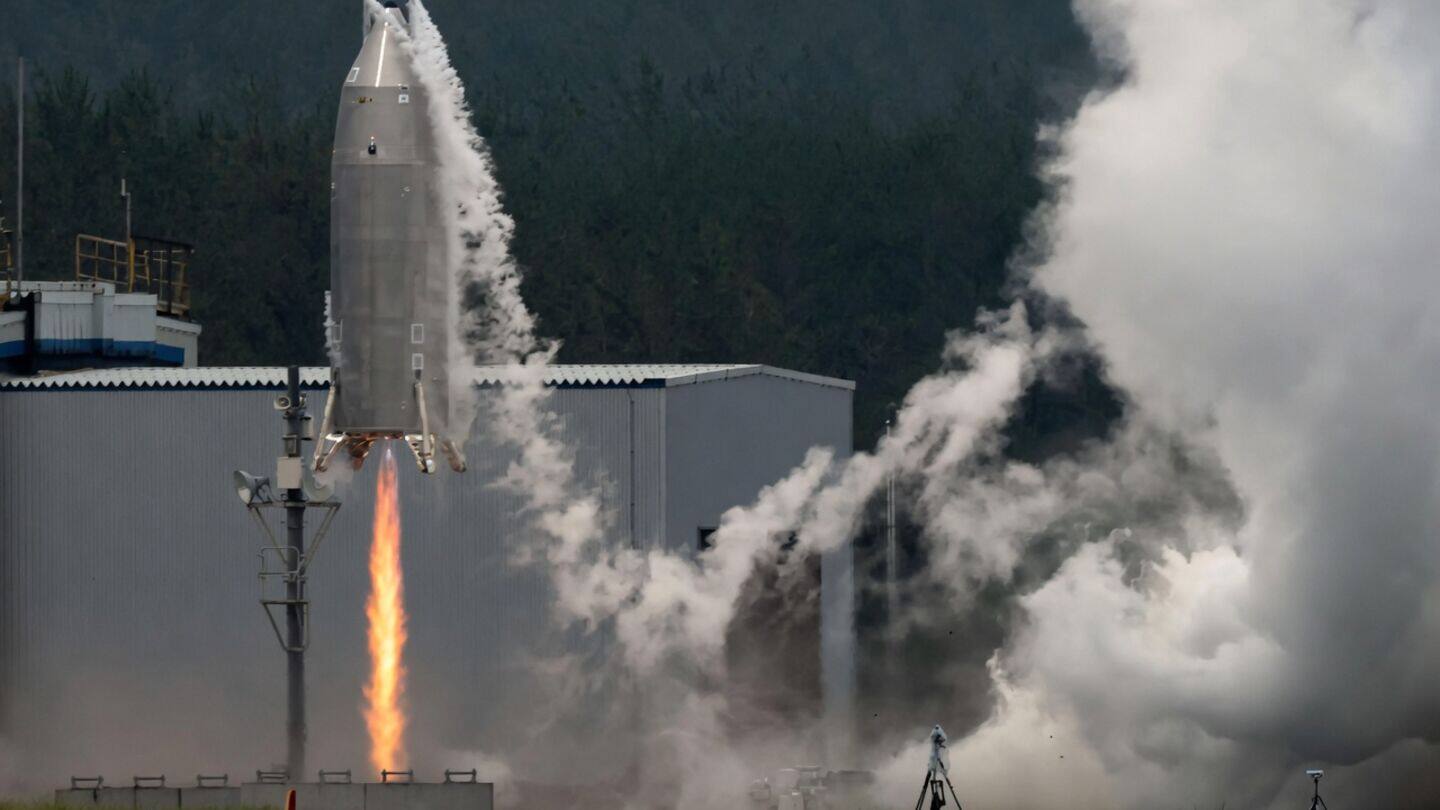
Japan's reusable rocket launched and landed successfully
What's the story
Japan's space agency, the Japan Aerospace Exploration Agency (JAXA), has successfully tested its prototype reusable rocket. The test was conducted at JAXA's test site in Noshiro, Akita region. The rocket reached a height of about 10 meters and landed safely after a flight lasting some 40 seconds. This marks a major milestone in Japan's efforts to develop cost-effective space technology.
Test success
'Great sense of relief'
Takashi Ito, who led the launch at JAXA, expressed his relief over the successful test.
"I feel we have put a great deal of time and effort into this, and now that the prototype has taken off and landed without problem, I must say I feel a great sense of relief," he told reporters after the test.
Data analysis
JAXA confident about obtaining useful data
Ito also stressed on JAXA's confidence in the data obtained from this test.
He said, "The agency will review data to fully determine the success of the test, but he is 'confident' that it 'obtained very useful data.'"
This information could be instrumental in further refining and improving Japan's reusable rocket technology.
Cost reduction
Significance of reusable rockets
Traditionally, rockets are single-use with their components either falling into the sea, burning up in the atmosphere, or remaining in orbit as debris.
The first launch stage is usually the most expensive component.
However, reusable rockets like SpaceX's Falcon 9 (in operation since 2017) could significantly cut down these launch costs.
This technology has already been adopted by other countries such as China which successfully landed its first reusable rocket on Friday.
Global competition
Honda's subsidiary launched and landed a reusable rocket last year
Japan is also working hard to make its rocket industry more competitive on the global stage.
In June last year, Honda's subsidiary became the first Japanese company to launch and land a reusable rocket successfully. This was a major step for Japan in this race.
The country's flagship H3 rocket was also launched successfully in June, after a previous failed attempt at putting a satellite into orbit.