Scientists still can't decipher mysterious radio signal detected in 2025
What's the story
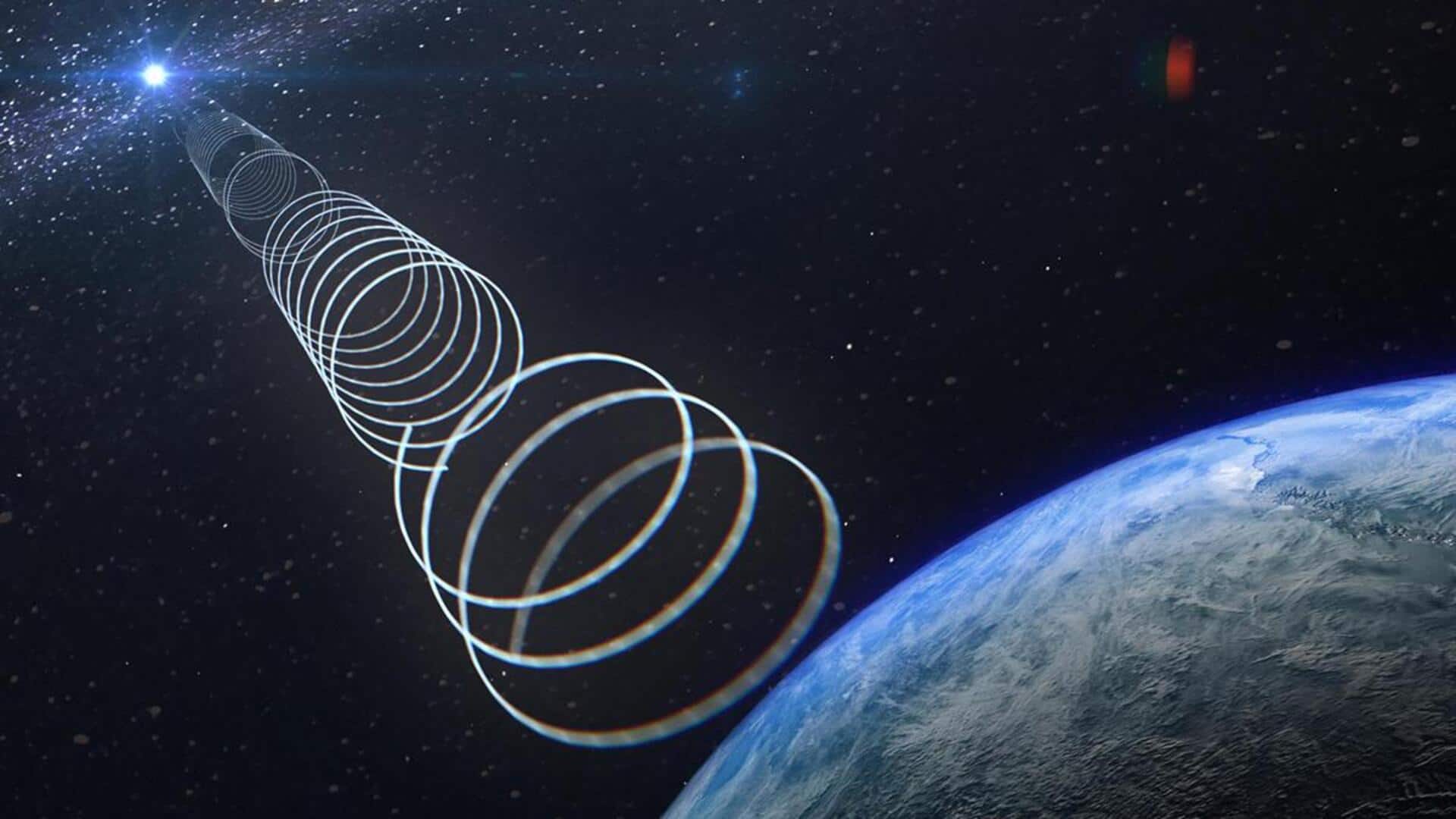
NASA's Fermi Gamma-ray Space Telescope detected an unprecedented gamma-ray burst (GRB) on July 2, 2025. The event, dubbed GRB 250702B, lasted for seven hours and emitted bursts every few seconds. This is the longest GRB ever recorded, and its origin remains a mystery despite extensive observations with ground-based telescopes such as the Gemini telescopes in Chile and Hawaii, the Very Large Telescope in Chile, the Keck Observatory in Hawaii, and the Hubble Space Telescope.
Cosmic voyage
GRB 250702B's journey through a dusty galaxy
The GRB originated from a dusty galaxy located eight billion light-years away.
This is remarkable as the gamma-ray burst had to pass through a thick layer of material that blocks all visible light before reaching our solar system.
The telescopes could only pick up infrared and high-energy X-ray wavelengths due to this dust cloud, making the signal invisible in ordinary light.
Unexplained phenomenon
The mystery behind GRB 250702B's origin
The cause of GRB 250702B remains a mystery, with researchers proposing three possible scenarios: the death of a massive star, a black hole consuming a star, or the merger of a helium star and black hole.
"This was the longest gamma-ray burst that humans have observed — long enough that it does not fit into any of our existing models for what causes gamma-ray bursts," Jonathan Carney, lead author of the study, said in a statement.