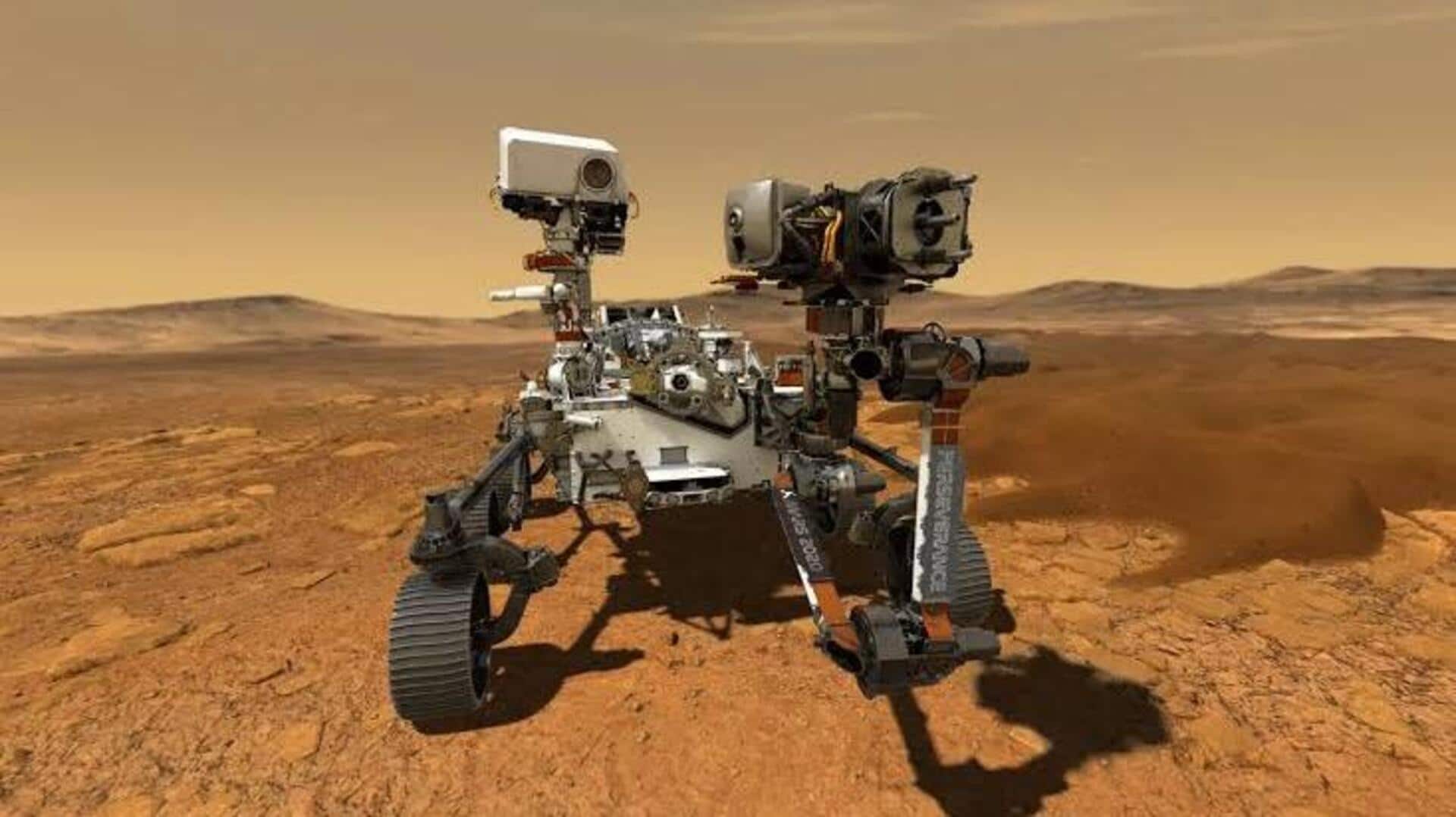
Perseverance overtakes Opportunity to become Mars' longest-driving rover
What's the story
NASA's Perseverance rover has set a new record for the longest distance traveled by a vehicle on another planet. On October 11, 2026, its odometer hit an impressive 45.22km, surpassing the previous record held by NASA's Opportunity rover since 2018. The achievement marks a major milestone in space exploration and highlights advancements in autonomous navigation technology that are enabling scientists to explore more of Mars in less time.
Record-breaking trek
Journey across Jezero Crater
Perseverance reached the record-breaking distance on its 2,006th Martian day, or sol.
The rover has been exploring Jezero Crater, a region that scientists believe once housed a lake and river delta.
Since landing in February 2021, Perseverance has driven across various terrains to collect rock and regolith samples from different geological locations. These include the crater floor, an ancient river delta, and the rim of the crater itself.
Tech advancement
AutoNav's role in Perseverance's journey
Perseverance uses an autonomous navigation system called AutoNav to assess terrain and identify safer routes.
The technology has enabled the rover to cover greater distances while navigating rocky and uneven landscapes.
More than 90% of its total driving distance has been completed using this tech, a significant improvement over earlier Mars rovers that relied more heavily on instructions from Earth.
Mission extension
Extended mission and potential biosignature discovery
Perseverance's original mission envisioned just 20km of driving, but NASA has now approved an extension to explore the crater rim until around late 2028.
The rover's plutonium-based power system is performing as expected and has "many years of useful energy still available," according to NASA.
The biggest achievement so far is the discovery of a potential biosignature in reddish rock believed to have formed 3.2-3.8 billion years ago in a river channel feeding the lake that once filled Jezero Crater.