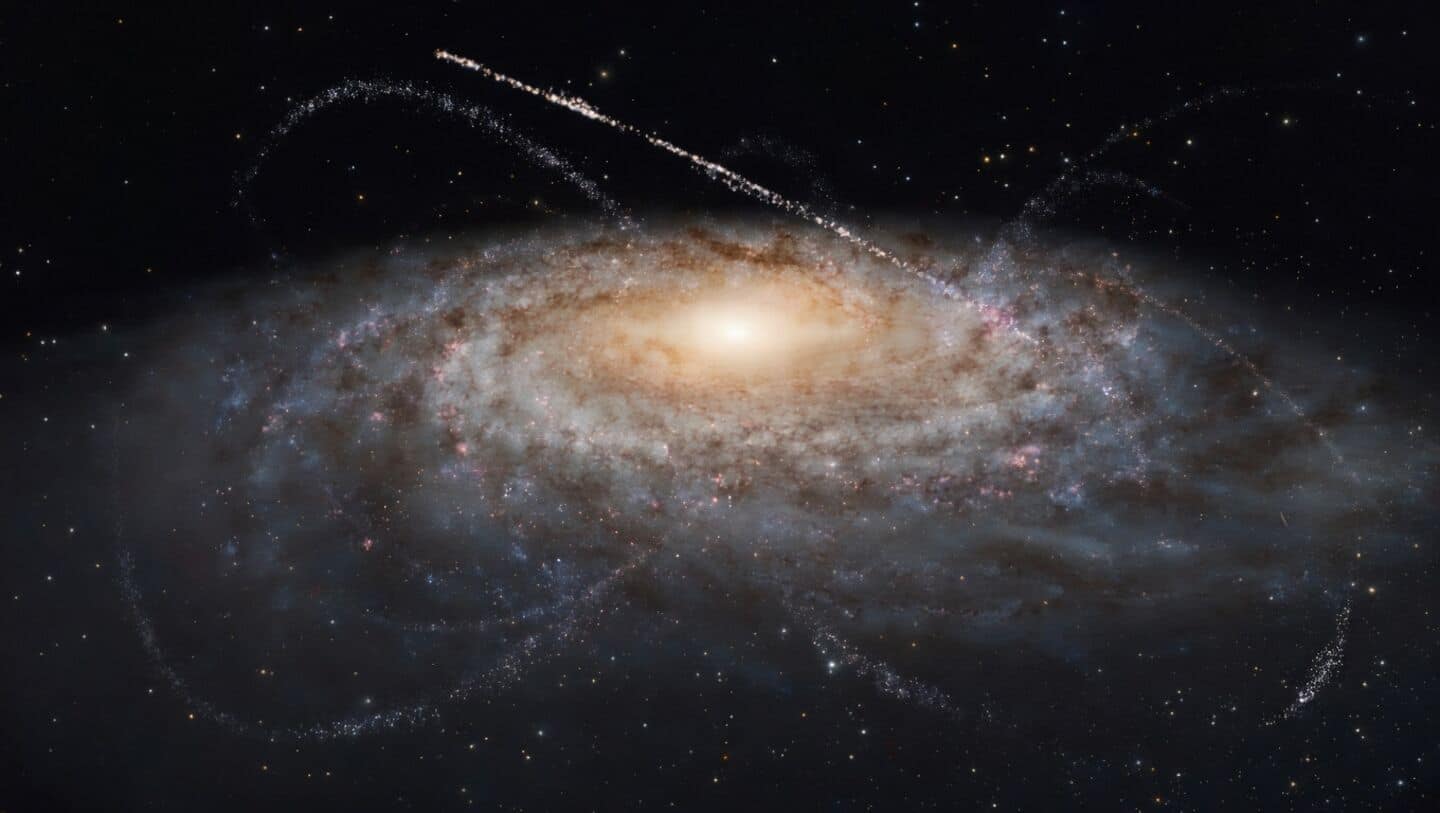
Watch: Dozens of hidden stellar streams found in Milky Way
What's the story
Astronomers have discovered dozens of faint star streams in the outer regions of the Milky Way galaxy. The discovery was made using data from the European Space Agency's Gaia mission and a new algorithm that has more than quadrupled the number of known candidates for these "stellar streams." These findings could provide new insights into how the Milky Way evolved and how its dark matter is distributed in our galaxy.
Cosmic trails
Stellar streams provide insights into galactic evolution
Stellar streams are long, thin ribbons of stars that form when compact star clusters pass through the Milky Way's gravitational field and lose some of their stars.
The shapes and motions of these streams hold a record of the gravitational forces they have experienced over time.
This makes them valuable for mapping the mass of our galaxy, including its dark matter halo.
Innovative approach
A leap in stellar stream discoveries
The study, led by Yingtian "Bill" Chen from the University of Michigan, has identified 87 stellar stream candidates associated with globular clusters.
These are dense, ancient groups of stars that orbit the Milky Way.
The previous count was fewer than 20 stellar streams, often discovered accidentally in Gaia data.
This new technique provides a larger sample size for astronomers to draw broader conclusions about these cosmic structures.
Technological advancement
The breakthrough method
To identify these stellar streams, Chen created an algorithm called StarStream. The tool uses a physics-based model to detect streams rather than relying on visual patterns alone.
The team applied this method to Gaia data, which mapped the positions and motions of billions of stars in the Milky Way from 2014 to 2025.
This innovative approach has revolutionized the search for these elusive cosmic structures.
Surprising findings
Streams come in all shapes and sizes
The study also found that many newly discovered streams don't fit the traditional image of thin, well-aligned trails.
Some are shorter, wider, or even misaligned with their parent clusters' orbits.
This suggests that earlier searches may have overlooked these structures by only looking for the most obvious ones.
The expanded sample also indicates some diffuse globular clusters are losing stars at unusually high rates, possibly nearing complete tidal disruption.
Verification process
Future observations will confirm findings
Not all 87 stellar stream candidates are likely to be confirmed, as some detections have lower confidence due to background contamination from unrelated stars.
The study's results and the algorithm used can be tested with future observations from next-generation facilities such as the Vera C. Rubin Observatory, NASA's Nancy Grace Roman Space Telescope, and the Dark Energy Spectroscopic Instrument.
This will help verify which streams are real and further our understanding of these cosmic structures.