These were the most exciting exoplanets discovered in 2025
What's the story
In 2025, the number of confirmed exoplanets tracked by NASA surpassed a staggering 6,000. The milestone was achieved thanks to the planet-hunting capabilities of NASA's Kepler space telescope and Transiting Exoplanet Survey Satellite (TESS). The discovery highlights the diversity of our galaxy, the Milky Way, and its planetary population. Unlike our solar system's orderly architecture, new observations have revealed entire classes of planets that don't exist in our own system.
Dual-star systems
The emergence of 'Tatooine-like' worlds
This year saw the discovery of several planets orbiting two stars, challenging conventional planetary formation rules.
Among these was 2M1510 (AB) b, a planet orbiting two brown dwarfs about 120 light-years away. It orbits above and below the poles of its stars rather than along a flat plane.
The finding was made using Chile's Very Large Telescope after an unusual backward wobble in the brown dwarfs' orbits hinted at its presence.
Planetary survival
Earth-sized planets in binary systems
Later in the year, three Earth-sized planets were found orbiting the compact binary system TOI-2267, just 73 light-years away.
The discovery was made using TESS data, despite such tightly bound stellar pairs being thought to be gravitationally unstable environments for planet formation.
Separately, HD 143811 (AB) b, a massive planet hidden in archival data for years, was revealed by two independent teams. It orbits a young twin-star system about 446 light-years from Earth.
Life search
What about K2-18b?
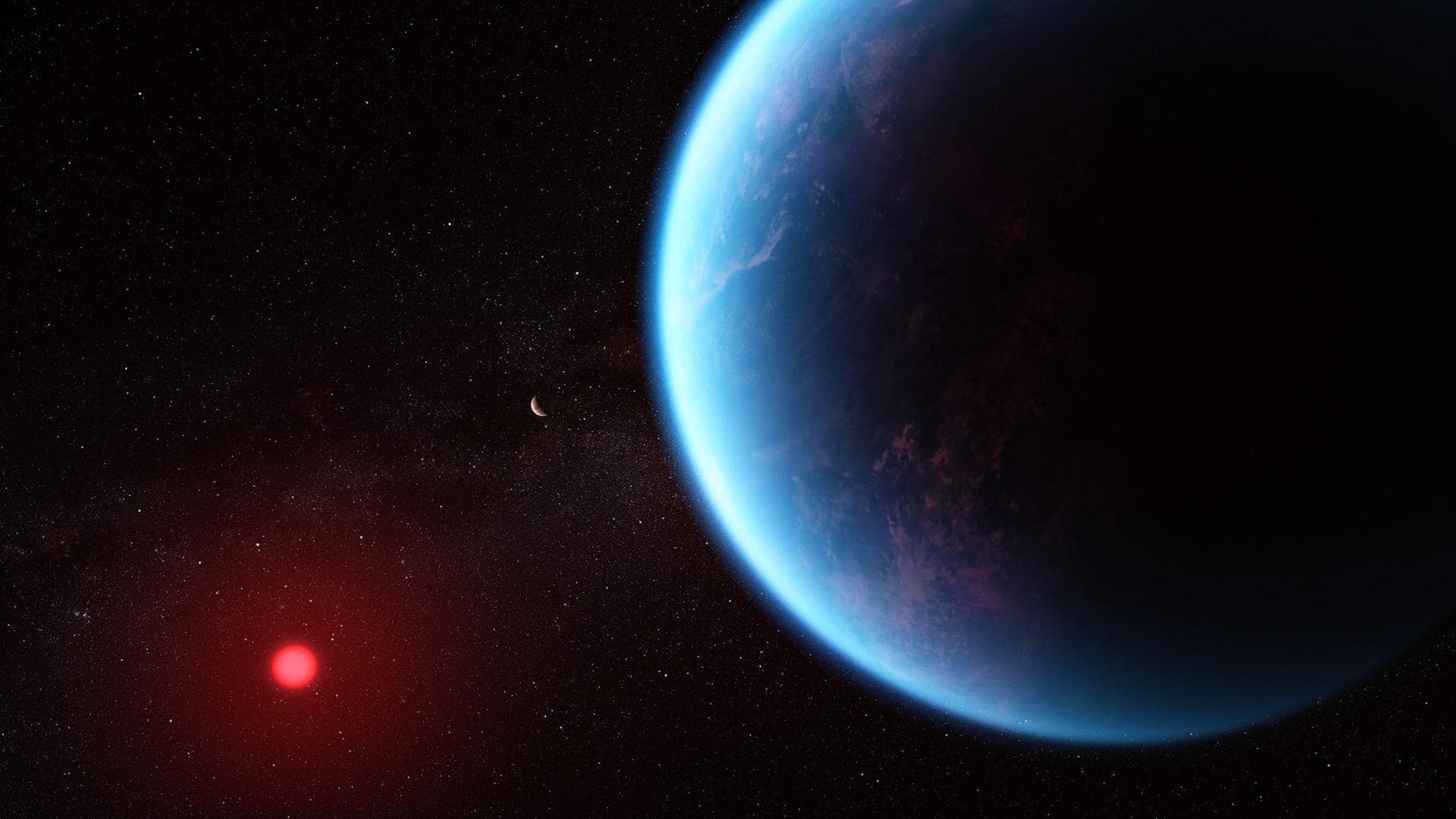
The exoplanet K2-18b became a major talking point in 2025 after claims of possible life sparked scientific debate.
A University of Cambridge-led team used new transit spectra from the James Webb Space Telescope (JWST) to suggest that dimethyl sulfide and possibly dimethyl disulfide, gases strongly associated with marine biology on Earth, could be present in the planet's atmosphere.
However, independent analyzes later challenged this interpretation, showing nonbiological gases could reproduce similar spectral features without invoking life.
Habitability concerns
TRAPPIST-1e's habitability
New analyzes of TRAPPIST-1e, one of seven Earth-sized planets orbiting a red dwarf star about 40 light-years away, suggest it may lack a substantial atmosphere.
This complicates hopes that it could support life-friendly liquid water.
Earlier JWST observations hinted at methane in the planet's atmosphere but follow-up studies have indicated those signals were likely contaminated by the star itself.
Planetary systems
Proxima Centauri's planetary system
In 2025, astronomers improved their understanding of Proxima Centauri's planetary system, the closest to our own at just 4.2 light-years away.
A new high-resolution spectrograph called the Near-Infrared Planet Searcher (NIRPS) confirmed the presence of Proxima b, an Earth-sized planet within its star's habitable zone.
It also confirmed another smaller planet, Proxima d, and helped rule out a previously claimed third world.